
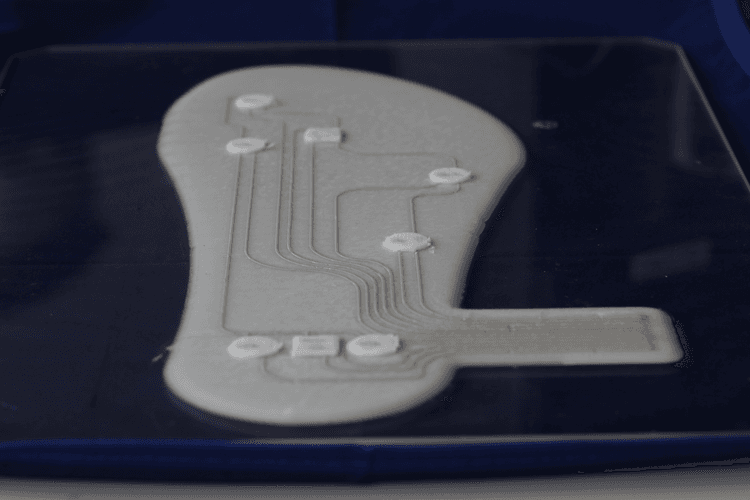
A newly developed device could dramatically improve the performance of custom footwear, a team of Swiss researchers recently announced. Scientists from ETH Zurich, Empa, and EPFL detailed how they 3D-printed a shoe insole with embedded sensors capable of measuring the pressure applied during walking, running, or other activities.
The team printed a material made of silicon and cellulose nanoparticles embedded with a layer of conductive ink. The conductive material — precisely distributed at the foot’s main pressure points — converts mechanical pressure into electrical signals that can be read as data.
Currently, custom footwear is developed using footprints created by the wearers as they walk across a pressure-sensitive mat, but that method can be time-consuming, and it fails to measure the footprints during exercise, athletic competition, or other scenarios. The new technique, by contrast, could allow designers to tweak the shape of the insole for elite athletes or for patients recovering from injury.
Gilberto Siqueira, the co-leader of the project and a senior assistant at Empa and the ETH Complex Materials Laboratory, said they could also use the sensors to identify different activities based on how strong a response is.
Developers can currently only read the data from the insole using a cable, but Siqueira said the team would next focus on developing a wireless connection.











![How Metal 3D Printing Is Now Delivering on Years of Hype [Q&A]](https://machinerys.net/upload/cache/202507/how-metal-3d-printing-is-now-delivering-on-years-of-hype-q-amp-a.webp)