Back in October 2014, Pepsi Max alarmed unsuspecting commuters at a central London bus shelter when it projected footage of an alien tentacle plucking people off the street, a meteor crashing into the bus shelter, and a prowling tiger.
Fast-forward five years and Augmented Reality (AR) is much more commonplace in advertising, entertainment, and even the workplace.
AR technology enhances a user’s view of the real world by overlaying computer-generated images and content via smart glasses, laptops, smartphones, and tablets. Most commonly associated with its applications in the gaming world such as Pokémon Go, Minecraft Earth, and Ingress, the scope of AR is rapidly expanding. It won’t be long before it’s standard procedure to go to a shop and try on a shirt without physically removing or adding any clothing or experience a vacation before you’ve even boarded the plane.
In 2019 the AR and Virtual Reality (VR) market grew to $16.8 billion, a figure that is expected to leap to $160 billion by 2023.
In many industries, AR looks set to completely transform operations by driving convenience, innovation, efficiency, and safety.
1. Manufacturing
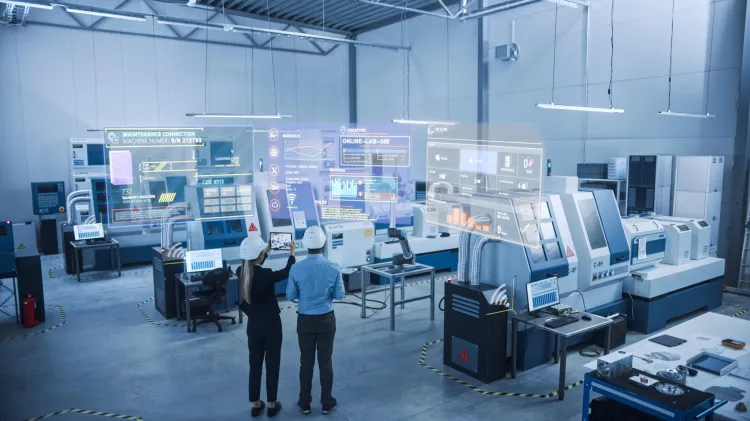
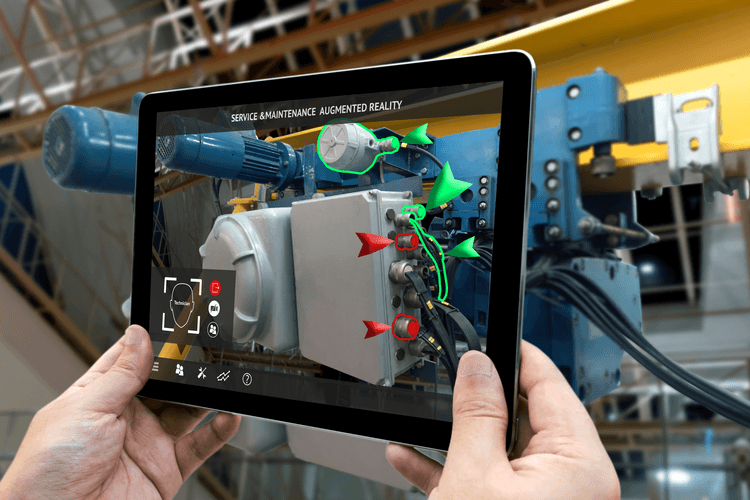
There are numerous ways AR can enhance the roles of people working in manufacturing including providing real-time information on machinery malfunctions and maintenance issues, safety warnings, and immersive design and assembly training that helps new talent learn in a controlled, secure environment.
iQagent, Inc, for example, has designed an AR app that leverages Apple’s ARKit to customize reality scenes with plant-specific process data, legacy documentation, and machine usage guides. Plus, it can place Point of Interest (POI) markers that identify equipment and process areas. Apps like this can drive efficiency and cost savings in areas such as production workflow and the design of machine controls.
2. Architectural Design and Construction
AR helps architects and construction professionals dream big and visualize realistically throughout their planning processes, whether it’s for the design of one building or an entire city model.
Morpholio’s Sketchwalk tool, for example, allows designers and their clients to walk through sketches, providing a better sense of the space. Fologram converts scaled 3D models into full images via AR glasses and Dalux enables users to design 3D models and digital drawings on actual construction sites.
3. Military
The U.S. Army has plans to partner more closely with tech companies to accelerate innovation within the military. AR is an area that is receiving significant investment including a $480 billion defense contract with Microsoft to develop the IVAS headset. This headset can display maps, the location of other squad members, birds-eye view images of nearby buildings and the reticle (or aim) of a weapon so users can shoot accurately. It can also be used for thermal imaging, to help users locate fellow soldiers in known enemy positions, and for the analysis of training exercises.
Another example of AR usage in the military is the F-35 pilot’s helmets. Priced at $400,000, these helmets can display real-time footage from the pilot’s external cameras (which eliminates blind spots), zoom functionality, digital night vision, and a targeting system.
4. Healthcare
AR is revolutionizing how medical staff is trained and how patients are treated, with the healthcare market expected to reach over $7 billion by 2026. It can assist surgeons with precise operations and accommodate remote surgery, making invasive procedures safer and more accurate, as well as helping doctors with innovative diagnostic techniques and neurological treatment. AR is also being used for patient therapy and has been proven to help in the curing of phobias and acute fears.
InnerOptic Technologyhas designed Magic Loup, which gives doctors a clearer view of a patient’s insides whileAccuVein, a handheld device, can scan a patient’s vein network and reduce escalations by 45%.
Several medical colleges are using AR to train medical students. The Cleveland Clinic is using AR to educate on anatomy, which negates the need for cadaver dissection or students’ need to attend live operations.
5. Mechanics
Porsche has developed an AR system that assists mechanics with the servicing and maintenance of their cars. Their AR can guide remote staff through the process and provide tutorials and documents as they work to improve customer service and repair quality.
PTC’s Vuforia’s AR solutions can show mechanics how to assemble and reassemble complex parts, with 3D images demonstrating how components fit together.
Australian company Tradiebot has developed an app called WorxAR, which makes it easier for mechanics to identify and repair defective parts.
6. Customer Service
AR is helping organizations to deliver more convenient, interactive and enjoyable customer service to consumers.
Cosmetic company Sephora uses AR to let customers experiment with different make-up looks, Rolex encourages shoppers to virtually try on different watches, and with Dulux’s Visualizer you can try out different paint shades for your room before you buy. Applications like these are likely to grow rapidly in the coming years. A Gartner report predicted that 100 million consumers will shop using AR in 2020.
7. Broadcasting
AR can be used in broadcasting for weather and news reporting, sports events, and educational programs to bring subjects to life. These programs can provide supporting information and simulations (such as the impact of a natural disaster) and help viewers better understand complex topics.
Advertisers might use AR to show their products on television shows such as sporting events and news programs using “a new kind of storytelling.” This would address one of the major concerns of advertisers today, which is viewers skipping, or leaving the room, during commercial breaks.