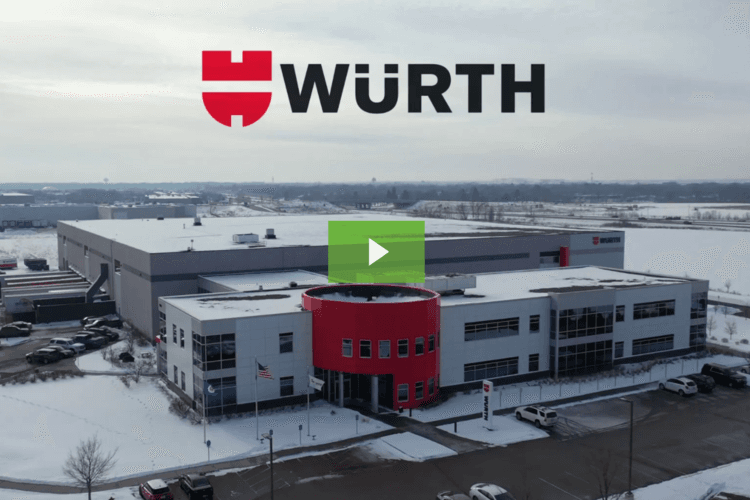
This article was sponsored by Würth Industry.
“When we walk into customer buildings, we’re able to find cost savings every time, and that’s an exciting thing when you’re coming in with something so new,” says A.J. Strandquist, the director of 3D Product Solutions at Würth Industry of North America.
Würth Group is a 75-year-old privately held German company with a U.S. presence that despite being “very old-school,” as Strandquist puts it, now pairs its longstanding success as a supplier with educating its customers about investing in cutting-edge additive technology.
“We’re the lubrication that helps the gears rotate,” says Strandquist. He explains that Würth educates clients about additive’s capabilities and its benefits for the manufacturing sector — like simplifying supply chains and optimizing development times. This education allows the companies to more easily implement additive technology into everyday processes, making them run more smoothly and efficiently.
One example of this implementation is how their expert sourcing team can create a 3D-printed part prototype to client specifications, and provide the prototype to a manufacturer that can use it to create a part that is industrial-grade. This minimizes the risk of manufacturing parts that are out of specification and reduces downtime significantly. “We bring the same rigor to our inventory control for 3D-printed products as we do with everything else,” Strandquist explains.
Strandquist considers the Würth team to be a “jack-of-all-trades.” Thanks to building out their networks to include enviable partnerships, the company’s team of experts can handle projects ranging from printing linkages inside of a veterinary transport vehicle to working alongside NASA engineers.
Want a Thriving Business? Get to Know Würth:
- Würth’s partnership with Baker Hughes, which allows them to provide access to technology that few people in the world can access, recently won them a bid from NASA.
- They are a one-stop-shop for industrial and 3D printing needs.
- Würth utilizes their decades of experience in C-parts and supply chain management to lower clients’ purchasing costs and fulfill additive manufacturing solutions. This allows their clients to focus on the parts of their business that they do best.
Thomas Insights (TI): What do you think is the biggest challenge facing the industry today, and how is Würth working to overcome it?
A.J. Strandquist (AJS): With markets in upheaval, supply chains shattering and then coming back together — 2020 is a great example of uncertainty. The motto we have here at Würth is "Be a suspension bridge.” Your inventory control needs to be as rigid as possible but have flexibility to adapt to uncertainty.
3D printing is how we have that third-level supplier if the first two fail.
This technology is a great answer to things that fall through the cracks because, unlike other forms of manufacturing, with 3D printing, you don’t have to tool up. You don’t have to get a specific piece of equipment to make something. Your ability to solve those little pop-up problems becomes much more doable with this technology.
TI: Tell me about Würth. What sets it apart from the competition?
AJS: Würth is the world’s largest industrial supplier with a keen eye on saving our customers time and money through clever inventory programs and lean logistics. Three or four years ago now, we started to investigate the application of 3D printing to help our customers in those endeavors, and we launched a full-fledged division this year. It’s the largest one in the country!
We cover the entire U.S. coast-to-coast, which enables us to supply our customers with innovative digital inventory solutions that go along with our bread and butter, which is fasteners, chemicals, PPE, and MRO items.
TI: What’s something about Würth that isn’t widely known that you’d like to highlight for TIU readers?
AJS: Most people know Würth as fasteners, nuts, bolts, and inventory management. Our big drive is for the sub-section of an OEM’s parts that benefit from 3D printing which is, today, probably less than 5% of their total product range. But now, Würth can give them digital inventory management as well.
Just like all those other projects that they procure in a classic way, the products that benefit from being 3D printed because of minimum order quantities or tooling or design features can be handled through the same exact inventory program.
Tack on that word "digital,” and you’ll start to understand where we’re baking this technology into everyday inventory practices and not making it a specialized function.
TI: What’s the biggest question you get from prospects or clients, and how do you respond to them?
AJS: The biggest question is usually just "How the heck do I use this?” 3D printing is a new form of technology to many audiences. Similar to a cell phone, what this printer does is connect facilities and people — not with a call but with a physical item. And just like with a cell phone, you have to show people the power of that technology. Years ago people were saying, "Well, I don’t want to carry around a phone with me. What’s the advantage of that?” And look where we are now!
As people get exposure to new technologies that make their life easier, what we do is invest in showing them how companies and industrial settings are using 3D printing to lower their total cost of ownership. To a lot of folks that are building farm equipment and not high-tech items, this application might be new. We want to be that partner to help educate and empower them to bring that technology in-house.
If people don’t understand it and they don’t know how to apply it, they’re not really going to want to use it or buy it. They have to realize what it can do, what it’s good at, and what it’s bad at (because it’s not necessarily good at everything).
With Würth, what’s great is the stuff that 3D printing isn’t good at is what we supply in our core range. So, when we plug all those things in together, we can give you this real honest approach of where you’re going to make money and where it doesn’t make a lot of sense.
TI: Can you share an example of success using 3D printing in a manufacturing environment?
AJS: With AGCO — an agricultural company making large combines and spreaders, which historically are not made for the world of 3D printing — we did a two-and-a-half day site visit and educational training. We went across that facility, speaking with employees from across every department, from purchasing to design engineering to sourcing to maintenance and then even into warranty parts, and we helped educate them on where other companies in their particular departments are using the technology to save time and money and mitigate risk.
On that facility walk, along with that team, we pulled over 60 items, and we have 15 of them that were confirmed cost-savings.
What’s great about that story is we really just wound them up. Once they had that exposure, all of the cost savings were driven internally by AGCO, not by a supplier. That really shows the power that we can have as we look to build that service-first mindset. It’s “teach a man to fish or give him a fish.” It’s much more valuable to teach them to fish because now they can use that tool every single day and find cost savings every day.