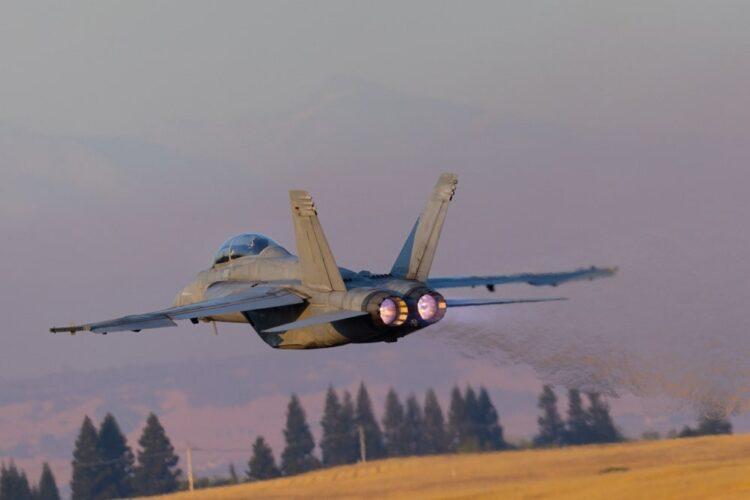
TheU.S. Navyhas announced its plans to develop the F/A-XX, a fighter jet set to replace the aging F/A-18E/F Super Hornet.
Thenew aircraftwill be cost-effective, versatile, and independent of Air Force technologies, like the Next-Generation Air Dominance (NGAD) platform which relies on advanced adaptive engines.
Independent Fighter Design
Both the Navy and the Air Force are working on new fighter jets, but are going about it in very different ways. With theNGAD, the Air Force is focused on building state-of-the-art aircraft with high-tech engines—which come with a steep price tag.
The Navy, on the other hand, is prioritizing affordability and versatility by choosing more practical “derivative-type engine solutions” in an attempt to distance itself from the Air Force’s acquisition delays and high costs.
The F/A-XX—A Multi-Purpose Jet
The F/A-XX will be a piloted platform able to collaborate with unmanned aircraft like the MQ-25 Stingray. It’s designed mainly for air-to-surface missions like long-range strikes and sea control; however, it will still have its fleet defense capabilities.
While combining these abilities into one jet has its budgetary and functional perks,some arguethat this approach could weaken overall air wing effectiveness, and leave gaps in long-range strike capacity.
Budgeting Concerns
Both the U.S. Air Force and Navy are working on several large projects simultaneously. This has put pressure on their budgets and resulted in funding cuts.
Planned spending on the F/A-XX program was reduced to $3.3 billion—down 67% from the initial request of $10.3 billion. Lawmakers did vote for $450 million to be restored, but the decision is still pending approval.
The U.S. Navy’s F/A-XX—Summary
The introduction of this new aircraft is a big step toward the integration of manned and unmanned platforms in carrier air wings. By putting the new F/A-XX platform alongsidethe F-35C, the Navy aims to maintain an adaptable and effective fleet.
The F/A-XX is designed to both address current challenges and accommodate the ever-changing demands of future missions. The Navy has acknowledged the possibility of schedule shifts, but is committed to its goal of balancing cost-efficiency with advanced capabilities.
Image Credit: Shutterstock/ranchorunner