
Artificial Intelligence (AI), also known as machine learning, is a field of computer science and technology that aims to create intelligent computers that imitate human intellect. The use of AI in manufacturing has brought about a new era of innovation and efficiency. This ground-breaking technology has the potential to revolutionize the industry altogether.
AI is expected to transform critical aspects of predictive maintenance and manufacturing operations by the end of 2023. This will increase productivity and cost-effectiveness to unprecedented levels. With the emergence of AI in the manufacturing industry, businesses can expect to stay competitive in a fiercely global economy.
Below, we explore the unique advancements AI brings to manufacturing and discusses its impact on the sector’s future.
Top 3 Uses of AI in Manufacturing and Distribution
There are three proven and effective ways that artificial intelligence is being employed in today’s manufacturing and distribution facilities.
AI-driven robots are one of the most significant developments in manufacturing. Companies such as Philips have embraced the power of AI to improve their manufacturing processes. These robots can learn and adapt to their surroundings using powerful machine-learning algorithms.
Their efficiency and accuracy increase over time. This technology enables greater precision, speed, and consistency in complicated production operations.
Now, businesses can monitor their manufacturing processes in real-time by employing cameras with AI algorithms. These cameras can detect flaws, identify bottlenecks, and analyze the overall flow of processes. This vital data helps optimize operations and decrease downtime. As a result, overall productivity increases.
AI in the manufacturing industry also positively impacts the seamlessness of distribution. Amazon, for example, has used AI-powered technologies to automate its delivery centers.
AI can help improve a business’s inventory management, predict trends, and simplify product delivery logistics. This saves money and assures speedier delivery, increasing client satisfaction.
3 Transformational Impacts of AI in Manufacturing
Now, let’s dive into the three significant changes AI has made in the manufacturing industry.
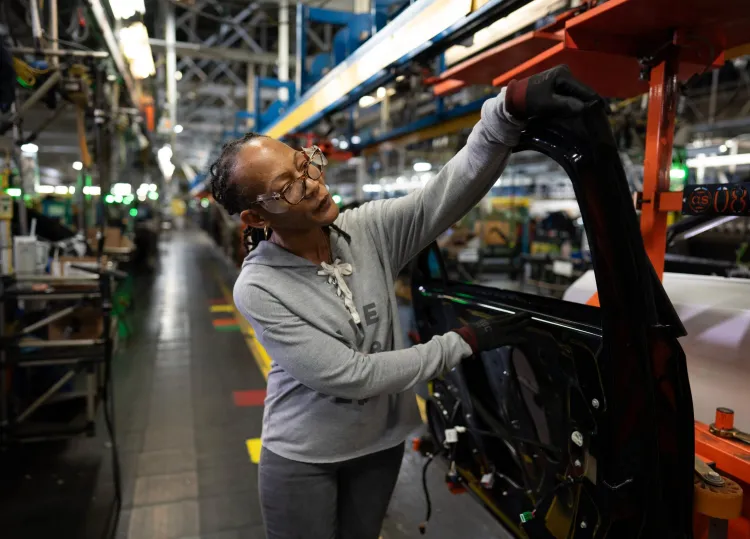
AI provides intelligent automation in production, allowing machines to do tasks independently with minimum human interaction. Companies may increase production, eliminate human mistakes, and improve operational efficiency by incorporating AI into industrial processes. Assembly line automation and real-time quality control are examples of such jobs.
AI can examine massive volumes of data, such as demand projections, inventory levels, and production capacity, to optimize the whole supply chain. Artificial intelligence systems can detect inefficiencies and foresee possible interruptions. This lets businesses take proactive measures to maintain smooth operations and minimize lead times.
Manufacturers must maintain consistent product quality. And AI plays a critical role in achieving this. The capacity of artificial intelligence to read big data sets and discover loopholes has proved essential in quality control and predictive maintenance.
Manufacturers can detect possible equipment breakdowns or quality concerns by combining manufacturing management software with AI-powered computer vision systems. This feature allows you to monitor sensor data and evaluate past patterns continually. Moreover, they can rectify issues before they become serious, avoiding costly downtime.
3 Significant Barriers and Risks of AI Systems in Manufacturing
While AI greatly benefits the industrial business, it also has obstacles and hazards that must be addressed.
Concerns about privacy and security develop when AI systems collect and handle massive volumes of data. Businesses must guarantee that appropriate safeguards are in place to secure sensitive information. Also, they need to be fully aware of how AI systems work.
AI system development and implementation in manufacturing can be complex and challenging. It necessitates specialized knowledge and substantial investment in infrastructure, training, and integration. So, employing the best resources to adequately design and implement AI programs to obtain the intended benefits becomes critical.
With the growing dependence on AI in the manufacturing industry, there is an increased danger of hostile cyber assaults, data breaches, and manipulation. Prioritize cyber security and put strong safety measures in place to protect your AI systems and the data they rely on.
3 Case Studies of Using AI in the Manufacturing Industry
Let’s look at three real-world instances of AI in manufacturing and maintenance that demonstrate the technology’s potential and influence.
To boost efficiency and quality control, Samsung is using AI-powered robots in its production plants. These robots have the ability to do difficult jobs with high accuracy, eliminating human mistakes and enhancing overall efficiency.
General Electric has implemented AI in its production processes to improve predictive maintenance. GE can prevent possible equipment failures by examining sensor data and previous trends, allowing for proactive actions and decreasing unplanned downtime.
AI-driven solutions have been deployed in Siemens’ smart manufacturing programs. Siemens optimizes manufacturing processes, increases energy efficiency, and assures high-quality goods by integrating AI algorithms and data analytics.
The Future Is Bright
Industrial business is being transformed by artificial intelligence in 2023. Manufacturers that adopt AI-driven solutions such as predictive maintenance and supply chain efficiency can achieve better output levels, enhanced efficiency, and increased competitiveness.
As AI in manufacturing processes continues to grow and integrate, the combination of intelligent robots and human inventiveness will push the boundaries of what is feasible in manufacturing.