The article was sponsored by Engineered Printing Solutions, a worldwide leader in industrial inkjet integration.
If you investigated direct-to-substrateinkjet printing early on, you might have had a negative experience. Even though the technology of using a computer printer to release ink drops onto either paper or another substance, such as plastic, to duplicate a digital image had been developed by the 1950s, there were still few options for industrial inkjet integration in the early 2000s. Only in the past few years did the technology start rapidly advancing.
“The industry is changing so fast you have to look again,” says Ken Tyler, sales engineer for the Midwest region for Engineered Printing Solutions.
The first inkjet printer that Engineered Printing Solutions ever built was for a toothbrush manufacturer, in 2006. At the time, they were a pad printing company. Julian Joffe had founded the East Dorset, Vermont-based company in 1985, and around the turn of the century, he’d begun to consider inkjet printing. The company “snapped up” some of competitor Markem’s software engineers and invested heavily into research and development.
“It was an all-company effort to get that done on time and out,” reflects Tyler on that first big sale. And it was a success: “They’re still our customer, and they’re continuing to buy new equipment.”
Today, Engineered Printing Solutions continues to trail blaze with custom industrial inkjet solutions that can print on everything from promotional drinking cups and hand-sanitizer bottles to automobile brake pads and medical syringes.
But Tyler insists: “Pad printing is not dead.” Though it can be more labor-intensive, it can sometimes be more productive — “particularly with robotic automation,” notes Peter Baldwin, the company’s marketing director.
For Engineered Printing Solutions, it’s all about serving the interests of the customer. That’s why they not only offer both pad printing machines and direct-to-substrateinkjet printers, but also have a wide variety of highly skilled team members, from engineers to technical service providers and customer service representatives, to walk customers through the steps of customizing a printer that meets their specific needs and continually expanding their knowledge of how to best use the products.
In fact, they say building that relationship with customers adds value to the company too, as the learning goes both ways. “To have that feedback coming back, to be able to upgrade and make modifications generationally as machines grow and become better, it’s a two-way street. I think both the customer and EPS benefit greatly from this type of relationship,” says Tyler.
What’s New at Engineered Printing Solutions
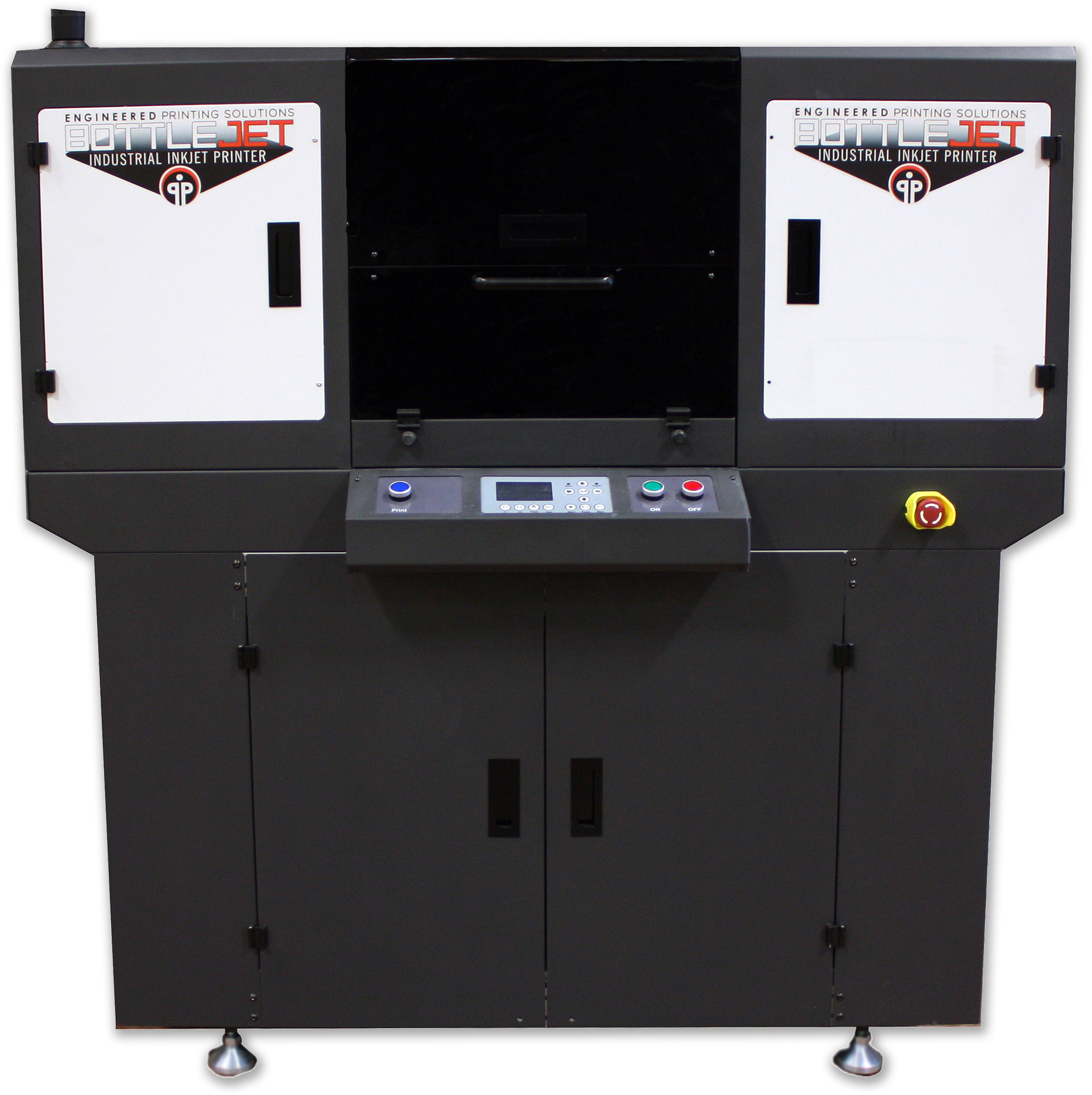
- The company just rolled out the new BottleJET 2.1, a third-generation cylindrical inkjet printer that’s a result of customer feedback and field testing.
- This year, they’re launching lunch-and-learns to build customers’ knowledge. These aren’t sales pitches but, rather, educational opportunities with time reserved for answering participants’ questions.
Thomas Insights (TI): Tell me about your company — what sets you apart from the competition?
Ken Tyler (KT): When it comes to custom inkjet equipment, specifically in the single-pass UV market, which is primarily direct-to-object market, we’re definitely the premier company and one of only a handful in the space.
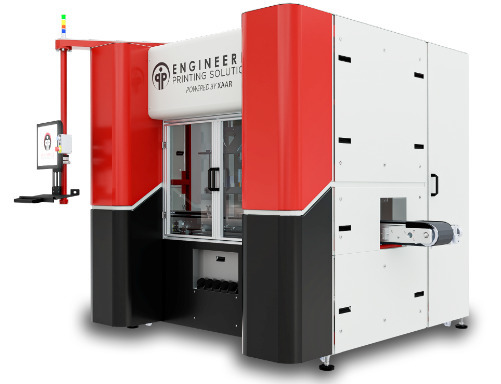
We provide customers with the opportunity to design their own printer. There’s a lot of equipment out there that you can go and buy, but more than likely, there will be some concessions if you’re limited to off-the-shelf choices, right? If you come to us and you want something very specific, we can build it exactly to your specs.
TI: What’s the biggest question you get from prospects and customers, and how do you respond to them?
KT: Most of the calls that our sales engineers get are coming from engineers who are going to use the equipment, and they have a lot of technical questions.
“How are you guys going to support us once the machine is in our facility and we’re producing?” That ongoing support is a big part of who we are as a company. This is a long-term relationship.
Once that machine lands, you’re going to move from one stage of our company to the next. At the very beginning, you’re going to reach out to the sales department. You’re going to have that experience until you decide to purchase the machine. Then your experience is almost entirely with our engineering staff and our project managers. You’re going to get to know them. You’re going to work together to build the machine that you want, and then when that portion’s done, it’s going to transfer over to tech service. Tech service is going to step in, make all the introductions, and then we’re going to teach you how to use the machine that you just bought.
After that, the machine’s going to shift to the customer’s location. We’re going to follow it with our technicians, install it when it’s ready, and then from that point, our responsibility is to provide all of the supplies and consumables to keep it running, maintain it, and provide ongoing support.
TI: What’s something about your business that isn’t widely known that you’d like to highlight for our readers?
KT: We’re not just a machine equipment supplier. That’s not our sole purpose. Instead, it’s a long-term relationship.
A lot of our customers are using our sales engineers and their experience as a consultant because in this industry, there’s a lot of specialty knowledge, especially on the inkjet side of the sector. It’s not always, “I have a project, and I need to get a piece of machine for it.” Sometimes it’s, “Hey, can you tell me how to print on this?”
We’ll figure out the formula, what ink to use, what the pretreatment process is, and we’ll send you that information back. And a lot of times, all of that is done as just a general service for our customer. It’s an added-value relationship. You have access to our technicians at any time for the life of the machine, and they can even dial in remotely and analyze any situation or problem that’s occurring.
Also, we’re continually giving our customers more resources to grow their own business. A lot of these machines are built for custom lines. Even if you get one, it doesn’t mean that you’re going to start using it to grow your business and sample products because that’s going to interrupt your production, your ROI, and all of the things that cause you to justify this large purchase to begin with. With Engineered Printing Solutions, you have the ability to use our company as your testing bed so that you can continually feed information to your customers. You can continually look for growth opportunities.
TI: What do you think is the biggest challenge facing industry today, and how is Engineered Printing Solutions working to overcome it?
KT: The biggest problem with selling this type of equipment is, oftentimes, customers are upgrading from an older analog technology. There are a lot of different technologies, and operators have been using these technologies for a very long time, so it can be daunting for them to start hearing about all of the differences between analog and digital. As a business leader, it can be challenging to determine if you have the workforce that’s capable of making such a substantial shift. And again, that’s where we come in. One of our main focuses is making sure that companies are prepared to make the changes required in a move from one technology to the other.
We don’t just say, “Here’s your machine.” We guide your workforce and show you: “You’re used to mixing ink manually. This is how we do it here.”
TI: Besides the printers themselves, has the ink changed at all?
KT: I think it’s very important that anybody who’s looked at, investigated, or even experimented with inkjet have another look if it’s been a while since you last considered it. Inkjet, over the past 10 years, especially in the ink space — UV ink space, direct object — has come so far. There hasn’t been a tremendous amount of printhead technology advancements, but it pales in comparison to what’s happening on the ink side.
The inks are coming out and changing now. They’re more flexible. They’re brighter. They’re longer-lasting in the sun. They’re changing at such a rapid pace! If you investigated inkjet, even if it was only a few years ago, and you were unsuccessful for a number of reasons, it’s worth investigating again.
Oftentimes, we’re selling into companies that have extensive engineering capabilities. They look at us and they go, “Well, you’re just an integrator. You’re taking everybody’s parts and putting them together. We can do that.”
But the reality is that most people can’t.
The small things that come with 20 years of understanding the way ink flies through space and the way ink reacts to different types of raw materials — those are the things that we bring to the table. A lot of companies can offer related capabilities and could potentially make the machine, but when it’s time to print, they struggle.
That is truly our value. Our knowledge, our history, and our experience in this space are why people come to us.









![The Dangers of AI in the Healthcare Industry [Report]](https://machinerys.net/upload/cache/202507/the-dangers-of-ai-in-the-healthcare-industry-report.webp)