Advancements inmilitary aircraft, weapons, and surveillance and tracking technologies wouldn’t be possible without the expertise of the industrial sector.
Today, manufacturers across the United States are leveraging3D printing, artificial intelligence (AI), automation,blockchain,injection molding, virtual reality (VR) and augmented reality (AR), and the Internet of Things (IoT) to develop products andcomponentsthat support critical military missions.
But that’s nothing new. Though manufacturing methods may have evolved significantly over time, the U.S. military and industrial businesses have a long and rich history of collaboration.
Here are just seven examples.
1. Project Azorian
Project Azorian was a U.S. Central Intelligence Agency (CIA) project to secretly retrieve a sunken Soviet submarine from the ocean floor.
The ballistic missile submarine K-129 sank northwest of Hawaii in 1968 — possibly as the result of a mechanical error — and the Soviet Union abandoned its search for the vessel a mere two months later.
The CIA commissioned the construction of a600-foot ship, advertised as a deep-sea mining research vessel, and a giant claw, which was nicknamed Clementine and used to clasp the submarine and drag it out of the water, much like a traditional arcade game.
The mission succeeded, but only to a point. As a result of some of the claw’s grabber arms breaking, a large part of the K-129 fell back to the ocean floor.
Discover the rich history of 5 groundbreaking submarines.
2. Acoustic Kitty
In the 1960s, the CIA launched a particularly chaotic project to turn cats into spies. Over five years, the Office of Technical Research and Office of Research and Development spent $20 million developing microphones, antennae, transmitters, and batteries that could be discreetly implanted within cats.
This was a time before microchips and digital devices so the project came at a huge cost. The CIA agents involved found it particularly difficult to train the animals involved in the study. The first one never even made it to its destination because it was hit by a taxi while crossing the street. Project Acoustic Kitty was ultimately deemed a failure as cat spies were simply not “practical.”
Find out why Elon Musk is putting Neuralink implants in monkeys’ skulls.
3. Operation Gold
In 1954, the CIA embarked on a major tunnel-digging expedition, referred to asOperation Gold. The mission sought to tap into the communication lines running between western France and the Soviet Union and Eastern Europe.
The tunnel extended 1,476 feet beneath sandy soil to reach a cable approximately 27 inches beneath the ground. American workers began digging in August 1954 and construction work was finished by February 1955. It took several more months to tap into the Soviet lines after which American listeners were able to monitor 500 connections at the same time.
Learn how New York City’s subway tunnels were built.
4. The Playing Card Escape
During World War II, prisoners of war were entitled to Christmas care packages.
The U.S. and British armiespartnered with Bicycle— the U.S. Playing Card Company’s (USPCC) signature brand — to create a special deck of cards that peeled apart when wet.
Hidden within these cards were detailed escape routes that enabled downed pilots and captured soldiers to find their way back to Allied lines.
Discover the supply chain secrets of getting mail to active duty troops.
5. Insectothopter
Developed in the 1970s, the Insectothopter was a miniature unmanned aerial vehicle, which took the form of a dragonfly. The CIA initially designed a mechanical bumblebee to house the miniaturized listening device it had developed, before later producing the dragonfly prototype.
The device had a range of 200 meters and a flight time of 60 seconds but, unfortunately, it was unable to withstand even the gentlest of breezes.
Do a deep dive into Northrop Grumman’s unmanned autonomous helicopter.
6. Project Blue Book
Project Blue Book was the systematic study of unidentified flying objects (UFOs) by the U.S. Air Force between March 1952 and December 1969.
For fear of threats to national security, investigations on thousands of UFO sightings took place. The CIA worked with the Air Technical Intelligence Center (ATIC) to evaluate all the information and data relating to these sightings. To prevent mass hysteria, details of the project were kept strictly under wraps.
See the snake-like robot NASA is using to search for life in space.
7. The Auto Industry and World War II
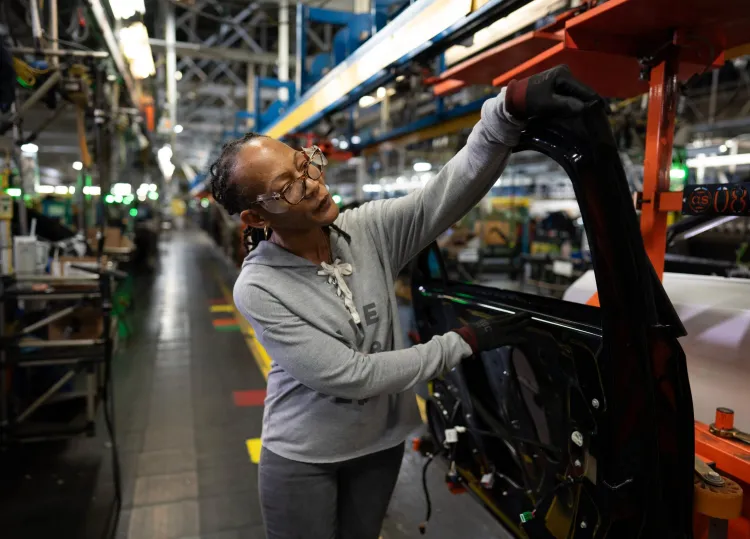
Perhaps the biggest collaboration between industrial businesses and the U.S. military happened during World War II when Franklin Roosevelt called upon the auto industry to create critical tools and equipment in his"Arsenal of Democracy” speech.
Soon after, in 1941, GM’s president William Knudsen implored the auto industry to build 50,000 airplanes, 130,000 engines, 25,000 light guns, and 17,000 heavy guns to support the war effort. GM eventually became the largest military contractor on earth, producing 206,000 aircraft engines, 301,000 aircraft propellers, 97,000 bombers, and 854,000 military trucks, to name just a few.
Check out these interesting facts about the automotive industry.