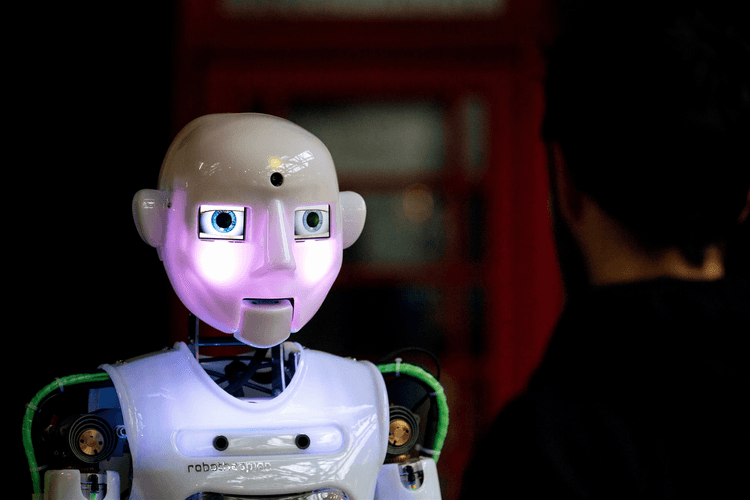
Sophia looks like actress Audrey Hepburn, Pedia_Roid screams when in pain, and Atlas does backflips like a professional athlete. While this isn’t an especially peculiar line-up for a regional talent show, it is for a list of robots.
From expressive Ameca to acrobatic Atlas, here’s a rundown of the world’s most lifelike robots.
1. Ameca
Made by UK-based Engineered Arts, Ameca is widely acknowledged as the most lifelike robot in the world. Development on Ameca began in Falmouth, Cornwall, in February 2021, and the robot was first revealed to the public later that year.
Though not yet capable of walking, Ameca emulates a remarkable range of human expressions — from disgust to disbelief — and articulately answers complex questions. It can also be used to test artificial intelligence (AI) and machine learning (ML) systems alongside Engineered Arts robot operating system.
Ameca has wowed attendees at events all over the world and is currently available for both purchase and event rental.
2. Mesmer
Mesmer is a modular robot system also developed by Engineered Arts. Because it is designed and built in-house from 3D scans of real people, the company can imitate human bone structure, texture on the skin, and facial expressions with incredible accuracy. As a result, Mesmer exhibits everyday human reflexes such as jaw movements, eye wrinkling, and smiling.
Engineered Arts Tritium operating system means Mesmer can be programmed intuitively and remotely controlled from any location.
3. Atlas
Boston Dynamics is widely celebrated for its groundbreaking innovations in the robotics industry. Earlier this year, it unveiled the latest demo of its most humanoid robot yet, Atlas. Atlas boasts a mobile hydraulic system, custom battery, and valves that enable it to deliver power to its 28 hydraulic joints.
As a result, it is lightweight, fast, and impressively mobile, seemingly navigating the world with human-like grace. Various demos show Atlas maneuvering its way through parkour courses by running, jumping, and flipping, or delivering heavy items as required.
At present, Atlas is not yet commercially available.
4. Sophia
In March 2016, Hong Kong-based Hanson Robots first unveiled Sophia, a humanoid device with potential applications in educational, retail, transportation, and medical environments.
This social robot, whose striking facial features are based on an amalgamation of Audrey Hepburn and the wife of the company’s founder, David Hanson, has divided opinions since her release. Some criticized Sophia herself for being disarmingly lifelike, while others accused Hanson Robots of overplaying her capabilities.
Controversies aside, there’s no question that Sophia has become a household name. She is the world’s first robot citizen and the only robot Innovation Ambassador for the United Nations Development Programme. Today, she is capable of imitating human gestures and facial expressions, engaging in conversations, and recognizing individual people.
The value of a robot like Sophia is particularly apparent in a post-pandemic world. As Hanson highlights, Sophia is capable of providing emotional support and companionship to the lonely and the isolated without compromising health and safety.
5. Tesla Bot
At Tesla’s AI Day in 2021, CEO Elon Musk revealed that the company was crafting a humanoid robot, which would be known as Tesla Bot.
An apparent prototype of the robot wowed event attendees with its lifelike movements and incredible coordination before it was revealed to be nothing more than a human in a robot costume. Disappointing, to say the least.
A year later, however, and the first real iteration of the Tesla Bot successfully walked out onto the stage at AI Day. Though wobbly on its legs, this demonstrated marked improvement from the previous year, and Tesla shared an exciting timeline for future developments. The first-gen prototype, Musk said, will walk efficiently and stay balanced, and be capable of carrying a 20-pound bag and using tools.
Tesla hopes its robot will one day be capable of performing tasks regarded as “unsafe, repetitive, or boring,” be it retrieving groceries or working on Tesla production lines.
6. Pedia_Roid
Simulating emergency situations for clinical training is no easy feat, but the company tmsuk might have found the perfect solution with Pedia_Roid: a humanoid robot designed exclusively for ER training.
Imagine a CPR dummy — only it has the limbs, the face, the hair, and the teeth of a human child. Pedia_Roid, the company claims, can mimic the restless movements of a child who is hesitant to receive treatment or experiences a change in medical condition.
The robot can express emotions such as feeling pain and crying and will move its head and limbs about in protest to treatments. It can exhibit convulsions, labored breathing, and exhaustion, and can even be used for healthcare workers to practice drawing blood, measuring blood pressure and blood oxygen saturation, and pulse sensing.
7. Nikola
Like Pedia_Roid, Nikola is another humanoid robot child. Designed by researchers from the RIKEN Guardian Robot Project in Japan and introduced in February 2022, the robot can effectively convey happiness, sadness, fear, anger, surprise, and disgust.
A study, which was published in Frontiers in Psychology, verified people’s ability to identify when Nikola conveyed any of these six emotions. This marks the first time a robot’s ability to convincingly convey human emotion has been tested and verified.Wataru Sato, who led the study, believes robots like Nikola could serve as valuable research tools for social psychology and social neuroscience.
Although the bot is currently bodiless, researchers hope that Nikola will one day be used to assist people in the home, whether they require physical assistance or because they live alone and crave companionship.
More Robotic Insights
- Surgeons Tag in Robotic Assistants as the U.S. Continues to Lead the Medical Device Market
- 5 Ways Robots Are Assisting Construction Workers
- This Spider-like Robot Inspects Sewage Pipes
- DARPA Program to Inspect and Service Satellites in Orbit
- Robotic Fish Designed to Devour Ocean Microplastic Pollution
- Boston Dynamics’ Dancing Robot Conquers a Construction Site
- With Just a Week of Machine Learning Training, Cassie the Robot Sets a Guinness World Record