Robotics in manufacturing is applied in nearly every scaled application. However, the forms and functions of these robotic systems are highly integrated and specific, making them expensive, difficult to implement, and only viable for companies with capital. Collaborative robots, or cobots for short, bring automation to small and medium-sized businesses with a lower cost structure and in more non-specific, modular roles.
In this article, we will explore what differentiates cobots from industrial robots, their current applications in industry, and some of the latest cobot innovations in 2023 and 2024.
What Is the Difference Between a Cobot and an Industrial Robot?

Often, traditional industrial robots don’t even register as robots to the untrained eye. In the manufacturing industry, these systems can be nests of sensors, nondescript angular components, and machine-tending tools centered around conveyor systems. They can also resemble robot arms and other more recognizable forms, but the commonality across all industrial robots is that they are installed and highly integrated into the factory floor.
Traditional robots perform the same movement repeatedly, completely automating repetitive tasks like packaging, capping, cutting, stamping, material handling, or other procedures in rapid succession. Built to replace the human worker, traditional industrial robots have advanced features that increase productivity and are sequestered away from places where they can pose a danger to operators.
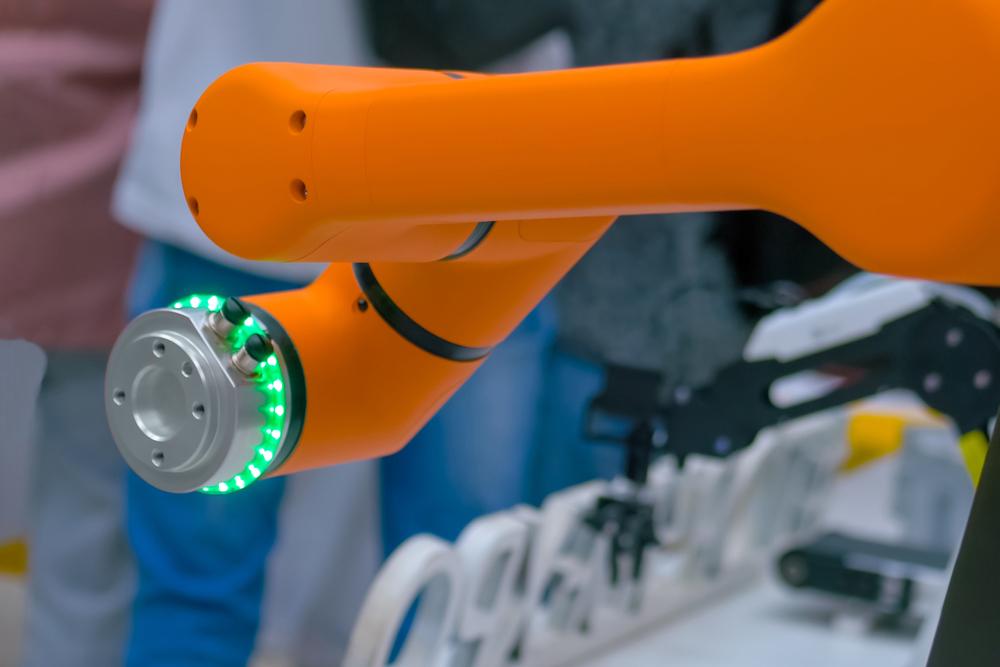
Collaborative robots, or cobots, on the other hand, vastly differ from this precedent. Cobots typically resemble a 4-,5- or 6-axis robot arm, many of which are mobile to help tailor-make a collaborative workspace. Designed with direct physical interaction in mind, cobots are human safety-first machines, complete with slower movements and a suite of safety sensors and vision systems to prevent operator injury.
Cobots provide collaborative automation as opposed to full automation. Instead of replacing human workers, cobots augment the work output of human operators to complement human skills. They can either be placed on an assembly line or in other places in a work environment and are equipped with learning modes where human operators can “teach” the cobot what to do by simply dragging it through the correct sequence of movements.
What Makes a Cobot Safe?
Cobots ensure that human workers remain safe with built-in sensors and safety protocols. Numerous systems exist so that contact, proximity, and/or speed are monitored to prevent any unnecessary injury to humans in the area. Cobots are also designed with rounded edges so anything in close proximity cannot snag on the cobot.
Which Industries Use Cobots?
Cobots find applications in various industries, such as the electronics industry, custom manufacturing industry, automotive industry, logistics, or anywhere else where they can work alongside humans to improve things. Thanks to the accompanying software automation of cobot systems, their programmed functions can change depending on the tasks. Many cobots aid human workers by lifting heavy objects, doing new tasks not well performed by humans, or helping qualified workers improve their accuracy and repeatability.
How Much Does a Cobot Cost?
Cost is variable, just as it is with all other industry tools. However, the current price of cobots hovers somewhere between $7,000 to over $50,000 dollars depending on the model. When compared to the traditional industrial robot price of $25,000 up to over $400,000, these prices are highly attractive, especially for small to medium-sized businesses looking to implement automation but are lacking the budget for conventional systems.
Types of Cobots
Cobots can typically be designated based on either application, tooling, or their specific mode of operation. Here we will describe the different modes of operation and forgo an explanation of each collaborative robot application or tooling choice, as there is more overlap in the latter category. Note that many current models of collaborative robots combine two or more of these modes together to increase performance.
1. Power and Force Limiting Cobots
Power and force-limiting cobots are built for human and cobot-shared workspaces. Though their force output is limited, their embedded sensors detect abnormal forces (such as a nudge, touch, or bump from a human) and halt all operations to prevent injury. Collision monitors on the surface, vision systems or electric motors of the collaborative robot prioritize safety, making them ideal for human-cobot collaboration.
2. Safety Monitored Stop Cobots
Safety-monitored stop cobots have a faster cycle time than other collaborative robots but are built with less comprehensive safety features and cooperation in mind. These types of robot will immediately stop functioning when an object comes within a set distance of the system and will resume work once the object moves outside its bounded area. They can be thought of as industrial robots with proximity-stop functionality.
3. Speed and Separation Cobots
Sometimes referred to as “fenceless” robot systems, speed and separation cobots are a blend of the above two types. These collaborative robots have range scanners that divide the space around the cobot into zones, where workers can work within this range, but the cobot will adjust its speed depending on their proximity. If no humans are in any zones, the cobot will work at its full set speed, and it will slow down as a human get closer until it stops at its closest ring.
4. Hand Guiding Cobots
As the name suggests, hand-guided collaborative robots include a sort of “learning” mode, where a user guides the end of the arm through a sequence of movements that it will ultimately perform autonomously. Through this direct input, hand-guiding cobots are much easier to reprogram than other cobot designs and allow for quick-switching of routines.
6 New Cobot Innovations
Companies can begin investing in collaborative robot technology today – numerous options are for sale that can help bring all the benefits of Industry 4.0. Below are six of the newest iterations of collaborative robots, each with new features that distinguish them from the variety of available options. This list was compiled in April of 2023.
1. JAKA Collaborative Robot Series – 5G Enabled, No Pendant Needed
Starup JAKA Robotics has unleashed its line of JAKA cobots after its series D funding in June of 2022. Each model is equipped with 5G antennas and is controllable by any smart device; no proprietary pendant needed. The five main variants of its collaborative robot series can assemble, glue, inspect, package, palletize, pick and place, polish, paint, screw, vision pick, weld, and perform custom actions taught by human operators. Itscobots are a promising addition to manufacturers as they are easy to deploy, versatile, and highly accurate up to 0.02 mm.
2. IBG FC RoboLite – Logistics-Focused Cobot/AVG Hybrid
A cobot-arm and automated guided vehicle (AVG) hybrid, IBG’s FC RoboLite system is built with logistics in mind. The cobot comes customized with a lifting table, a roller conveyor, and a tractor or forklift, depending on the intended role. With a 24-hour operating time and a rated total payload of over a ton, it can handle heavy-duty logistics tasks. The FC RoboLite is autonomous and can interface with other systems and controllers to react to its surroundings and outside commands, making it highly versatile in a complex logistics environment.
3. Elfin-Pro Collaborative Robot Series – Explosion-Proof, Massage-Therapy Ready
Chinese manufacturer Han’s Robot unveiled its new Pro series of Elfin collaborative robots rated for heavy payloads and harsh environments. Certain models in Han’s Robot’s catalog are rated for explosion-proof and high-humidity environments, making them much more durable than other cobot options. Besides the ability to function in automated loading and unloading, stacking, grinding, spraying, welding, handling, and sorting applications, they are collaborating with health physiology experts to be used for automated massages. Their delicate, pressure-sensitive movements combined with kneading and pressing end tools have been used to provide massage therapy to patients with great success.
4. ReBel Cobot by igus – Lightweight, Affordable, Open Source
At an attractive price point of under $5,000 and a weight of under 20 lbs, the ReBel Cobot by igus Motion Plastic is an exciting new direction for collaborative robot technology. Thanks to lightweight polymers and an open-source control platform, this cobot is great for both industrial and educational use. Easily deployed and re-deployed, the ReBel allows small companies to get in on the benefits of automation without the high initial investment costs.
5. Dobot CR20A Collaborative Robot – Heavy Payload, Wider Range, Modular Tooling
Dobot’s CR20A cobot arm is built with some of the most impressive specs to date: a 5 ½ foot working radius, over 40 lb payload capacity, 24 digital I/O ports, and an industry-first dual-channel end effector design that allows for multiple tools on a single detachable head makes the CR20A a versatile machine for automation. The collaborative robot has the flexibility to be used in laser welding, and logistics pick-and-place, The system can perform high-speed stops thanks to its vibration-reducing dynamic control algorithms and has state-of-the-art electromagnetic brakes in the event of an unexpected power outage. The CR20A can stack up to 7 items a minute and is compatible with European and American pallet dimensions.
6. Beckhoff ATRO Cobot – Fully Modular LEGO-Like Design
Short for the Automation Technology for Robotics, the ATRO Cobot by Beckhoff is a fully modular collaborative robot where each arm segment can be reconfigured like a LEGO set. Each motor module is standardized and, when paired with the standardized link modules and the TwinCAT control platform, allows for any combination of autonomous movement needed for a given application. This allows the ATRO to be anywhere from a 1-axis to a 7-axis cobot, supercharging the system’s personalization to the given task. The cobot also allows for air, fluid, and vacuum feed through the modules to permit any mechanical, electrical, pneumatic, or user-defined end tooling needed.
Emerging Paradigms in the Collaborative Robots Market
The above innovations illustrate that collaborative robots are specified into three key areas: deployability, modularity, and effectiveness. To be industry-ready, collaborative robots must be agile in their installment and function to compete with industrial robots. They are leaning into their customizable nature to outcompete systems that are tailor-made for their applications while combining ease of programming and use. Cobots rely on the human worker instead of disposing of them, meaning they are being built to enhance the collaborative workspace. In science fiction terms, collaborative robots are moving industry into something that looks more like Star Wars, where droids and humans work together, instead of a cold, abiologic dystopia like Blade Runner.