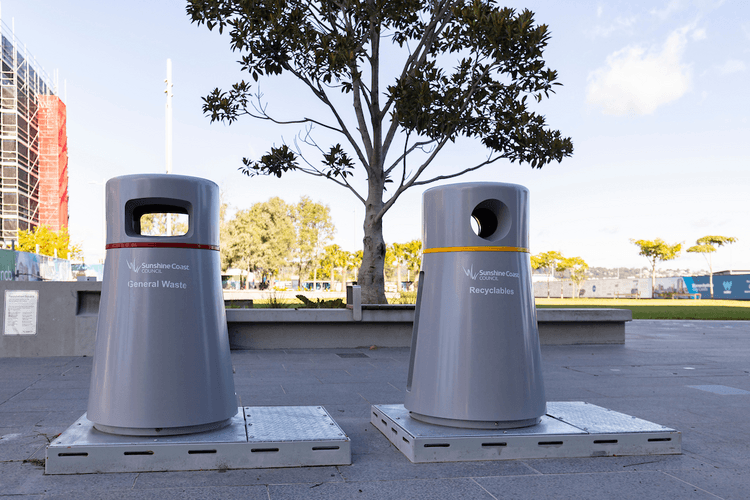
In mid-June, Australia launched its first underground automated waste collection system (AWCS) in the Maroochydore City Centre on the Sunshine Coast.
This revolutionary network of hi-tech bins could provide a sustainable and innovative resolution to the world’s waste problem. But how does an AWCS work and what benefits does it promise?
How Does the AWCS Work?
Maroochydore’s AWCS was designed by Envac, a company that works to support the development of smart cities through embedding exceptional technologies.
The $21 million project saw the creation of an underground pipe network that stretches for more than 6 kilometers. As an underdeveloped greenfield site, Maroochydore City Centre was the perfect test site for the country’s first AWCS because developers were able to install a high-speed fiber-optic network at the same time. This network can accommodate smart signage and lighting, wifi hotspots, and movement sensors.
Alongside the piping network, several bin inlets and a contained collection station have been installed to support a system that will receive and process organic, recyclable, and general waste.
When waste is deposited into an Envac bin, it will be stored in a sealed underground compartment before a vacuum pump sucks it through the system of pipes.
Twice daily, an airtight and soundproofed central waste facility activates the vacuum pump that can move each type of waste through the system’s piping with a vacuum pressure of up to 43.5 mph. The waste can then be disposed of or transferred to recycling facilities.
Sunshine Coast Council Mayor Mark Jamieson said of the system: “This project is just one of the ways in which the new Maroochydore City Centre will be one of the smartest cities in the country and another step towards achieving our vision for the Sunshine Coast to be Australia’s most sustainable region.”
What Are the Benefits of an AWCS?
In comparison to curb-side garbage collection, AWCSs provide several benefits:
- Hygiene — The system is continuously and closely monitored, which means waste is regularly disposed of and there will be no overflowing dumpsters. This eliminates odors, bugs, flies, and vermin, and results in cleaner streets.
- Convenience — Large dumpsters will no longer fill a city’s streets, obstructing the sidewalks for workers and residents. AWCSs also combat noise pollution because they negate the need for garbage trucks.
- Sustainability — AWCSs could see more waste being diverted from landfills.
Americans generate around 254 million tons of waste every year, and around half of that will end up in a landfill. Every day, the U.S. produces enough trash to fill63,000garbage trucks.
With total global waste predicted to double from nearly two billion tonnes in 2016 to four billion tonnes by 2050, it’s critical that cities invest in sustainable and efficient methods for waste management. AWCSs that leverage smart technology enable more efficient monitoring, tracking, treating, recycling, and disposing of waste. In addition, with waste collection trucks no longer required, there will be less traffic on the streets and a reduction in greenhouse gas emissions.
What Does the Future Hold for AWCSs and Waste Disposal?
The Swedish-designed Envac waste collection systems, which are ISO 9001 and HACPP compliant, have been tested in a handful of other cities including Stockholm, Seoul, Barcelona, London, Singapore, and Beijing. Meanwhile, in Australia, there are plans to expand the existing AWCS underground pipe network as the Maroochydore City Centredevelops.
Governments around the world are increasingly committed to developing sustainable smart cities, which includes the creation of green spaces, investing in zero-emissions public transport systems, and addressing waste management. With this in mind, it might not be long until AWCSs become a common addition to sustainable city living.