Scientists at the University of Colorado Boulder have developed “living concrete,” which they’re describing as a “Frankenstein-type material.”
And it’s definitely alive.
The recipe for concrete hasn’t changed much since its first iteration in 6500 BC when concrete-like structures were built by the Nabataea traders or Bedouins who occupied areas of southern Syria and northern Jordan. Essentially, hard materials are mixed with a binder to produce a rigid material.
That is, until now.
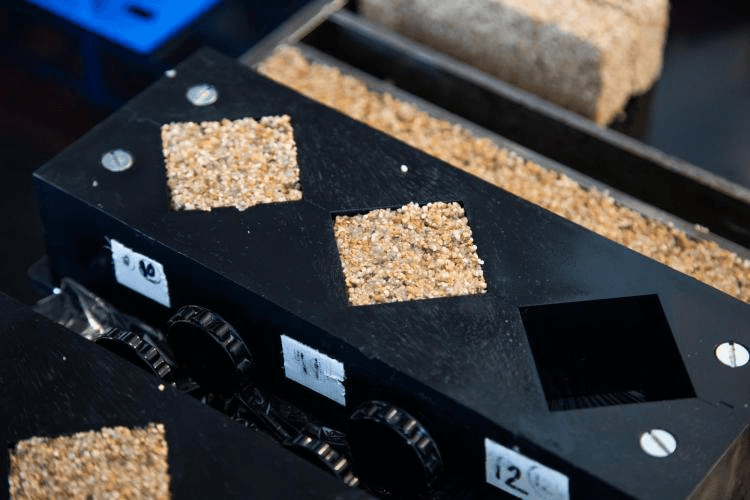
The Living Materials Laboratory’s living concrete consists of sand and bacteria. The material is made by creating a sand scaffold and a water-based gel that accommodates bacterial growth; The bacteria multiply and mineralize in a process much like seashells forming in the ocean.
The photosynthetic cyanobacteria function not only as a structurally sound and load-bearing component but can also perform biological functions including reproduction and healing when exposed to an increase in temperature or humidity. Scientists in the lab have shown that a single brick could reproduce eight bricks after three generations.
The Benefits of Living Concrete
Living concrete isn’t just horror-movie worthy; It actually carries some major societal benefits.
Firstly, as laboratory head Dr. Wil Srubar highlights, “We use photosynthetic cyanobacteria to biomineralize the scaffold, so it actually is really green.” This is a welcome development, given that concrete is currently the second-most consumed material on Earth and accounts for 6% of carbon emissions.
Secondly, the concrete blocks are a lot more adaptable than traditional concrete. Rather than requiring virgin sand from oceans, which is becoming increasingly scarce, living concrete can use waste products including glass and recycled concrete.
Finally, the possibilities living concrete provides for the future of building manufacturing are endless. The material can be grown on-site and molded into any shape or size, which means there’s no need to transport masses of resources to remote locations. It will also be useful for building temporary structures, such as disaster relief accommodations. Looking slightly further afield, living concrete could ultimately be used for building on other planets.
Scientists at the Living Materials Laboratory hope to see their living concrete in use within five to 10 years.