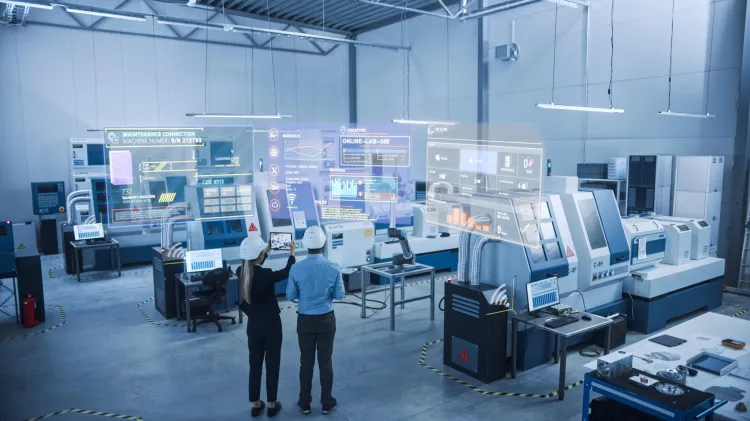

Smart manufacturing — also called Industry 4.0 or manufacturing 4.0 — has been around for some time. Great visions about the future of manufacturing are plentiful, and there are many proofs of concepts, but scaling the digital in manufacturing is significantly less represented.
Why? Because not enough attention is paid to the value creation aspect of smart manufacturing. In too many cases it is still seen as a techno spiel more than anything else.
We need to move from vision to value and impact. It starts with identifying pain points and providing digital solutions. Start small but with noticeable benefit. Small wins can then be scaled to other areas in manufacturing where new value can be created.
The Impetus for Change
As in so many other industries, one needs a crisis to get going — unless there has been a relentless drive by leadership for transformation. Research by ISG and Keypoint Intelligence show that COVID-19 is accelerating the adoption of Industry 4.0 products and services towards smart manufacturing and smart factories. Digital workflows and automation are becoming requirements, no longer goals.
The COVID-19 crisis has impacted manufacturing in a multitude of ways: substantial drops in sales have reduced production levels and capital expense budgets, supply chain issues have increased localization and diversity efforts, and safety distancing measures have impacted the labor force in factory plants.
It’s not just COVID-19 impacting the need for smart manufacturing, though.
Prior years have seen local natural disasters, such as tsunamis and earthquakes, and the recent trade wars impact manufacturing. Climate change’s growing impact on faraway production, increasing overseas labor cost, and complex global operations management have gradually increased the need for more resilience and diversity of manufacturing and supply chains. Additionally, extremely dynamic consumer behavior as well as demand for personalized and customized products are resulting in overall smaller production batches — away from the manufacturing industry’s high-volume production lines.
Crises show that well-oiled factories and supply chains come to a halt not exactly knowing where issues and challenges lie. Having a real-time and up-to-date view — based on IoT data — of factory operations and supply chains is critical to making operations resilient and to identifying problems and pain points as they occur so that solutions can be found.
Digitalization efforts in the broader manufacturing space are supporting this demand. Increased reliance on data through IoT and improving AI capabilities drive equipment automation and augmentation of human labor in the manufacturing world. It enables manufacturers to transition their operations from reactive to predictable environments.
This shift delivers two vital benefits with real bottom-line impact — optimizing planned downtime and minimizing unplanned downtime. It also allows for diversity in manufacturing and supply chains that will help confront such crises as the current one and solve global problems in a progressively fractured world.
Digital Opportunities
We are now living in a world where there are more machine customers than consumer customers. Ongoing digitalization and the evolution of technology are accelerating this. Think of power tools asking for maintenance, factory machines ordering preventive maintenance, printers ordering their ink, increased sustainability through less waste, and much more. These machines are getting smarter, and some of them are starting to behave like humans. Their power of augmenting humans and resulting improvements in efficiency, productivity, and safety are enormous.
Additive manufacturing, or 3D printing, has seen exponential growth as it serves two main purposes. It allows companies to manufacture unique pieces or small runs quickly, locally, and at relatively low costs. It also flows well for personalized manufacturing of finished goods.
Digital twins are virtual representations of real-world entity systems created to improve manufacturing decision-making. 24% of companies using IoT use digital twins: they use it to create new business opportunities such as predictive maintenance, monetization of manufacturing assets, and new business models.
An additional step is blending digital twins and their real counterparts — smart spaces. One can imagine immersive, interactive, and automated experiences, blending AI, VR (virtual reality), and MR (mixed reality) in a way that changes how people perceive the world. Today, people are learning to adapt technology in order to augment themselves; the future is headed toward technology learning from human in order to adapt and help humans in their production activity.
We have seen a strong introduction of autonomous products in manufacturing, logistics, agriculture, and mining — think drones, vehicles, and robots — with varying capabilities. Depending on the applications, capabilities can be autonomous or in coordination with humans whether in isolation or collaboratively. Regulation and ethical considerations more than technological prowess will determine the next steps. The intelligence for such things resides either in the device or vehicle itself or in the cloud or edge depending on the real-time or near-instant analytics that is required.
Supply chains have been impacted on several occasions in the past, but the current crisis has changed the game. It’s likely for the long term since we are seeing peaks traveling the world at different times, and we suspect this is likely the first pandemic in a series.
In manufacturing environments, social-distancing measures are likely to be put in place for the longer term. Having real-time and up-to-date knowledge of all operational entities and logistic centers in your value chain will be critical to balance supply and demand in a world of yo-yo pandemic impact. Knowing where to produce, where to keep inventory, and how to reconfigure your supply chain based on customer demand and pandemic-impacted operations is only possible with real-time data.
Digital’s Barriers
Manufacturing is often a conservative industry, somewhat old school, and very focused on productivity and quality. A lot of efficiently run operations are still based on paper or legacy based systems. Introducing new technology is disruptive in such an environment and deemed risky. Bringing in new technology is difficult largely because of the unknown.
Fear
One of the barriers to embracing digital is fear. Technology is often seen as adversely impacting jobs. The belief is that robots and sensors are replacing humans, while in reality they are only partly doing so but are more so augmenting humans to become more productive, efficient, and safer.
Likewise, many look skeptically at introducing digital technologies that create new business models or even new products and services that, while adding value, require a learning curve. Many machine operators look warily upon the advent of new technology because they fear the unknown (digital literacy).
Having staff participate in the design, pilot, and scaling phase and providing sufficient training is key to acceptance and success. Involve all stakeholders where possible so they co-own new developments, and then start to implement the technology in small steps, where it brings the most value. Not only will you get acceptance in these initial pilots, it also will democratize the technology across the board.
Data
Another barrier is related to the data itself. What is often overlooked is that data needs to be structured — prepared and catalogued — in the right format and at the right time in order to be relevant for usage. Analyzing the data can happen through cloud-based services without too much customization. However, shipping all data into the cloud does not always make sense: latency for real-time applications needs to be minimal, and therefore it’s better to utilize edge devices (regardless of fixed wired connections or fast 5G wireless feeds).
AI is not the all-encompassing holy grail. Focusing on a real problem to solve, making sure that AI can help to solve it, and having the right data are just three critical items to cover in an initial and manageable experiment.
Privacy
Another barrier is ensuring privacy is understood and maintained as sensors gather data on the workers and in the manufacturing environment. Explaining what data is being gathered and how that data is being used by AI systems is a great first step (explainable AI). Transparency and consistency of use will create trust.
Security
A final barrier is security. Given the proliferation of IoT devices, the number of points of attack expands dramatically in the types of attacks and the complexity. Solid analytics will improve overall security.
Your Transformation Journey
Find the area where your proof of concept can create immediate true value rather than an easy place where digitalization is simple to implement. Then, scale that proof of concept to a larger area where additional value can be created.
Proving return on investment (ROI) is a major challenge in this industry. It is about finding a balance between fast and risky implementation and slow and missed opportunities. One needs a combination of agile business case planning and a frugal implementation journey to scale where value can be created.
It’s important not only to have a roadmap for the transformation journey, but more so an innovation portfolio strategy that allows you to make quick, informed decisions about what initiative to stop, what to continue, and what to accelerate. Be sure to not only address transformation for optimization and efficiency but also to include transformation that creates value through new products, new service, or new business models.
Is the answer to move to a service business model, in a similar fashion to how jet engine manufacturers lease their engines rather than sell them? It depends. Associated with this service move is the use of data and with it the complex issue of data ownership, security, and privacy. If you own the data, you can offer services such as predictive maintenance to avoid machine breakdown, remote assistance in the field, etc.
Best Use Cases for Industry 4.0
In a survey by ISG on global Industry 4.0 adoption, the following use cases came out on top: condition-based monitoring, predictive maintenance, over-the-air updates, remote services, and equipment simulations. These were followed by initial trials in new business models such as equipment as a service and manufacturing as a service.
The World Economic Forum (WEF) has some outstanding examples of smart factories, so-called Lighthouse Factories. Measured improvements in the WEF lighthouse factories (WEF and McKinsey Global Lighthouse Network KPIs) include improved productivity (factory output increase, product cost decrease, reduced operating cost, reduced quality cost), improved sustainability (reduced waste, reduced water consumption, higher energy efficiency), increased agility (reduced inventory levels, reduced lead time, shortened changeover, reduced walking distance for inventory picking), and increased speed to market.
Principles for Scaling Smart Manufacturing
- Don’t fall for the shiny-object syndrome by implementing a cool technology project. Fundamental factors for success in implementing smart manufacturing include a clear focus on a pain point and step-by-step experimentation wherein assumptions are validated before any further steps are taken.
- Use the lean innovation mantra: plan big, start small, and scale fast.
- Engage all stakeholders in the design and implementation of your experiments to ensure buy-in of all stakeholders: Change management is mostly directed from the top, but it is only successful and thriving if rooting from the bottom. Given the introduction of new technologies at all levels of the organization, invest in recruiting or hire experts to train your current staff. And because we are embarking on an important transformation journey, invest in communication and change management.
- Such principles create a foundation that allows a much faster innovation process than typically observed in manufacturing: accelerated computation and analysis of all data collected through sensors, simulation of new products and services in a digital twin context, and support of operator and field workers through AR (augmented reality). It is all about installing an innovative mindset to prepare for the many unknowns to come.








![Making Advanced Manufacturing Technology Approachable with Jason Ray [New Podcast]](https://machinerys.net/upload/cache/202506/making-advanced-manufacturing-technology-approachable-with-jason-ray-new-podcast.webp)

![Designed to Optimize Technician Workflow, VC-Backed UpKeep’s CMMS “Takes the Work Out of Work Orders” [New Podcast]](/upload/20250615/w1ybeeqjjp3.png)