Approximately 2.2 billion people around the world do not have access to safe, clean, and fresh drinking water. It’s an infuriating reality to contend with, given that two-thirds of the earth is made up of water. Unfortunately, 97% of that water resides in our oceans and, although it amounts to enough water to fill around 353,670 million billion gallon-sized milk containers, it isn’t fit for human consumption. That is, until now.
GivePower recently developed an innovative solution that uses our oceans to address global water shortages. The NGO is determined to put an end to the 300,000 children who die each year as a result of water-borne diseases and address water scarcity around the world.
GivePower’s Solar Water Farms
Over the past six years, GivePower has provided over 2,650 solar-powered energy systems to power food production, electricity for schools and emergency services, and clean water through desalination. Today, their primary focus is to use sustainable energy for the generation of clean water via their solar water farm technology.
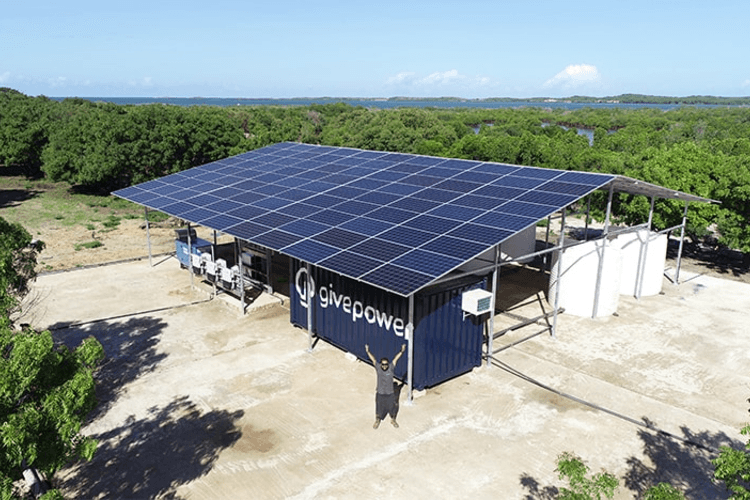
The first water farm was constructed in 2018 in Kiunga, a 3,500-strong fishing community off the eastern coast of Kenya and a few miles from the border of Somalia. The village’s proximity to the Indian Ocean makes it a perfect location for GivePower’s project.
The systems sit in 20-foot shipping containers and are capable of producing 50 kilowatts of solar energy and powering two water pumps. Ultimately, this means they can transform 75,000 liters of seawater into drinking water each day.
They’re affordable, sustainable, clean, and have the stamina to cater to 35,000 people daily for 20 years.
The Impact of Clean Water
For years, villagers in Kiunga had no option but to drink, cook with, and wash in dirty, brackish water, or else travel hours to access clean water. It was not uncommon to see children with scabs and scars on their stomachs and knees, aggravated by salt entering their wounds from bathing in saltwater.
GivePower’s solar water farms have resolved these issues by giving villagers access to a safe water supply, along with reducing the spread of several diseases and conditions including kidney failure. Following the success of this pilot project, the company intends to roll out similar schemes in Haiti and Columbia.
“Humanity needs to take swift action to address the increasingly severe global water crisis that faces the developing world,” said Hayes Barnard, founder and president of GivePower. “With our background in off-grid clean energy, GivePower can immediately help by deploying solar water farm solutions to save lives in areas throughout the world that suffer from prolonged water scarcity.”
The company has also most recently noted the importance of clean water amid the ongoing COVID-19 pandemic; as a result, GivePower has activated its newest large-scale Solar Water Farm – the BLU Drop “Max” – in LaGonâve, Haiti, which can provide clean drinking water for up to 35,000 people daily.
Innovation in Water Technology
GivePower isn’t the only organization leveraging innovative technology to address water shortages. Zero Mass Water has developed solar-powered hydro panels to extract ambient moisture from the air and produce, purify, and mineralize water to optimal quality. The panels can currently produce 20 bottles of water per day; the company also has a long-term plan to make drinking water an unlimited resource for communities worldwide.
Dar Si Hmad, a Moroccan-based non-profit, has been advancing its fog collector technology, installing collectors on the slopes of Mount Boutmezguida to harvest approximately 6,300 liters of water per day. Mist is collected when it passes through a weave of nets and is filtered and piped into five villages.
Water is Life partnered with Carnegie Mellon to produce a “drinkable book,” which has provided readers in Ghana, Kenya, Ethiopia, and Haiti with water and sanitation advice. The coffee filter paper on which the book is printed has the means to purify water, reducing 99.9% of bacteria for a single person for up to four years.
The World Health Organization predicts that 3.5 million people could experience water scarcity by 2025. With the help of tech-savvy non-profits like these, let’s hope this outcome can be prevented.