This holiday season, if you’re so inclined, you might just gather around a piano amongst your friends and family and belt out some of your favorite tunes. Don’t have a piano? Well, it wouldn’t be the Thomas Industry Update if we didn’t have a hack for you.
Prelonic Technologies, an Austria-based developer of printed electronics, has unveiled an idea that hints at the future of electronics — and it may be simpler than you think. A new test shows ways for users to interact with their electronics in ways that aren’t facilitated well by a small gadget. Take, for example, a digital keyboard where playing keys on a small screen would be a challenge.
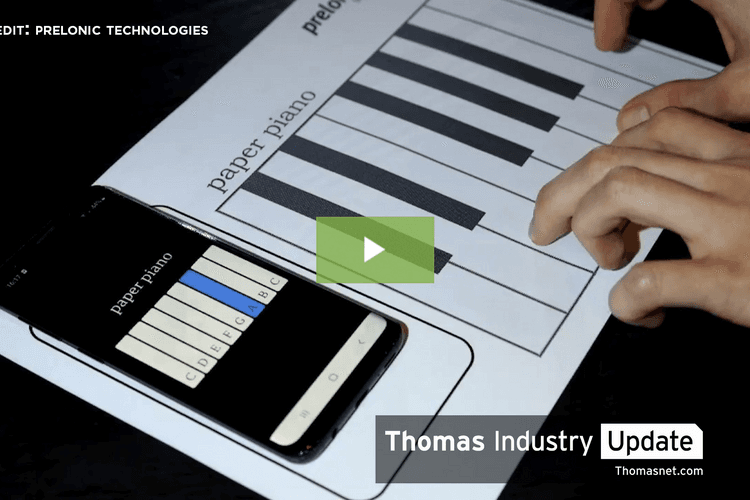
In Prelonic’s vision, users could interact with their devices via a piece of printed paper. It’s called Prelonic Interactive Paper — or PIP — and it’s equipped with push buttons connecting to a mobile device, allowing users to control the mobile device with their movements. Prelonic says there is no power source necessary after integrating the phone’s technology with the paper, resulting in the ability for a user to play a song by thumbing across this thin sheet.
Gizmodo details the process, where a standard laser printer is used to first print a set of piano keys onto a single sheet. The back of the paper is then “printed with a circuit layout using conductive carbon and then sandwiched with another printed conductive sheet and a small NFC chip in-between.” The NFC chip acts like Bluetooth when the phone is placed on top, although it requires less power.
When reportedly combined with a smartphone app, “the paper piano can be physically played, producing notes through the device.”
Gizmodo goes on to suggest that the applications for this type of technology most certainly don’t end there. Custom controllers — including full computer keyboards — could be created at very little cost and then easily recycled after the NFC chip is removed.