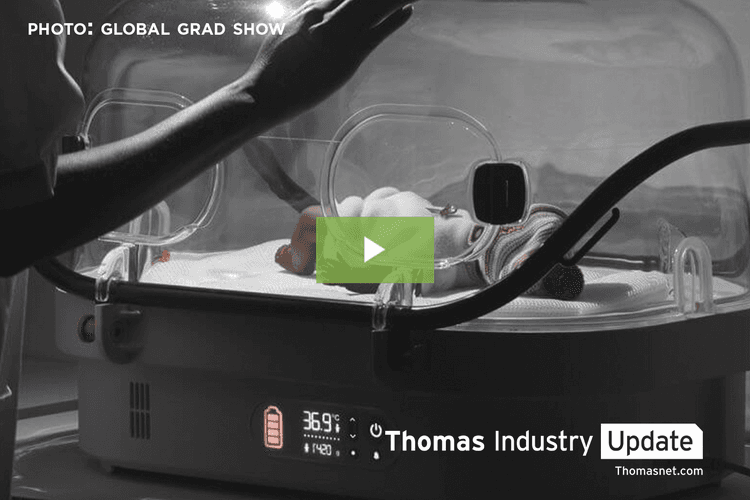
The Robust Nest is a new incubator design that hopes to fill a vital need worldwide, saving the lives of newborn babies. The transportable incubator was designed by Fabien Roy, a graduate with a master’s degree in product design from ECAL, the Lausanne University of Art and Design in Switzerland.
The design is intended to be smaller, more portable, and capable of withstanding blackouts or power loss. According to UNICEF, 1.1 million newborns die of hypothermia in sub-Saharan Africa within their first month of life. Hypothermia is increasingly recognized as a significant cause of infant death in areas low on resources, including South Asia.
According to the World Health Organization, thermal care is a critical component of essential newborn care, yet hypothermia remains under-documented, under-recognized, and under-managed.
Roy hopes his Robust Nest solves some fundamental problems. Developed in collaboration with the EssentialTech Center at the Swiss Federal Institute of Technology Lausanne, the Robust Nest has a thermal battery inside the base that provides heat. In case of blackouts or during transport, the battery can warm the child for up to seven hours. The incubator is also a lot smaller than traditional designs. According to Roy, about 16 Robust Nests can fit in the same footprint as a single conventional model.
The incubator is also designed for safer transport. It has a metal ring that not only acts as a handle but can also be attached to a seat belt or act as a bumper in case of any shocks along rough terrain. In addition, the incubator is easy to assemble out of the box and consists of easily replaceable components that should be locally available.
Last year, Roy entered his project in the Global Grad Show, a contest seeking innovations by graduates around the globe that can make a positive social impact. The Robust Nest was one of more than 700 projects that have entered the program. Roy joined the contest because he hopes to find potential partners who could help further develop the technology and create a next-generation design.