Engineers at Princeton University have found a way to make soft plastics for3D printingthat are not only flexible but affordable and recyclable. Unlike similar materials, thisnew technologycombines stretchiness and rigidity in a single structure—something that, until now, has rarely been achieved.
New Flexible Material
This material differs from alternatives (i.e., liquid crystal elastomers and traditional thermosetting polymers) in that its physical properties are tailorable. Engineers can manipulate the printer’s tool path to control exactly where the material should be stretchy, flexible, or rigid—all within a single design.
The technology uses a thermoplastic elastomer, a type of polymer that creates nanoscale cylindrical structures within a stretchy matrix. These tiny structures, which are just 5–7 nanometers thick, are what allow the material to be firm in one direction and soft in another.
Properties
Unlike most plastics used in manufacturing, the material is designed to be reused. In addition to the impressive feat of combining flexible and rigid areas in the same object, this new technology also has self-healing properties.
This is achieved by using a controlled heating and cooling process called thermal annealing, which not only strengthens the material after printing but allows damaged items to repair themselves. The researchers proved this by cutting and reattaching a sample, which then regained its original properties and strength without any signs of degradation.
Applications
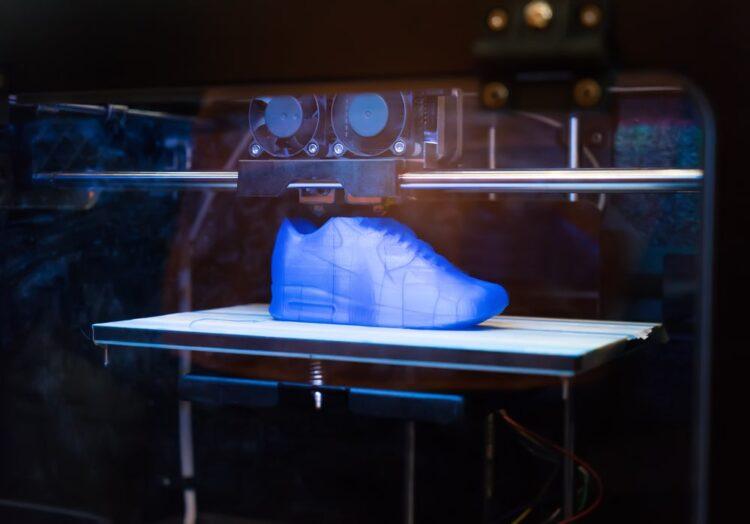
All these properties make this new invention perfect for making medical devices, prosthetics, high-performance shoes, soft robotics, and generallysustainable, and long-lasting products.
It can be used to make multi-layered products that are complex in design, so it’s ideal for wearables, and lightweight yet durable helmets. The engineers have even included additives to give the plastic extra properties, such as glowing red under UV light.
Project
While, typically, making a material like this would be incredibly complex and expensive, the team pulled it off using thermoplastic elastomers that cost just a cent per gram (for comparison, alternatives cost around $2.50 a gram).
The project was led by Emily Davidson, an assistant professor of chemical and bioengineering at Princeton, with the help of graduate student, Alice Ferguson. For more on this exciting development, read the full report inAdvanced Functional Materials.
Image Credit: Shutterstock/asharkyu