This article was sponsored by Nexa3D, a manufacturer of 3D printers and materials that is digitizing the world’s supply chain sustainably.
“The world doesn’t need another 3D printer unless it is orders of magnitude better,” Avi Reichental, the CEO, chairman, and co-founder of Nexa3D considered when he first conceived of the additive manufacturing venture. In 2014, Popular Mechanics magazine had already named Reichental one of the Top 25 Makers Who Are Reinventing the American Dream, and he had delivered a TED Talk on the future of 3D printing that would go on to garner more than 2.5 million views.
But he saw the innovative potential for additive manufacturing that had yet to be unleased: “I founded Nexa3D in 2016 after 12 years in the industry as the CEO of 3D Systems because I realized that to take 3D printing to its full potential, it needed to be much faster, more productive, accurate, and affordable.”
“Fast forward to 2021: Nexa3D is making the fastest industrial 3D printers in the world by a factor of about 20 times productivity — with a much lower cost of ownership,” he says. The Ventura, California-based company can reduce manufacturers’ operating costs by up to 85%.
To accomplish this, Nexa3D developed its own technology stack. Innovations include the Lubricant Sublayer Photo-curing (LSPc) print engine for photoplastics, including the NXE 400 and NXD 200; the Quantum Laser Sintering (QLS) print engine for thermoplastics, the QLS 350; and Digital Twin Printing (DTP) software that allows for new material properties.
“Our superpowers are in layer speed and build size,” Reichental reveals.
Nexa3D helps clients increase the fidelity and functionality of their products, customize and personalize, and deliver products to the market faster. For instance:
- DMM, a Japanese manufacturer, has purchased five Nexa3D printers because it compresses their cycle time and delivery by about 50%.
- FLYER, a Swiss manufacturer of premium-quality e-bicycles for various terrains since 1995, used their NXE 400 printer to rapidly prototype their new e-bicycle.
- Arcimoto, a micromobility company in Eugene, Oregon, used Nexa3D’s technology to reduce the weight of some parts of its Fun Utility Vehicles (FUV) by as much as 50%. “The lighter the vehicle, the longer the range per battery charge is,” explains Reichental. “It’s good for the planet — and good for the pocketbook.”
Nexa3D’s ability to bring reliable products to market efficiently stands in the gap of global supply chain disruptions. “There is so much waste that we can eliminate and so much carbon footprint that we can reduce in every part of the supply chain from sourcing it overseas, shipping it, warehousing it, land transportation, having the wrong parts where you don’t need them, and paying for surplus,” Reichental notes. “We want to digitize the supply chain sustainably and be part of the solution of hyper-localizing and simplifying manufacturing.”
To this end, Reichental says, “At Nexa3D, we believe that we’re not just building 3D printers — we’re building time machines because we give our customers back a lot of time. And time is something that is so valuable that you can’t give customers and society enough time back. So the more time we can give back to our customers, the more creative and innovative they can be.”
Thomas Insights (TI): Nexa3D managed to reduce 3D printing time from days to mere minutes. What are some ways that this will change industry?
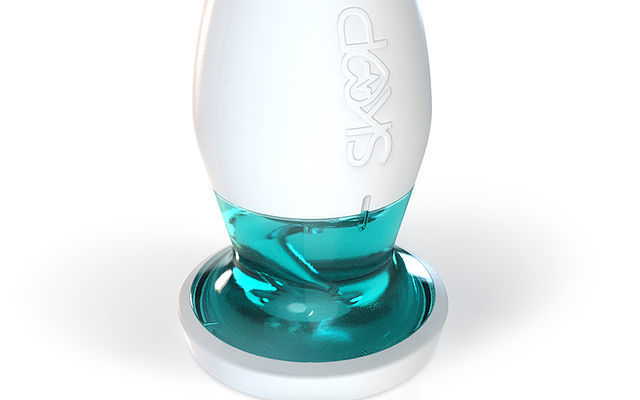
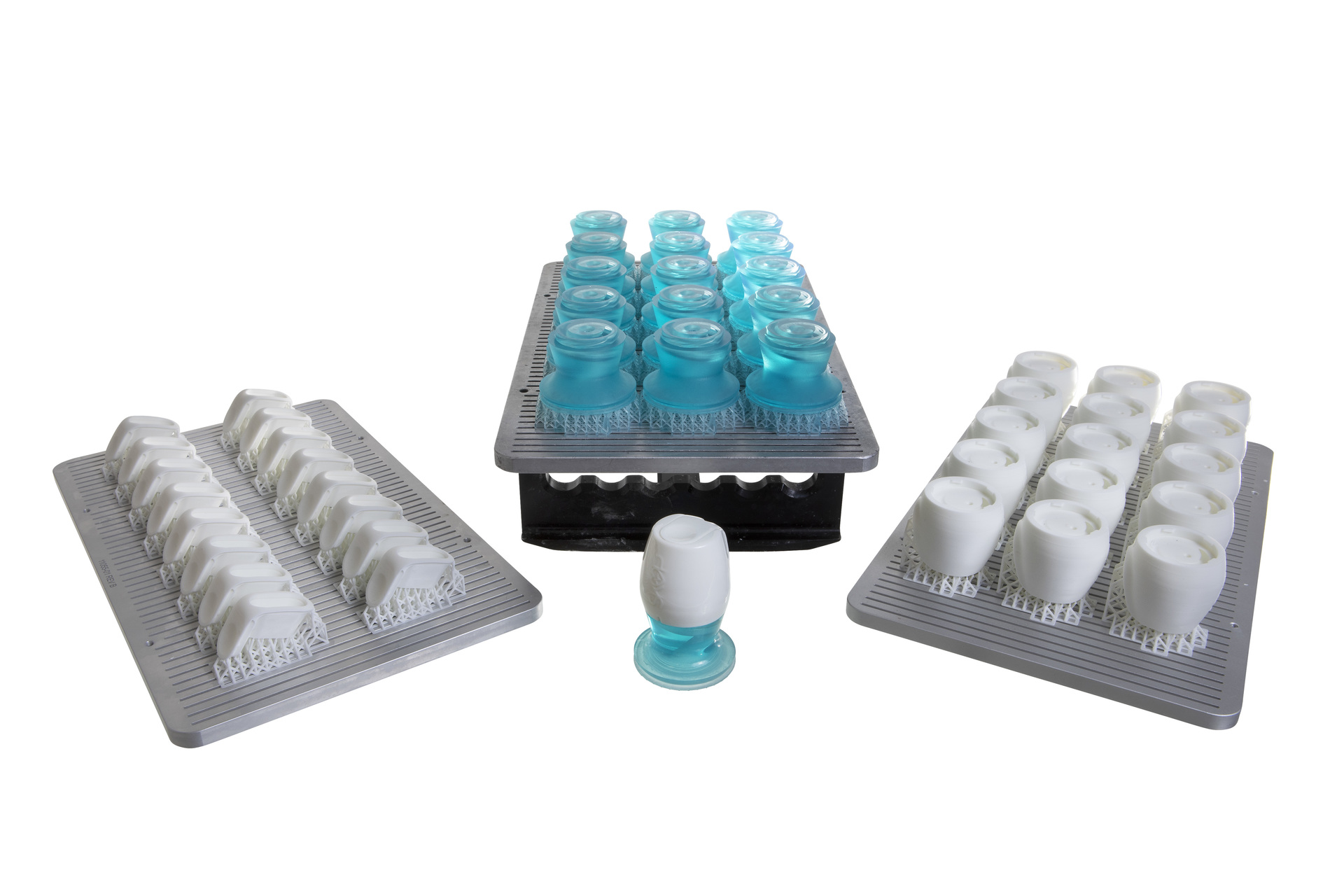
Avi Reichental (AR): We just released an incredible success story with a young company in France called WeMed. During COVID, WeMed saw the need for telemedicine, so they invented a completely new stethoscope called the SKOP. The only way to make this little remote stethoscope, which you can put on your heart so it transmits your heartbeat to your doctor, is to 3D print it. The big deal about the SKOP is that it takes designs that nature patented millions of years ago — how an ear canal is constructed — and perfected it with biomimicry.
This is an example of a very demanding product. You need to make sure that you have extreme accuracy and consistency. In the course of about four months, we developed and customized the materials with our partner, Henkel; we color matched them; we worked with the contract manufacturing company Third to make sure you would never know they were 3D printed unless you looked on the inside; and we worked to scale up. They are now on track to produce about 100,000 of those products.
This is really where Nexa3D shines: we did this to industrialize and democratize access to 3D printers.
TI: How else is 3D printing advancing the medical field?
AR: One of the biggest open-ended opportunities for 3D printing is in orthodontics with aligners, dental restorations, and dentures. The audience of potential users is both clinicians and dental labs.
There are no constraints to the manufacturing process. You can make patient-specific devices really, really fast and very, very cost-effectively.
That’s a way to not just put a smile on your face because you can show straight teeth, but it’s an opportunity to enhance the quality of life in a way that’s economical, fast, and life-changing, especially for an aging population.
Our aim is to completely change the way that people think about design. It’s also an opportunity to improve healthcare as we know it.
TI: What’s the biggest question that you get from prospects and customers, and how do you respond to them?
AR: There are two big questions. The first one is: “Can you prove to me that your printer provides as much as 20 times productivity over other existing printers?” to which we answer, "Absolutely. Come see for yourself.” We love doing live demos on Zoom, and we invite everybody who is in disbelief to come see for themselves.
The second most common question is: “Can I print this part on a Nexa3D printer?” And the answer to that is: “Send us your design, and we will find out together,” with a follow-up question of: “Why wouldn’t you want to further optimize your design for 3D printing and take full advantage of the fact that with Nexa3D you can further optimize, combine parts, and improve parts? When you do all of that, you simplify your supply chain, and you reduce the material and energy inputs, which makes it much more sustainable, environmentally speaking.”
For a hundred years, we have been constraining our imagination and design language within the boundaries of traditional manufacturing techniques. For the first time, we have complete freedom of design and expression, and we have opportunities to reimagine how circular economy principles, biomimicry, and unlimited digital fabrication capabilities can converge together to make the impossible possible.
TI: Can you tell me a little about your strategic partnerships?
AR: With technology developing at an exponential rate, the future happens faster than we can even imagine. No single company out there — large or small — has the ability to go it alone. So we decided from the get-go that we were going to create partnerships, for example, with material suppliers, with software suppliers, and with other production automation equipment suppliers because in the end, if we want to effect change in the whole ecosystem of Industry 4.0 solutions, we need to give our customers the full and complete solution — not just elements of it.
We have great collaborations with companies like Henkel, BASF, Evonik, and DSM. We are open to bringing more partnerships and collaborations to the marketplace. To enable that, we just announced another collaboration with Henkel to open a factory of the future right here in Ventura, our headquarters. We’re calling it NEXTFACTORY. And NEXTFACTORY will have complete manufacturing capabilities to show customers in airliner production, in footwear production, in automotive production, and in investment casting how they can take their products to full production scale powered by Nexa3D.
TI: Is Nexa3D hiring?
AR: We’re expanding our portfolio quite a bit with additional solutions in the next 12 months.We’re passionate about what we do, and we know that we’re not the only ones. So we want to find some more kindred spirits because we think that we created an environment in which anybody can come and do the best work of their lives with us.Nexa3D is growing, and we’re looking to hire as many as 50 more Nexers to come join the team. Together we can change the way that people design and make products.