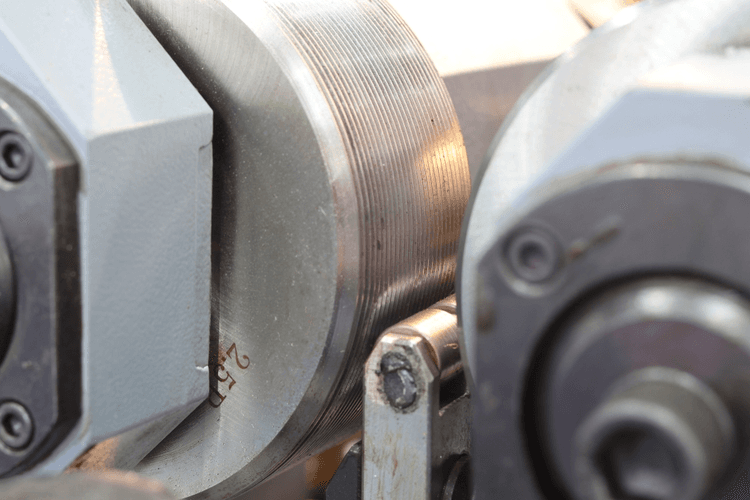
Thread rolling is a cold forging process that can be enacted upon any malleable metal. Distinct from other types of threading methods such as chasing, cutting, and grinding, thread rolling is the desired process for creating exact, unvarying, level thread structures.
Types of Thread Rolling
Although there are a broad variety of thread rollers in production, all employ a system of matching hardened steel dies and reforming circular diameter surfaces into threads. To accomplish this, a cylindrical apparatus, also known as a blank, goes into the machine and the dies either revolve (cylindrical dies) or counter (flat dies) to create threads.
Flat Die Thread Rolling
Flat die thread rolling utilizes two dies: one static and one mobile. The stationary die and the moving die are positioned opposite one another. During the forward movement of the machine, a thread is rolled on one blank at a time. The diameter of the blank die and the distance between the faces of the dies at the completion of the machine’s stroke determines the diameter of the manufactured thread.
Flat dies are often utilized in the creation of special threads, tapping screws, wood screws, knurling, and machine and cap screws.
Planetary Thread Rolling
Capable of manufacturing threads on tens of thousands of parts per hour, planetary die rollers are the preferred form of threading processes for high-volume production.
Two-Die Cylindrical Rolling
Thread rolling that employs cylindrical thread rolling dies offers several manufacturing advantages, namely increased accuracy when threading difficult or large-sized materials.
Three-Die Cylindrical Rolling
To shape circular cross-sections of materials, three-die cylindrical rolling machines boast three to 60 tons of rolling force. Using a ring roller, three-die cylindrical rolling machines can achieve any length of material and are best utilized with solid materials longer than one meter.
Diameters
Pitch diameter and blank diameter influence the viability of a thread rolling process. To calculate a blank diameter, it’s essential to first determine if the goal is to achieve a tapered pipe thread or a straight thread. If the goal is a straight thread, a requisite understanding of the parameters of both the pitch diameter and the major diameter is required.
Pitch Diameter
The pitch is defined as the distance between a point on one thread and a corresponding point on the neighboring thread measured along an axial plane. The theoretical midpoint of the thread is known as the effective diameter or the pitch diameter.
To measure the pitch diameter, thread features must be considered. Imagine that the width of the thread groove, or minor diameter, and the width of the thread crest, or major diameter, are equal and equal to half the supposed pitch of the thread. The pitch diameter is the diameter of this conceived cylinder.
Major Diameter
Formed around the crest of an external thread, the major diameter is the diameter of an imaginary cylinder.
Blank Diameter
The diameter of the part onto which the threads will be rolled is the blank diameter, which is usually equivalent to the maximum thread pitch diameter minus .002 inches.
The material displaced by the rolling process will be displaced onto the nearby thread until the minor diameter is below the blank diameter. This displaced material, above the blank diameter, produces the major diameter.
Other Terminology
- The angle of thread is measured along an axis and incorporates the angle between two thread sides.
- Crest connects the two thread sides and becomes the top surface of the thread.
- The depth of thread refers to the distance between the thread’s crest and root. It is measured normal to the axis.
- External thread indicates a thread cut on the outside of a machine part. A bolt or a screw is an example of an external thread.
- Internal thread signifies a thread cut on the inside of a machine part, much like a nut.
- Helix angle represents the angle created by the helix of the thread at the pitch diameter with a plane perpendicular to the axis.
- Lead denotes the distances the threading tool will progress along an axis during one spindle revolution.
- Measured along the length of the fastener, metric threads are determined by a thread pitch, or the distance between threads articulated in millimeters, instead of a thread count.
- Because their grain moves in multiple directions, rolled threads are stronger than cut threads and are expressed by dies.
- The most conventional thread type available is tapered threads. Having a slight taper, the threads form a seal when pressed together, holding the fitting in place.
- A U.S. standard for tapered threads used on threaded pipes and fittings is known as National Pipe Thread Taper (NPT).
- MAThread® is a patented thread design used on any externally threaded screw, bolt, or other product, and can be located on more than 3,000 different fasteners throughout high-volume manufacturing plants. The thread design is self-correcting, effectively eliminating the possibility of thread damage or seizing.
Utilizing Rolled Threads
Because of their exceptional shear, tensile, and fatigue strength, rolled threads are frequently necessary by design. While other methods eliminate material to generate thread forms, thread rolling relocates the material with reinforced steel dies.
Removing material weakens the thread while shifting material elevates the density of the thread at crucial points, specifically at its root, thus enhancing its quality.
Resources:
- https://www.cjwinter.com/blog/pitch-diameter-and-blank-diameter-defined
- http://www.reed-machinery.com/pdf/thread-rolling-with-flat-dies-tech-data-master.pdf
- https://todaysmachiningworld.com/magazine/how-it-works-precision-thread-rolling/
- http://www.heroslam.com/en/cylindrical-dies
- http://www.gokcuoglu.com/en/our-products/267857A2
- https://www.boltdepot.com/fastener-information/measuring/tpiandpitch.aspx
- https://mathread.com/
- https://www.pooleyinc.com/pdf/PipeThreads.pdf
Image Credit:Mr. 1/Shutterstock.com