![Where Does New York City Get Its Electricity? [A Byte Out of the Big Apple]](/upload/20250615/b5un21qolw0.jpeg)
A Byte Out of the Big Apple

New York City attracts captains of industry, innovators, and creatives. It’s home to iconic skyscrapers and intricate subway tunnels, the neon lights of Times Square and delicate flora of Central Park, brick-and-mortar shops and dotcoms — and they’re all driven by the manufacturing industry.
Join Thomas Insights Executive Editor Stephanie Nikolopoulos as she takes a "byte” out of the history and future of the Big Apple in this monthly column.
Confused and frustrated murmurs echoed in the office as our computers went blank. My colleagues and I began swiveling around in our chairs to see what was happening. Although the overhead fluorescent lights had also shut off, afternoon sunlight streamed through the giant windows overlooking Fifth Avenue. We looked outside.
It was a little after 4 p.m. on the muggy summer day of August 14, 2003, and 11,600 traffic signals had stopped working. All of New York City had lost power.
We’d learn later that a high-voltage power line all the way out in Ohio had softened from the heat of its high current to the point that it drooped into some foliage and faulted. This wouldn’t have been so significant except the utility company’s alarm system had a software bug in it and failed to alert the operators in the control room that they needed to redistribute the load.
The result was the biggest blackout in North America — and the second biggest in the world — at the time. Eight states in the Northeast as well as Ontario, Canada, were without electricity, impacting 50 million people. The blackout lasted about 30 hours and cost about $6 billion.
But at the time, we didn’t know what was happening. The 9/11 memorial banner hanging over the Lincoln Tunnel still seemed fresh, and soldiers with the New York National Guard regularly patrolled transit hubs. It was a relief to learn it was just a blackout, but subways, buses, and flights weren’t running, leaving many stranded.
I was still living in New Jersey at the time, an hour and a half commute away from my office, and was stranded with nowhere to go. I joined the throng of people outside Port Authority. When the sun set, pitching New York City into darkness, I looked up past the unlit skyscrapers and for the first time I can remember, I saw stars in New York City.
Close to 20 years later, what does New York City’s energy grid look like?
The History of New York City Electricity
Known for its glittering skyline and the neon signs of “The Great White Way” (Broadway), a New York City before electricity seems unimaginable. But there was a time when New Yorkers relied on moonlight, campfires, and candles.
New York City Before Electricity
The Lenape people who resided in Manna-hata (Manhattan) considered fire to be their “Grandfather,” a source for staying warm, cooking food, fashioning tools, and managing the land. To start a fire, they would strike flint against a piece of steel. The intense friction would create a spark that they could kindle with dried pine needles. To make the fire portable, some Indigenous people created candle-wood, which was a pine-knot torch.
When European immigrants settled on the East Coast, they brought a diminishing supply of candles with them. Women began producing them in the New World each autumn, an arduous but necessary task that involved repeatedly dipping wicks into melted tallow, in other words, animal fat, so the Colonials could have light in the dark winter months. Beeswax and sweet-smelling bayberry candles were an option only for the elite.
In the late 18th century, technology evolved as whaling grew into the United States’ fifth-largest industry. It allowed for the production of candles produced from spermaceti wax poured into wooden molds as well as whale-oil lamps. Unfortunately, on July 19, 1845, a fire broke out at the J.L. Van Duren Oil Merchant and Sterin Candle Manufacturers located at 34 New Street in New York City’s Financial District. It spread to a warehouse filled with saltpeter, which is used to make gunpowder and firecrackers, resulting in an explosion that demolished seven buildings. The Great Fire of 1845 resulted in new safety measures.
Just as whales were becoming harder to find off the coast of North America due to overhunting, Edwin Drake struck oil in Titusville, Pennsylvania, on August 27, 1859, ushering in the American oil industry. The petroleum age provided kerosene, which was significantly less expensive to use in lamps.
When Did New York City Get Electricity?
Kerosene lanterns flickered in tenements in the early history of New York City. But in 1882, horse-drawn wagons began hauling coal down to Lower Manhattan to the Edison Electric Illumination Company at 257 Pearl Street, the United States’ first commercial power plant. There, “jumbo” — a reference to the elephant in the popular P. T. Barnum Circus at the time — steam-powered engines activated generators.
The electric age switched on on September 4, 1882.
Edison powered the buildings with direct current (DC). With the price similar to that of gas, customers signed on, and demand for electricity rose.
The War of the Currents
Later that decade, Edison and George Westinghouse engaged in the “war of the currents,” when Westinghouse found a way to bring high-voltage alternating current (AC) indoors using transformers.
The war came to an end after Edison lost majority control in the merger that formed Edison General Electric Company in 1889, and then a subsequent merger with Thomson-Houston Electric Company in 1892 resulted in the creation of General Electric (GE). Edison’s name had been dropped.
However, Edison was a savvy businessman, with his hand in many business ventures. Back on December 17, 1880, he had founded the Edison Illuminating Company, which was not part of the above-mentioned mergers. It was sold in 1901 to Consolidated Gas, which, with the rise of electricity, changed its name to Consolidated Edison. Today, we know it as conEdison or ConEd.
Westinghouse was also savvy. In 1895, he and Nikola Telsa had built the world’s first major hydro-electric power plant. This, however, wasn’t in the city but further upstate in Buffalo, where it harnessed the power of the mighty Niagara River.
How Does New York Generate Electricity Today?
New York’s own resources provide about a quarter of the power for the state today. In 2021, about 54% of its in-state electricity generation came from nuclear power and renewable sources.
New York Natural Gas
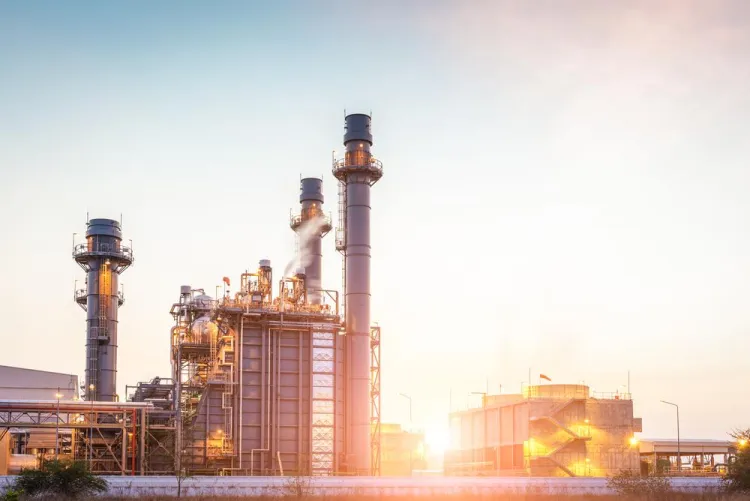
In 1821, the United States drilled its first commercial natural gas well, which was in Fredonia, New York. In 2021, natural gas made up 38% of electricity generation in the United States, making it the country’s largest energy source. In 2022, natural gas made up 46.22% of the electric grid in New York. However, New York is currently working toward phasing out natural gas.
Natural gas, mainly made up of methane but also containing natural gas liquids (NGLs) and nonhydrocarbon gases, is a fossil fuel. This energy source comes from the remains of animal and plant life from millions of years ago, and because New York is situated over Marcellus shale play it may be sitting on top of trillions of cubic feet of natural gas. Gas and steam turbines use natural gas to produce electricity.
The NYSPCSC regulates such New York utilities and natural gas providers as Consolidated Edison Company of N.Y., Inc.; Corning Natural Gas Corporation; Empire State Pipeline; and New York State Electric & Gas Corporation.
New York Coal
The second-largest energy source for generating electricity in the United States in 2021 was coal. It comprised about 22%.
However, New York shuttered its last remaining coal-fired power plant back in 2020.
New York Nuclear Power
In 2022, nuclear made up 21.16% of the electric grid in New York.
Until fairly recently, the state had four working nuclear power plants. In 2021, Indian Point Energy Center closed. The three remaining operating nuclear power reactors are the James A. FitzPatrick and Nine Mile Point plants, both of which are in Oswego, and the R.E. Ginna plant, in Ontario, New York. With Indian Point’s phased closure, nuclear power utility-scale net generation dropped from 34% in 2019 to 25% in 2021.
New York Hydropower
In 2021, New York state produced 11% of the United States’ hydroelectricity. This made it the third-largest hydropower creator in the entire country. In 2022, hydro made up 21.28% of the electric grid in New York.
There are many small plants in the state, but the New York Power Authority operates three large-scale hydroelectric projects that generate 28.7 billion (kWh) of electricity each year. These are the Blenheim-Gilboa Power Project, Niagara Power Project, and the St. Lawrence-FDR Power Project.
The Niagara Power Project, consisting of the Lewiston Pump Generating Plant and the Robert Moses Niagara Power Plant, is the largest electricity supplier in New York. When it opened in 1961, the Niagara plant was the largest hydropower venture in the Western world. Today, it supplies 2.6 million kilowatts of electricity.
New York Solar Power
In 2022, solar made up 4.30% of the electric grid in New York.
New Yorkers have several solar options. These include home installation, in which solar panels are mounted either directly on a house’s roof or on the ground, and community solar, in which one subscribes to a clean energy project at an offsite location.
Major solar installations located in New York include Invenergy’s Shoreham Solar Commons, which was installed in Shoreham in 2018 and acquired by Duke Energy Renewables; CS Energy’s Branscomb Solar, which was installed in Schaghticoke in 2021 and has led to plans for several more solar projects; and Corning Incorporated’s project, which was installed in Tonawanda in 2020.
New York Wind Power
In 2022, wind made up 3.77% of the electric grid in New York.
New York is actively developing five offshore wind projects right now, which is set to become the country’s biggest offshore wind pipeline. The New York State Energy Research and Development Authority (NYSERDA) projects include LIPA’s South Fork Wind Farm, which is set to become New York’s first offshore wind farm at the end of this year; Sunrise Wind, which is located off of Long Island’s east coast and will be operational in 2025; Empire Wind 1, which is located off Jones Beach State Park and will be operational in 2026; Empire Wind 2, also located off Jones Beach State Park and will be operational a year later in 2027; and Beacon Wind, which is located off Montauk Point and will be operational in 2028.
Other New York Electric Sources
In addition to the above-mentioned sources, the electric grid mix in New York in 2022 was also made up of oil (1.45%), biomass (1.21%), and other fossil (0.6%), based on data from the U.S. Energy Information Administration (EIA).
Take Another Byte Out of the Big Apple
- Horses in a Tempest: How New York Dealt with Hurricane Sandy
- Unearthing How New York City’s Subway Tunnels Were Built
- Is That a Giant Rube Goldberg Machine in Port Authority?







![How Catchers and Pitchers Are Using Technology to Communicate on the Baseball Field [Thoughts After Dark]](/upload/20250615/d2nua0zbcvi.jpeg)