By 2027, Northrop Grumman and Raytheon Missiles & Defense will deliver a Hypersonic Attack Cruise Missile (HACM) to the Air Force. This will be the first missile of its kind in the United States and represent a milestone for scramjet technology, a method of compressing fast-moving air for fuel use.
Missiles date back to the 13th century, and over the last decade, they have rapidly advanced and shaped warfare and deterrence strategies. As ranges and capabilities continue improving, missile innovation has endless potential.
Below, we explore the five types of missiles that have shaped the defense sector. But first, let’s uncover the differences between missiles and rockets.
The Difference Between Missiles and Rockets
Rocket and missile are often used interchangeably, but they have a few key differences.
While both missiles and rockets are area weapons that use engines to attain high speed, missiles have the added advantage of a guidance system. After a missile is launched, its trajectory can be altered mid-flight. A rocket, on the other hand, is directed by the rocket launcher.
Because missiles often travel longer distances, they tend to have larger tail fins and wings. Rockets are technologically simpler, which is why they were developed before missiles.
How Missiles Work
Missiles, like many things, obey Newton’s Third Law of Motion — a force, or thurst, moves it.
Missiles burn fuel in an engine, typically either a rocket engine (which contains its own oxygen) or a jet engine (which gets its oxygen from the air), to produce thrust. The resultant thrust pushes the missile opposite the heated exhaust gasses exiting the nozzle. Liftoff is achieved if the thrust exceeds the missile’s weight.
The missile then follows a ballistic trajectory, up and down, or a cruise trajectory, parallel to the surface of the Earth or ocean, until it reaches its target. Some missiles can change course continuously, while others are locked in after engine shutdown.
The Cost of Missiles
Missile production costs vary depending on many factors. For example, an air-launched hypersonic missile, like the Air Force’s AGM-183 Air-Launched Rapid Response Weapon (ARRW), could cost between $15 to $18 million.
Once platform integration and sustainment are factored in, total program costs for 300 missiles could reach $5.3 billion. These medium-range hypersonic missiles have an average reach of 620 miles at Mach 7 velocities of more than 5,300 mph.
Longer-range variants, similar to the Army’s ARRW, would cost $41 million per unit in a 300-missile run, with total program costs of about $17.9 billion. These variants have a range of 1,800 miles and fly at Mach 10, or nearly 7,700 mph.
5 Types of Missiles
While the first wartime rockets were introduced in the 13th century, it would take more than 700 years to deploy the first missile. Below, we explore five of the most famous types of missiles.
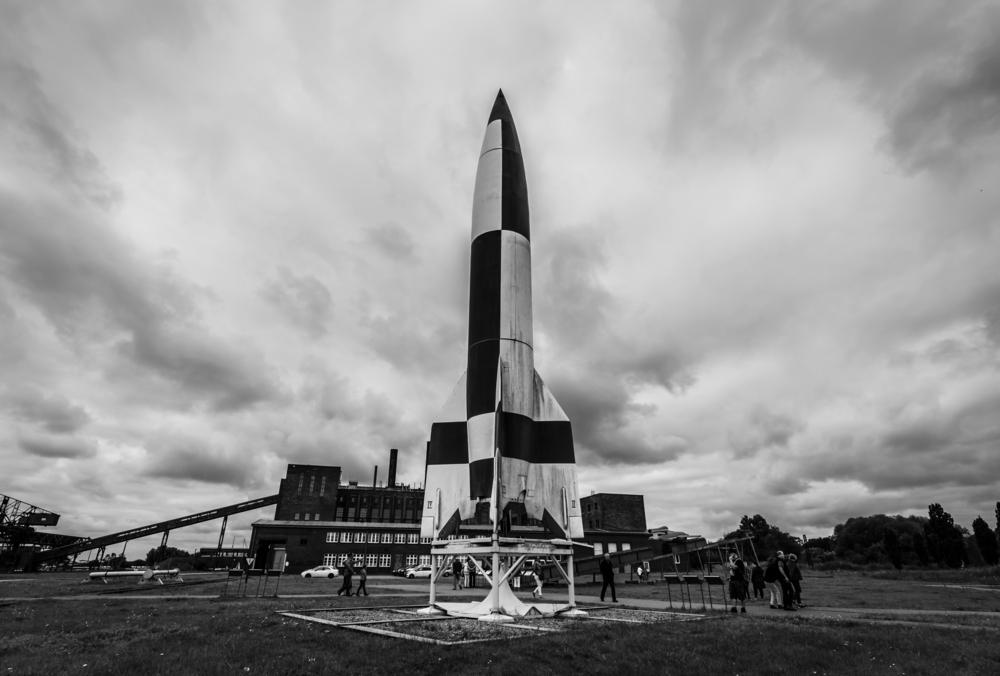
1) V-2: The First Missile Birthed Today’s Guidance Systems
The German V-2 was the world’s first ballistic missile. The V-2 had its first successful test flight in 1942, and Germany launched 3,000 of these missiles during World War II.
As Germany’s most capable missile, the V-2 could send one ton of explosives more than 150 miles downrange in just five minutes. During flight, the V-2 was guided by internal gyroscopes that measured its acceleration as it ascended. Since it relied on internal measurements, the V-2’s guidance system could not be jammed.
Radio signals from the ground could also guide the missile. However, once its alcohol-and-liquid-oxygen-powered engine lost thrust after about a minute, it would fall, making a plummeting V-2 indetectable.
These missiles demonstrated unprecedented wartime bombing capability and made a long-lasting, global impact. After the war, captured V-2s informed U.S. and Soviet missile designs. Additionally, its guidance system is the ancestor of missile guidance systems in use today.
2) R-7 Semyorka: Igniting the Space Race
In 1957, the R-7, or the Semyorka, was officially launched for testing. The intercontinental ballistic missile (ICBM) had greater weight-lifting capabilities than its predecessors.
The world’s first satellite, Sputnik 1, was launched aboard the Soviet R-7, which was capable of launching nuclear warheads at American targets or payloads into space.
In April 1961, the Soviets scored another Space Age victory when an R-7 variant, Vostok, delivered the first manned craft. Other modified versions have sent numerous surveillance and communications satellites into space, and the R-7 family of launch vehicles is responsible for more extraterrestrial forays than all other space launch vehicles combined.
Its current evolutions are in use today, as the R-7 line also birthed the Soyuz lineage of spacecraft.
3) Hellfire R9X: A "Flying Knife” Limits Collateral Damage
The Hellfire missile system is an air-to-ground option designed to defeat individual targets — specifically heavily armored vehicles like tanks — while decreasing exposure to enemy weapons.
Hellfire precision-guided missiles are used worldwide, and multiple nations have purchased more than 100,000. They are versatile, can be launched from various aerial platforms and drones, and are also prized for their ability to engage targets while limiting collateral damage.
The Hellfire R9X further limits collateral damage by removing explosives altogether. The missile utilizes six blades instead of a warhead to open targets and perform precise strikes while avoiding civilian harm.
4) Tomahawk Land Attack Missile (TLAM): Demonstrating Ever-Advancing Capabilities
The Tomahawk is an all-weather, long-range, low-altitude subsonic missile used by the U.S. Navy and the United Kingdom’s Royal Navy. It’s launched from ships and submarines to penetrate heavily defended airspace at over 500 mph, and strike targets more than 1,000 miles away.
First used in Operation Desert Storm in 1991, its popularization is due to its low-altitude flight capabilities that avoid enemy radar detection. The current Block IV Tomahawk configuration entered into service in 2004. More recently, Raytheon delivered the Block V variant in 2021.
The latest generations feature improved capabilities, including better navigation and communication technologies, the ability to "loiter for hours” before changing course in flight, and an increased lifespan. Intelligence, surveillance, and reconnaissance (ISR) abilities offer an additional tactical edge.
These weapons are also comprehensively battle-tested. The United States and allied military forces have used GPS-guided Tomahawks on more than 2,300 combat occasions.
Raytheon and other companies have recertified and upgraded the Tomahawk IV inventory into Block V variants. In 2022, Raytheon was awarded a $217 million Navy contract to supply 70 Block V missiles for the Navy, 54 for the Marine Corps, and 30 for the Army.
The upgraded Tomahawk is part of the Navy’s next-gen Distributed Maritime Operations (DMO), a strategy of networking ships, aircraft, and drones to increase the military’s “operational envelope.”
5) LGM-30G Minuteman III ICBM: A Military Marvel 50 Years Later
The still-operational third generation of Minuteman missiles was first deployed in 1970, and production ceased in 1978. The United States currently holds an inventory of around 400 of these missiles, with the arsenal split between missile fields in Wyoming, Montana, and North Dakota.
It was the first American missile fitted with MIRVs or nuclear warheads that could be independently controlled after detaching from the missile. However, in response to arms control conventions, Minuteman III missiles now only carry a single nuclear warhead.
These missiles offered a revolutionary advancement compared to previous-generation ICBMs by adding a "quick-reacting, inertially guided, highly survivable component to America’s strategic deterrent program.” They weigh nearly 80,000 pounds but achieve intercontinental ranges of greater than 6,000 miles. Three solid-propellant rocket motors power the missiles to Mach 23, or approximately 15,000 mph.
The Minuteman, the only land-based facet of America’s nuclear triad, was upgraded between 2002 and 2007, which cost around $7 billion. It has served the nation for more than 50 years and will remain in use through the 2030s.
The Future of Missiles
Throughout history, missiles have been used on land and in space. With continued advancements and upgrades, missile capability will only go up from here.