Image Credit:Boom Supersonic
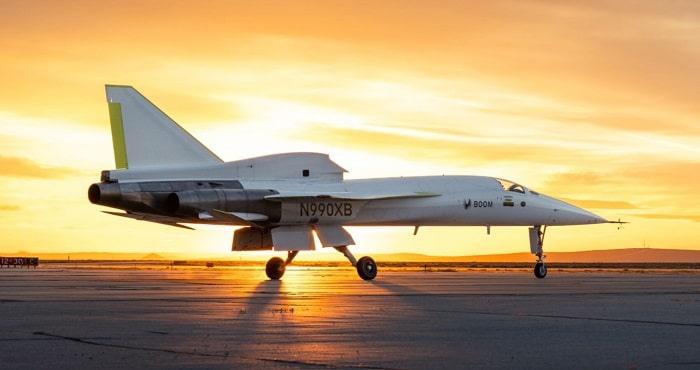
On April 16, 2024, Americansupersonic airliner Boomannounced that the Federal Aviation Administration (FAA) provided an unprecedented Special Flight Authorization (SFA) for the XB-1 — an airplane that can fly faster than the speed of sound —to perform test flightsat extremely high speeds.
The aircraft has already successfully demonstrated its ability to take off, maneuver, and land safely. During testing, it reached an altitude of 7,120 feet and speeds of up to 238 knots (273 mph). When the time comes for the XB-1 to take its first supersonic flight, it will be piloted by Test Pilot Tristan Brandenberg.
The Boom Supersonic XB-1 Airplane
Over 20 years since we said goodbye toConcorde, Boom designed its groundbreaking XB-1 supersonic jet, also known as the "Baby Boom”. With its sleek and aerodynamic design, this plane was expertly built for high-speed flight.
The XB-1 is constructed from advanced materials such as strong yet lightweight carbon composites that can withstand the pressures of high speeds. Inside the cockpit, you’ll find state-of-the-art avionics and control systems to ensure precise handling and safety during flight.
Test Flights
After experiencing significant delays to its initial set test flight date (due in 2022), the XB-1 was finally tested on March 22 of this year at the Mojave Air & Space Port in California, and piloted by Boom’s Chief Test Pilot, Bill Shoemaker.
These initial test flights, which the SFA includes specific routes and areas in California for, are designed to test the capabilities and safety of the XB-1, and there will be many of them before pilots attempt to fly the plane faster than the speed of sound.
Mach 2.2 Capability
The Boom XB-1 plane features a familiar delta wing configuration and is powered by three General Electric J85-15 engines, each providing 4,300 pounds-force of thrust that allow it to break through the sound barrier, achieving speeds faster than Mach 1. In fact, it is designed to maintain Mach 2.2, which is exceptionally fast, with a range of over 1,000 nautical miles.
To put this into perspective, an average flight from New York to London takes around 7–8 hours on a Boeing. Concorde, at Mach 1, managed to do it in around 3.5 hours. At Mach 2.2, the Boom XB-1 could potentially do it in just 1.5 to 2 hours. While this may be a little ambitious with several obstacles to overcome before reaching that stage (i.e., g-force, noise level, aerodynamic heating), supersonic test flights for the XB-1 will start with speeds of Mach 1.1, 1.2, and 1.3.
Boom’s XB-1 Supersonic Aircraft—Summary
With its innovative design and cutting-edge technology, the Boom XB-1 represents a significant step forward in the development of supersonic technology and the revival of supersonic air travel since the Concorde’s retirement in 2003.
Test flights have allowed the test pilots and engineers to gather valuable data on the aircraft’s systems and behavior, ensuring that it meets safety and performance standards as it strives to achieve supersonic speeds, and pave the way for the development of faster commercial airplanes.