
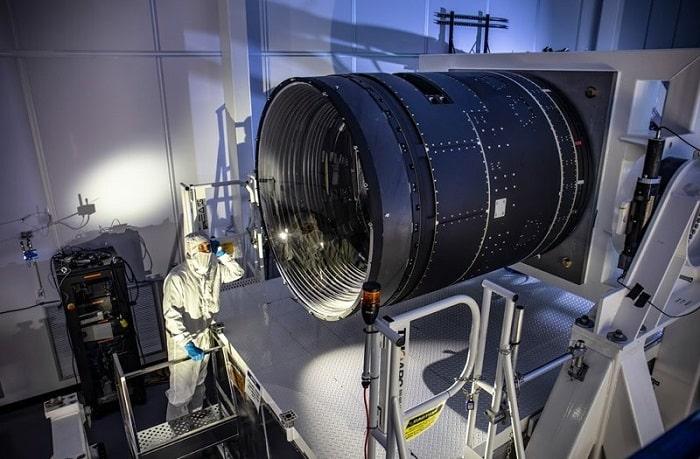
On April 3, 2024, the U.S. Department of Energy (DOE) released news of a new digital camera, the Legacy Survey of Space and Time (LSST) Camera, that will take pictures every 20 seconds for ten years. At 6,200 pounds, the camera is around the size of a small car and is the largest astronomy camera ever built.
The Legacy Survey of Space and Time (LSST) Camera
The process of creating the LSST, from design to construction, was backed by the DOE’s Office of Science and took over 20 years. In addition to taking these no-doubt beautiful images, the LSST will provide insights into the universe, in particular, dark energy and dark matter—something that scientists still don’t have a good grasp on.
With the LSST, scientists will be able to take a deeper dive into how the solar system was formed and gain more insights into the Milky Way’s stars. In fact, they’ll be privy to billions of galaxies and over 37 billion astronomical objects inspace.
The Record-Breaking LSST Camera
Earning a spot in the Guinness Book of Records, the LSST, in addition to being the largest astronomy camera ever constructed with its 5’5″ diameter, also has the highest resolution of any astronomy camera. With 3,200 megapixels (over 150 times more than the average photography camera), the LSST could, according to the DOE, take a clear picture of a golf ball located 15 miles away.
The camera will take images every 20 seconds with its three huge lenses—the largest of which is over five feet tall. It also features six filters that can be swapped out in under two minutes and will give scientists better insights and data into different types of light. For the best view of the Southern Sky (the southern celestial hemisphere), the camera is located in theVera C. Rubin Observatoryon top of the Chilean mountain, Cerro Pachón—over 8,900 feet from sea level.
Dark Matter and Dark Energy
Dark energy is what scientists have dubbed the enigmatic force causing the universe’s expansion. The LSST will help them understand more about this process by looking at how it has already expanded till now.
Dark matter and dark energy make up 95% of the universe’s mass-energy, and yet scientists have still not managed to figure out what these things are exactly. Dark matter has yet to even be detected. Scientists are hopeful that all this will change with the help of the groundbreaking LSST.
LSST Collaborative Effort
The creation of the LSST was a collaborative effort between the DOE’sSLAC National Accelerator Laboratory, theBrookhaven National Laboratory, theLawrence Livermore National Laboratory, and France’s National Institute of Nuclear and Particle Physics at theNational Center for Scientific Research. The DOE led operations at the Rubin Observatory.
The Rubin Observatory is funded by both the DOE’s Office of Science and the National Science Foundation, but early funding for construction was provided by private donors through theLSST Discovery Alliance. The LSST’s construction and use will be instrumental in furthering research abilities and gaining invaluable insights into the universe.
Image credit:Jacqueline Ramseyer Orrell/SLAC National Accelerator Laboratory/DOE