In 2019, we introduced Thomas readers to Arris Composites — a global manufacturing leader that is reinventing the manufacturing process by creating lighter, stronger, and more sustainable products. Since then, the company has continued to tally up its index of accolades, and even made it on Fast Company’s list of the Top 10 Most Innovative Manufacturing Companies in 2021.
According to founder Ethan Escowitz, Arris Composites started in a Berkley, California, garage with a goal to revolutionize carbon fiber for industrial use in automotive, aerospace, and consumer products industries. The company aims to “advance humanity by creating the highest performance products for everyone.”
In 2020, the company introduced its Additive Molding™ technology, which combines 3D printing and molding techniques to cut the cost of carbon fiber products and make parts that are lighter than metal and just as strong.
Research Collaboration with Airbus
The company’s contributions to sustainable manufacturing landed it a major research collaboration with aerospace giant Airbus, announced in October of 2021. The goal of the project is to replace metal cabin brackets with a lighter, 3D-aligned continuous fiber composite part to reduce aviation emissions.
According to Arris’ announcement, “100 aircraft manufactured in a year with 500 brackets each add up to 50,000 lighter weight brackets that contribute to a lifetime fuel savings of 113 million metric tons and a reduction of 357 million metric tons in CO2 emissions.”
Series C Funding
To support the global demand for the company’s patented automated manufacturing technology, Arris announced last November that it had raised $88.5 million in Series C funding. The funding is set to further scale global operations that are transforming how next-generation products are made. To date, Arris has raised $147 million with support from investors.
Reimagining Drone Design
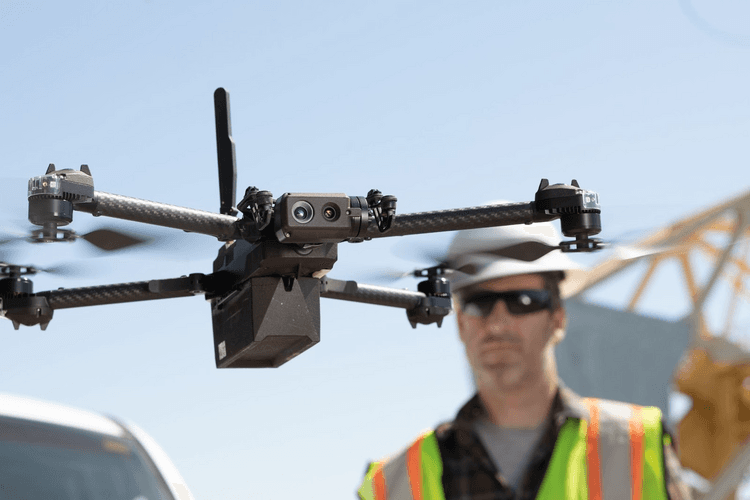
Utilizing its Additive Molding™ technology, Arris and Skydio, an autonomous flight technology leader, designed a compact, longer-range, and more advanced airframe design used in the Skydio X2 drone for enterprise, public sectors, and defense.
The groundbreaking technology is the first to be used in the unmanned aerial vehicle industry, and offers a number of advantages such as the strength of titanium at a lighter weight, component consolidation to one multi-functional structure, and scalable use in the aerospace sector. As part of the Department of Defense’s Blue sUAS program, the Skydio X2 is utilized for asset inspection and patrol use.
“The evolution of aerospace design has been punctuated by breakthroughs in manufacturing and materials,” said Escowitz. “Such a moment has come where manufacturing of optimized structures has converged with composite materials ideals to unlock previously impossible, high-performance aerospace designs.”