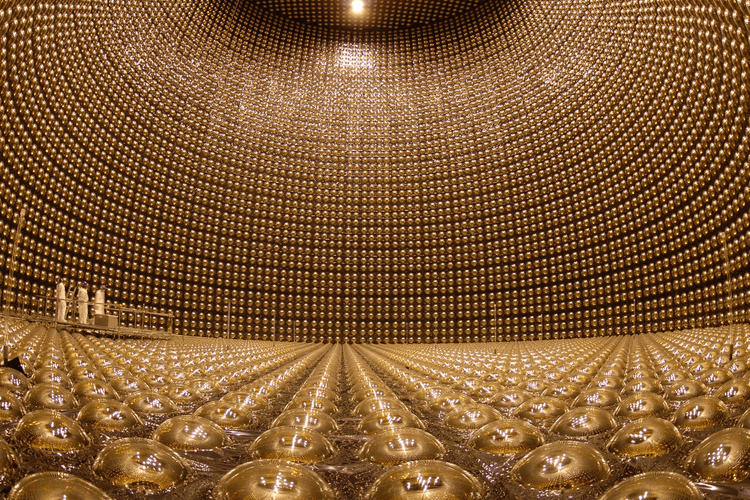
Using a cavern buried 1,000 meters under a mountain, 50,000 tons of ultra-pure water, and 11,000 light detectors, Japanese scientists have created an early-warning system to alert astronomers when a supernova is about to happen.
Even in a galaxy that’s home to hundreds of billions of stars, a supernova is a surprisingly rare event. Astronomers estimate that a star within reach of Earth’s sensors will collapse into itself and turn into a black hole only once every 30 years or so, providing a once-in-a-career opportunity to study this phenomenon. With Japan’s Super Kamiokande neutrino detector, experts will have an increased chance of observing the event taking place.
The “Super-K” works by sensing the neutrinos, or sub-atomic particles shot out by stars before they begin to collapse. Neutrinos have the incredible property of being able to pass through any solid matter, which is why the detector is buried so deep under Mount Ikeno that only neutrinos can reach it.
The 15-story high detector comprises an enormous tank with 50,000 tons of water that is so ultra-pure that it can dissolve metal. When neutrinos enter the tank they move faster than the speed of light in water and produce a shockwave of light much like a Concord produces a sonic boom. These shockwaves are picked up by 11,000 extremely sensitive light detectors called photomultiplier tubes.
While sensing neutrinos from collapsing stars is the Super-K’s main purpose, it is also being used to study the way neutrinos oscillate as they pass through matter – but they don’t have to wait for a star to collapse in order to do so. Scientists about 180 miles away on the other coast of Japan fire an enormous neutrino beam through the earth (1,700 meters below sea level) towards Mount Ikeno, where it is picked up by the Super-K’s shockwave detectors, allowing experts to study the relationship between matter and anti-matter and provide insights into the origin of the universe.