If all goes well with the 2020 Perseverance rover mission, NASA will have a helicopter on Mars by mid-February 2021.
Carrying no instruments and collecting no data, the box-like Mars Helicopter is intended solely to be a technology demonstration to test the first powered flight in the Martian atmosphere.
But engineers at the University of Pennsylvania have suggested an entirely different approach for exploring and analyzing Mars from the air, known as "nanocardboard” flyers.
“The Mars Helicopter is very exciting, but it’s still a single, complicated machine,” said Penn Engineering’s lead researcher Igor Bargatin. “If anything goes wrong, your experiment is over, since there’s no way of fixing it. We’re proposing an entirely different approach that doesn’t put all of your eggs in one basket.”
What are Nanocardboard flyers and How Do They Fly?
Nanocardboard flyers are not actually made of cardboard. And with no moving parts, they can’t actually fly. Instead, they levitate.
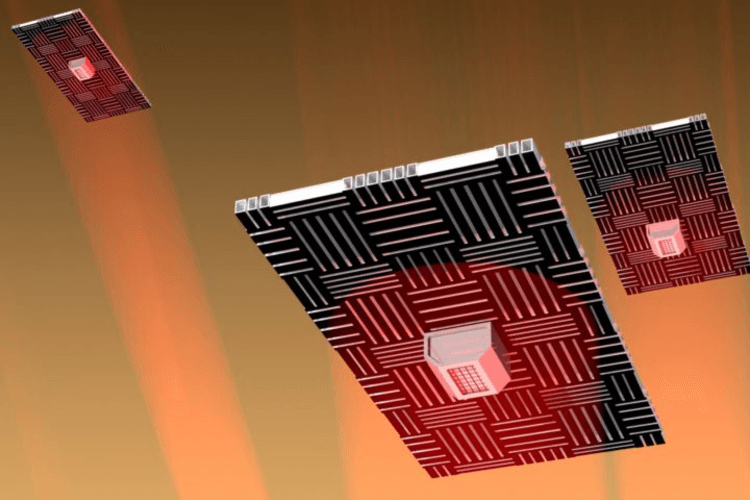
Inspired by the corrugated (sandwich) structure of cardboard and only a few nanometers thick, the flyers consist of a hollow plate made from aluminum oxide and spanned by channels to create the corrugated effect.
This corrugation is responsible for the material’s record-setting ratio of weight and stiffness and prevents cracks and breakage. The tiny flyers weigh about a third of a milligram, which means it would take over a million of them to weigh as much as the Mars Helicopter.
The channels enable the plates to levitate when heat is applied to one side, causing air to circulate through their hollow structure and provide thrust. This phenomenon, known as “thermal creep,” harnesses the power of temperature differentials between the upper and lower sides of the flyer.
It’s a bit like dust floating in sunbeams, but the flyers can be powered and steered with a beam of light or pinpoint laser heating different parts of the plate to alter their direction.
Bargatin suggests that vehicles on Mars such as the Perseverance rover could carry a fleet of flyers, launch them when needed, and steer them by laser. This could be a particularly valuable capability as rover operators are very careful to avoid sending the rover into potential hazards (such as a ditch) that it will not be able to extricate itself from.
What Sort of Payloads Could They Carry?
Nanocardboard flyers would be limited to sensors and payloads that weigh only a few milligrams. The Pennsylvania team’s next mission is to miniaturize chemical sensors to the point where they could be carried by the flyers and used for tasks such as detecting methane or water on the surface.
The flyers could also land and have sand particles or grains of dust passively stick to them for transport back to the rover for study.
The thin atmosphere on Mars means flyers can travel over much longer distances than they would be able to on Earth and carry payloads ten times heavier than they are.
To date, researchers have successfully lifted silicone rings using the flyers in a low-pressure test chamber to simulate lifting mock payloads in the Martian atmosphere.
Other Applications
Nanocardboard flyers may be used as atmospheric probes on other planets such as Pluto, or Neptune’s moon Triton.
On Earth, the flyers could be deployed in the mesosphere to study the movement of the atmosphere and provide valuable data on climate and weather.
Researchers originally envisaged the flyers being used for search and rescue operations, where they could dart in and out of tiny holes in the rubble to help locate trapped people. Equipped with a camera, the flyers could also be used for applications such as inspecting a jet engine without having to take it apart.