Farming has sustained the world for at least 10,000 years. So any advance that boosts farming productivity is indispensable, especially with recent resource shortages, growing global hunger, worsening climate conditions, and supply chain disruptions.
Soil sensors are one solution that has proven its merit on smaller scales and could become invaluable for agricultural purposes. Below, we’ll explore why, including the benefits, use cases, and future of this emerging technology.
What Are Soil Sensors?
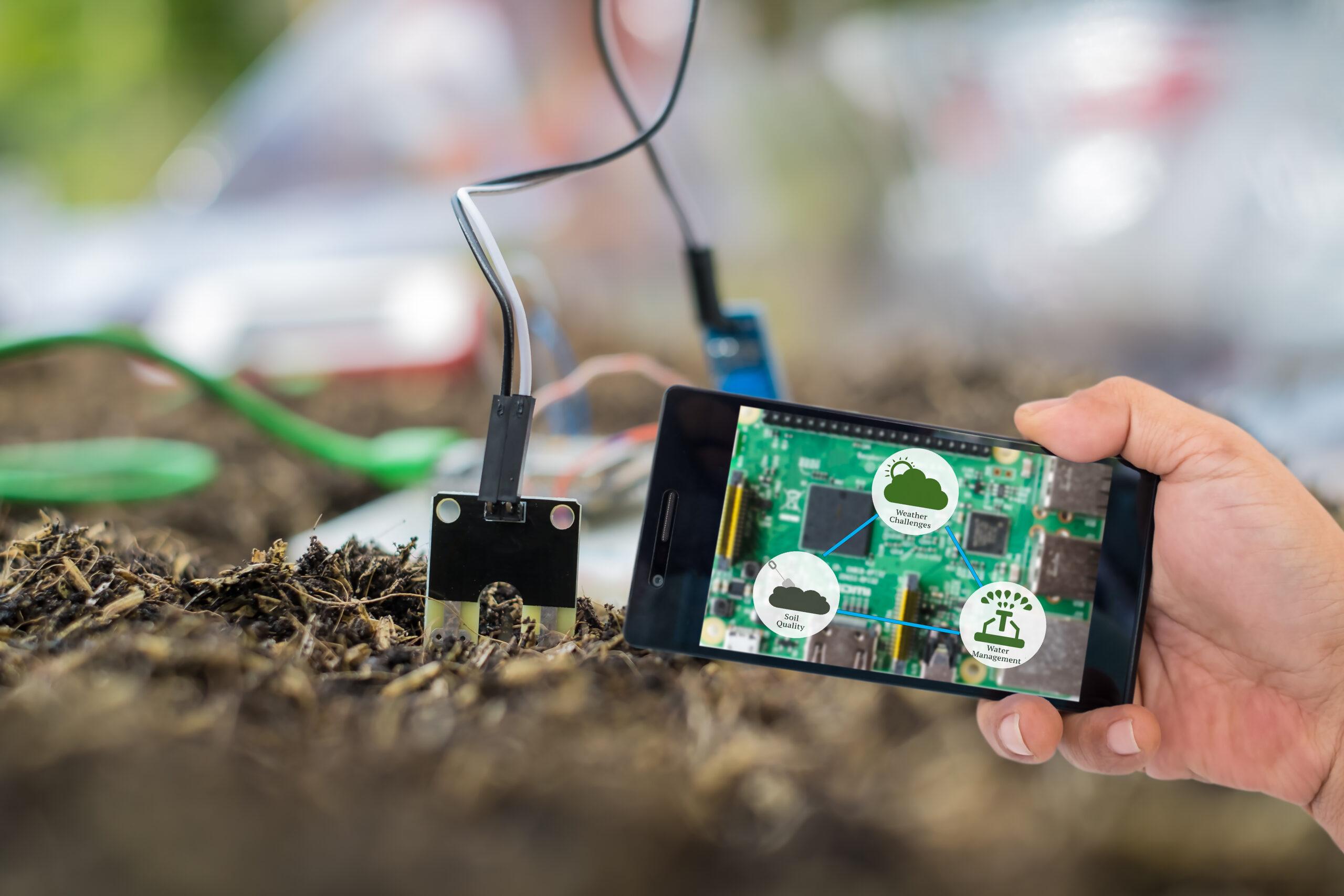
Sensors track soil conditions, enabling real-time data collection and analysis. Sensors can track almost any soil characteristic, like the DNA of resident microorganisms, to shift the balance toward a healthier soil microbiome, increased yield, and reduced resource use.
The various types of sensors in agriculture use diverse methods, such as electrical signals and measuring the reflection of light waves, to ascertain the essential field characteristics that can transform farming operations.
Types of Soil Sensors
Soil sensors can measure soil characteristics such as moisture content, temperature, pH, salinity, humidity, photosynthetic radiation, and nutrient balance—chiefly the vital nitrogen, phosphorus, and potassium (NPK).
In addition to their crop management benefits, such as better grain quality and reduced nutrient leaching, soil sensors can inform forecasts around water resources, land stability, and climate change .
Other use cases include irrigation scheduling, watershed assessments, microbial ecology profiling, and plant disease prevention.
Some specific sensor types include:
A vacuum gauge ascertains soil tension , a measure of how much effort it takes plants to pull water from the surrounding soil.
A gypsum block or other special matrix houses a sensing element that detects soil tension via electrical conductivity.
The most accurate , expensive, and complicated sensor. It emits high-energy neutrons in all directions to measure their delay after colliding with water molecules in the soil.
Water content is measured according to the soil’s capacity to store electrical energy.
Parallel rods act as transmission lines , timing a voltage pulse as it reflects back to the sensor. As with electromagnetic sensors and neutron probes, TDR devices are volumetric water content sensors, monitoring the volume of liquid water based on the volume of soil.
Stationary sensors are left in the ground for long-term monitoring, but a portable soil moisture sensor gives on-the-go moisture content readings.
IoT Integration in Soil Monitoring
Internet of things connected devices can collect, collate, and analyze immense tracts of data, keeping it organized and accessible for growers, landscapers, or anyone seeking a greener thumb.
Machine learning and AI integration sift results and evaluate previous predictions to provide insights such as crop recommendations , based on observed patterns in conditions, production, and resource partitioning.
The constant input of information progressively builds an extensive database that can recommend best practices based on distinct soil types or challenging conditions.
Benefits of Using Soil Sensors
Tracking soil status provides many benefits for farmers and gardeners, including increased crop yield and enhanced resource efficiency. IoT, cloud services, and AI integration allow growers to make data-driven decisions.
Sensors optimize fertilizer use, keep plants healthy, maximize resources, and minimize the runoff and off-gassing that attack the environment. Constant monitoring also prevents problems, such as pathogen outbreaks or soil compaction.
Monitoring the soil condition using soil sensors can also optimize fertilizer and water use. It’s estimated that approximately 30% of the nitrate fertilizer applied in the US washes away and contaminates water sources. Even adept irrigation systems can reach up to 50% water wastage, and agriculture is responsible for 70% of global freshwater usage. The ability to efficiently and effectively replenish soil moisture could have a big impact.
Installing and Calibrating Soil Sensors
Each sensor will have its own installation guide , but installation typically requires digging a hole or trench within a crop row and placing the sensors at multiple depths, including near the plant roots.
Over a large area, best practices dictate placement at sites indicative of the rest of the field or soil type to be managed, near water emitters, and in direct contact with soil (i.e., no air pockets). Sensor sites should also be flagged or otherwise marked on the surface to avoid accidental damage.
In addition to proper installation, sensor calibration is key. Soil sensors register soil moisture data as Volumetric Water Content (VWC), and each type of soil has its own VWC. Soil moisture sensors often have different sensitivities, and may need to be calibrated individually.
Equipment failures may occur due to electrical problems, interference from wildlife, or misconnected wires. Any air leaking into a tensiometer will make it unreliable. Ensuring the correct installation depth and waterproofing methods can help avoid future issues.
Common troubleshooting techniques include:
Monitoring Soil Health
Soil sensors offer a more accurate, streamlined strategy for soil health assessment. Conventional soil assessments are the equivalent of a biopsy, which can take weeks or months, depending on soil properties.
Sensor measurements are far quicker, taking an hour or two per 50 acres . The sensors display everything necessary for efficient crop management, including water content, water tension, and the presence of organic matter—a great indicator of overall soil health—without the need to physically remove soil samples.
Integration with Farm Management Systems
According to a StartUS Insights report, soil sensors are the most impactful soil monitoring technology due to their scalability, efficiency, and utility. Combining soil sensors with other burgeoning farming technologies, including AI-powered soil mapping, aerial imaging, automated soil monitoring robots, emissions trackers, augmented reality soil analysis, nanotechnology, and blockchain integration, can optimize farm management.
Challenges and Solutions in Soil Sensor Technology
Based on a 2020 University of Nebraska report, only 12% of US farms use soil moisture sensors to determine irrigation schedules. Soil sensors have become more viable due to significant improvements in accessibility, user-friendliness, and data processing and display capabilities, but more progress is needed.
Soil sensors must become more cost-efficient and interoperable for global adoption. Many types of sensors exist, resulting in a lack of standardization and compatibility.
Many existing technologies rely on proprietary sensors, which can make customization difficult. Advancements in sensor technology, like those developed by UC Berkeley, simplify onboarding to provide live data monitoring and promote agile decision-making across fields and markets.
Case Studies: Successful Implementation of Soil Sensors
A Clemson University study found that soil moisture sensors can increase farmers’ average net income by 20% by increasing irrigation efficiency in tested fields that grew peanuts, soybeans, or cotton.
Installing six soil sensors at pear orchards in Italy led to water savings of up to 50%, according to soil sensor manufacturer Sentek. Similarly, one Italian strawberry grower saved more than $700 per hectare by installing a moisture probe that helped cut down on excess watering.
Sporting venues are also adopting soil sensors. Wembley Stadium and Citizens Bank Park (the home of the Philadelphia Phillies) are among the sporting venues using soil sensors to maintain lush playing surfaces while maximizing water and energy use, according to soil sensor maker Soil Scout.
Future Trends in Soil Sensor Technology
Emerging trends include nanotechnology , with gold-or-silver-based nano-particles that increase sensor sensitivity for detecting soil pollutants like heavy metals.
Sensors coated with nano-compounds could track soil characteristics and then release nutrients, such as oxygen, in response to fluctuating soil quality. Others calculate bioindicators, like earthworm counts, or microorganism diversity, through DNA analysis, to improve the soil microbiome.
The future of agriculture will rely on devices that can take even more precise measurements. Researchers at Penn State developed a sensor that can take nitrogen gas and temperature measurements independently, thanks to a membrane that blocks nitrogen gas from interfering with the temperature reading. These types of extremely accurate readings will optimize fertilizer use, yielding better crops and mitigating environmental damage.
Image credit: Montri Nipitvittaya/Shutterstock.com
Find Thomasnet.com® Services and Suppliers
Soil Moisture Meters
Soil Remediation Services
Irrigation Systems Suppliers
Agricultural Equipment Suppliers