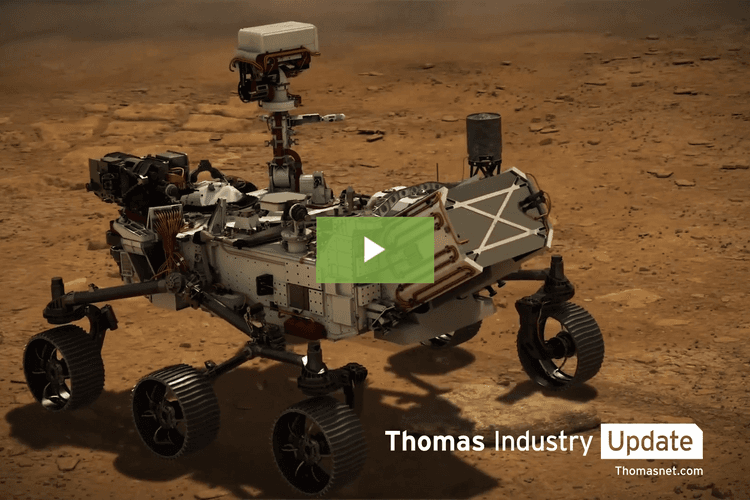
NASA’s next Mars sojourn is underway. As part of the Mars 2020 mission, the new Perseverance rover is headed to the Red Planet to look for signs of ancient life and collect rock and soil samples. The rover, which is about the size of a car, has some impressive tech onboard, including a custom force/torque sensor that is part of the subsystem created to harvest and catalog materials.
Based in Apex, North Carolina, the engineers at ATI Industrial Automation developed the force/torque sensor aboard Perseverance. The team at NASA’s Jet Propulsion Laboratories (JPL) needed an automated system to collect and handle the Martian samples and move them through an indexing process. ATI created the Adaptive Caching Assembly, an application that looks like a pick-and-place operation commonly found on a factory floor.
The Sample Caching Subsystem includes the Adaptive Caching Assembly, a robotic arm with a drill, and various drill bits used to collect samples from multiple locations.
This subsystem is similar to automated processes also found in the agricultural industry, where robots are used to make repetitive operations more precise. While ATI has previously developed sensors for harsh environments, including foundries and refineries, nothing compares to the conditions expected on Mars, where subzero surface temperatures and rugged terrain are typical. Oh, and it had to survive an Atlas 5 rocket launch, too.
After a sample is collected, a small robotic arm, known as the Sample Handling Assembly (SHA), inspects and seals each within the rover’s onboard laboratory.
ATI’s sensor integrated within the SHA end effector assembly to make it more responsive. With force-sensing from ATI, the SHA can maneuver the tight workspace and perform with acute accuracy.
ATI adapted its sensor tech with thermally stable, low-outgassing materials to offset the wide range of extreme environmental conditions. To make sure that the sensor was up to the task, the company also had to design specialized calibration equipment to conduct 24-hour surveillance of product trials.
After years of development, Perseverance successfully launched from Cape Canaveral, Florida, on July 30, 2020. The rover won’t reach the Martian surface until February 2021.
Beyond extraterrestrial applications, ATI’s Space-Rated Force/Torque sensor provides active force control for applications where repair opportunities are limited or in situations with a high vacuum or extreme temperature variability.








![The Rise of Industrial Robots Operating in the U.S. Just Broke a Record [Report]](https://machinerys.net/upload/cache/202507/the-rise-of-industrial-robots-operating-in-the-u-s-just-broke-a-record-report.webp)

![Digital Twins Give Visibility Over Entire Factory So You Can Work Virtually [Interview]](https://machinerys.net/upload/cache/202507/digital-twins-give-visibility-over-entire-factory-so-you-can-work-virtually-interview.webp)