![Digital Twins Give Visibility Over Entire Factory So You Can Work Virtually [Interview]](/upload/20250615/uo4q5pgujh5.png)
Work used to involve literally getting your hands dirty, physically assembling and testing new products. These days, though, we’re moving our work into the virtual world.
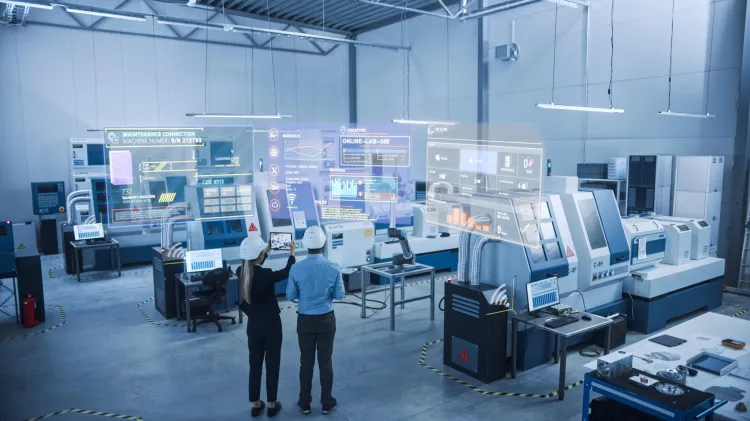
Digital twins is the concept of designing, testing, manufacturing, and supporting products virtually, and only once it’s reached its required functionality manufacturing it physically. Replacing atoms with bits, this 21st-century concept saves time, material, and costs.
Thomas Insights spoke with Dr. Michael Grieves, the founder of the digital twin model at the Florida Institute of Technology, to learn how this new approach is driving Manufacturing 4.0.
Acknowledging that Industry 4.0 is a nebulous term, Grieves explained that, “Industry 4.0 is about trying to decrease the amount of time from an adverse event to remediation of that.” The goal of digital twins, however, is to predict those failures before they even happen. “So the digital twin really is more advancement over Industry 4.0,” he says.
Digital Twins Improve the Supply Chain
This ability to predict failures before they happen is accomplished, in part, because digital twins allow us to tear down walls to information.
Dr. Grieves explains: “What’s happening is that we are moving from silos of information to a holistic perspective of the product itself. In manufacturing, the focus historically has been on the work cells and looking at them on an individual basis. But I really want to string them all together to look at the whole manufacturing process and be able to adjust.”
Dr. Grieves clarifies that it’s not just the siloing of information but the sequential aspect that can be detrimental to supply chains and that digital twins are rectifying this issue.
“In the past, one of the big problems is that the OEM would make a change to their design, and somebody three or four levels down the supply chain wouldn’t find out about it until months and months afterward. It would cause them big problems because they had been working on an older version of it for that period of time,” he explains. They would have to throw out all their work and create a new design, which is a waste not just of time and materials but is also the type of aggravation that can weaken business credibility and morale.
With the digital twins model, however, Dr. Grieves says, “Today, I can have people simultaneously and instantaneously looking at the same thing, and when I make a change, everybody sees it.”
Digital Twins Create Better Quality Control
Critically, digital twins allow for many “more variations” in testing to reduce the possibility of failure, according to Dr. Grieves. Even today, testing is sometimes done with a relatively small sample test size and is conducted manually. For example, someone in charge of quality control may physically shake a box and drop it to ensure that the products inside do not break or shift. With digital twins, because the testing is done in the virtual world, a greater number of types of tests can be run to see how it impacts the bulk.
Just as significant, with a digital twin now more key people, with varying skill sets and vantage points, can participate in the testing process.
A Back to the Future Moment for Factories
“When we built factories in the past, we built the supervisory area to overlook the factory floor so people could see it. That was good when we had smaller versions of factories where somebody could look at what was going on,” says Dr. Grieves. Just as warehouses are getting both bigger and smaller, so are factories.
“It’s really kind of a Back to the Future thing, where now we can create a replica of the factory — what I call factory replication — that allows me to see the actual factory as the digital twin,” he notes. “We now can have visibility over the entire factory, no matter where you are in the world, as long as you have the right authority to do that.”
More than that, he says, this factory replication can help “predict how that factory’s going to operate on the basis of what’s happening at every moment.” Thanks to the data coming from the factory floor, one is able to project into the future so when a different glitch than expected happens, one can adjust all the aspects of the factory before it comes to a complete standstill.
How Digital Twins Contributes to Sustainability
The digital twins model improves sustainability. “If I don’t make mistakes, then I’m going to have less waste by definition,” says Dr. Grieves.
Because product iterations and tests are performed digitally, there is less physical waste. This aids in becoming more eco-friendly.
He explains that this saves time and money: “In the past, if they had to rely on making a physical prototype to test out how they thought something was going to work, that could be days or even months and cost thousands, if not hundreds of thousands, of dollars.”
Furthermore, it frees up people resources. “People’s wasted time is a physical resource that information replaces,” said Dr. Grieves. Because there are fewer silos of information and better visibility in the sequence of the supply chain, workers have more opportunities to perform higher-level work.
Are Digital Twins Too Good to Be True?
“Now just to put a little reality to it,” Dr. Grieves warns, “you’ve got to have confidence that your information is going to be able to predict [properly].” As we know, one of the reasons for the failure of Boeing’s Starliner space capsule was misinformation provided from its Mission Elapsed Timer (MET); Also, though it was corrected prior to the initiation of the sequence, its Service Module Disposal Sequence was not properly coded. While that engineering fiasco played out in real-time, it’s a sobering reminder of the importance of correct information provided and utilized.
He says, “Today, they can take their idea, put it into the digital twin, and then run the digital twin through its paces to see if it actually is going to do what they think it’s going to do. So, you still have to have the knowledge of how the functionality is going to work and what cause and effect is.”
This also goes back to testing. Dr. Grieves explains: “A lot of times what has happened in the past with engineering [is that] because of cost and time constraints is you test for the usual suspects that are going to cause you problems. And my contention is always it’s the unusual suspects that bite you.” However, with digital twins, “if I let the computer go to work and start to run through multiple iterations, I’m going to be able to test more things than I’ve tested in the past, by far.”
Digital Twin Summit 2020
Dr. Grieves collaborated in the creation of the virtual ASME conference Digital Twin Summit, where cross-industry experts will share their first-hand knowledge of virtual work. The conference is for those seeking virtual ways to design and manufacture products, progress the performance and reliability of warehouse machinery, confirm processes, regulate quality control, and develop service-based engineering solutions.
Event highlights include a talk on Digital Twins Across the Engineering Lifecycle, presentations that provide a glimpse into the Digital Twins of Tomorrow, and digital networking opportunities. The Digital Twin Summit will take place virtually on November 11–12, 2020.
ASME is a non-profit organization whose mission is to be an educational resource and means for progressing engineering and manufacturing. It has more than 100,000 members throughout the world.







![Making Advanced Manufacturing Technology Approachable with Jason Ray [New Podcast]](https://machinerys.net/upload/cache/202506/making-advanced-manufacturing-technology-approachable-with-jason-ray-new-podcast.webp)