Business adoption of artificial intelligence (AI) has more than doubled in the past five years. Last year, the global AI market was worth approximately $89.9 billion, and it’s expected to grow to $407 billion by 2027.
From healthcare and manufacturing, to financial services and transportation, here are seven industries undergoing an AI-powered transformation.
1. Healthcare
The latest projections from McKinsey and Harvard researchers suggest that AI could save the United States up to $360 billion every year if adopted more widely in healthcare. That’s not surprising when you consider its endless applications.
AI is helping doctors to detect and diagnose diseases, develop personalized treatment plans, and remotely treat patients. Applications like Lucid Lane and Babylon Health, for example, leverage AI to monitor and serve patients on a 24/7 basis.
Tools can be used to analyze medical images, automate time-consuming administrative tasks, and provide better healthcare to people in remote or disadvantaged areas. AI robots are enabling surgeons to perform operations with military precision, which can reduce the invasiveness of surgery.
AI-powered drug discovery platforms are capable of analyzing vast swathes of biological and chemical data to quickly identify high-potential drug candidates, predict their effectiveness and safety, and optimize their design. Already in development are drugs that treat conditions such as glioblastoma, ulcerative colitis, and some cancers.
As a result of these technologies, medicines are cheaper and faster to develop, patients receive a higher standard of care and enjoy better health outcomes, medical professionals are better supported, and healthcare facilities run more efficiently.
Get More Insights on Artificial Intelligence in Healthcare
- 6 Medical Robots Making a Difference in Healthcare
- Companies Design Medicine Using AI
2. Construction
AI is serving to drive operational efficiencies, reduce production costs, improve working conditions, meet complex customer demands, and enhance quality.
In construction, AI platforms are revolutionizing project scheduling by providing multiple options for time, materials, and project cost. Image recognition systems can monitor, and proactively address, unsafe behavior on the worksite and AI-powered sensors can identify critical construction risks by using monitors that detect high temperatures, smoke, and other potential hazards.
Get More Insights on Artificial Intelligence in Construction
- How AI Could Build a Stronger Construction Industry
- 5 Ways Robots Are Assisting Construction Workers
3. Manufacturing
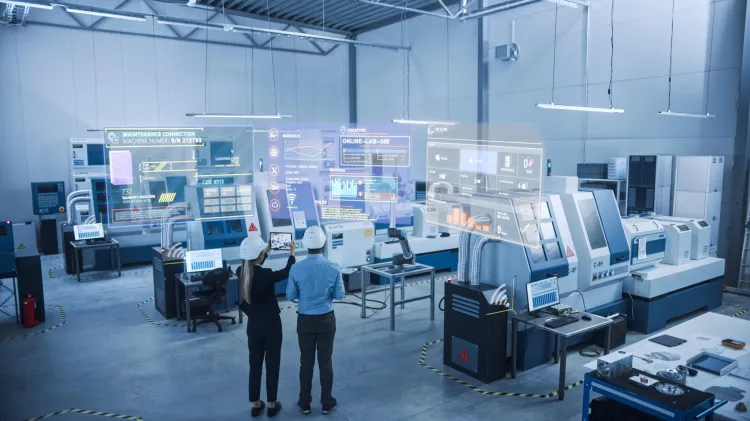
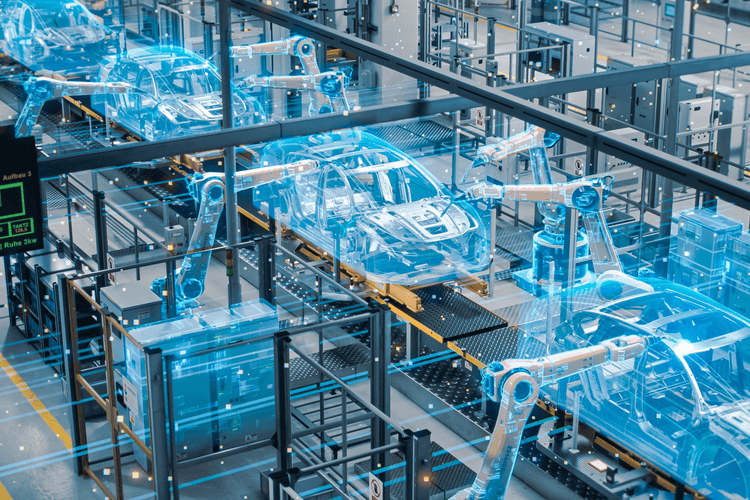
On the factory floor, AI can analyze sensor data to predict breakdowns and accidents, assess various scenarios to improve last-mile deliveries, and automate the most repetitive tasks.
AI-powered collaborative robots (cobots) take on numerous responsibilities, be it packing, welding, material handling, palletizing, labeling, inspecting product quality, or assembling. This supports increasingly popular manufacturing processes, like mass customization and modular cell production.
AI is also being used to help industrial businesses provide better customer service. For example, our digital manufacturing marketplace, Xometry, leverages AI to power our Xometry Instant Quoting Engine®. This enables buyers to acquire design for manufacturability (DFM) feedback, lead times, and pricing in a matter of clicks, and easily choose the optimal price and lead time option for a project.
Get More Insights on Artificial Intelligence in Manufacturing
- 3 Ways Textile Manufacturers are Seamlessly Integrating AI into Production
- Warehouse Robotics Market Expected to Grow to $51 Billion in Sales by 2030
- How Automation Can Help Manufacturers Eliminate 5,000 Hours of Downtime
4. Retail and E-Commerce
By 2030, AI-powered e-commerce solutions will be worth $16.8 billion. Today, as many as 78% of brands say they have implemented AI tools in their online stores or plan to do it in the near future.
Advanced algorithms, for example, are being used to predict what might be of interest to individual consumers based on their demographic, social media activity, and purchase history. This data can be used to enhance the shopping experience both online and in-store, be it via personalized web pages or one-of-a-kind discount codes.
Retailers are also achieving better demand forecasting by mining data from both their customers and competitors and predicting industry trends. This can be used to inform product development, supply chain strategy, marketing campaigns, and merchandising.
AI-powered chatbots are another valuable asset to retailers, providing consistent and effective customer service that drives engagement and loyalty. These chatbots can provide guidance on products and services, answer common questions, process orders and returns, and respond to complaints.
Get More Insights on Artificial Intelligence in Retail and E-Commerce
- H&M, Zara, Fast Fashion Turn to Artificial Intelligence to Transform the Supply Chain
- Selling the Future: 3 Key Ways AI Brings Potential Billions to Modern Retail
5. Human Resources
According to IBM, 66% of CEOs believe artificial intelligence can stimulate significant value in human resources (HR) and 50% of HR executives understand that AI has the capacity to transform the function’s key dimensions.
There are resume-screening tools that drive efficiencies and eliminate unconscious bias during the recruitment process and predictive analytics tools that calculate the likelihood of a job candidate accepting an offer, how they will perform in that role, and their expected tenure.
AI-powered skills assessments help to match the right people, to the right job, at the right time, be it prospective hires or existing employees. This improves retention and productivity in the workplace, drives internal mobility, and informs succession planning.
Skills mapping tools, meanwhile, help organizations identify existing and future skills gaps so they can develop learning and development programs to upskill their employees.
Recruitment chatbots can be used to improve and accelerate the recruitment and onboarding process. These tools can assume the most time-consuming tasks, be it scheduling interviews, conducting interviews, answering candidate questions, sending follow-up messages, or providing key information and training to new starters.
As a result of these technologies, HR professionals can focus on more value-adding activities, systems are more efficient, and the workforce is happier and more productive thanks to more meaningful career opportunities.
Get More Insights on Artificial Intelligence in Human Resources
- AI, AI, AI! The Tech Is Everywhere — But Why Is It Evolving So Fast? [Thoughts After Dark]
- Land Your Dream Job in the Industrial Sector with These 4 Simple Steps
- Recruitment AI Bots Are Reading Your Social Media Posts
6. Finance Services
By the end of 2023, AI applications could offer banks cost savings of a massive $447 billion.
For starters, tech-savvy consumers expect a completely digitized and highly secure banking experience, and financial institutions (FIs) that fail to provide this run the risk of losing customers. There are chatbots that ensure customers have round-the-clock access to their accounts and financial advisory services, and tools are designed to prevent fraud and cyberattacks.
AI solutions can also assume the most repetitive and time-consuming banking tasks, be it credit scoring, data capture, invoice validation and processing, and issuing payments. The automation of middle-office finance tasks alone could save North American banks $70 billion by 2025.
Meanwhile, in corporate finance, AI tools are being used to predict and assess loan risks, carry out algorithmic trading, and reduce financial crime through advanced fraud detection.
Get More Insights on Artificial Intelligence in Financial Services
- What Does the Future Hold for AI in Fintech?
- How Smartphones May Someday Identify You by Your Grip
7. Transportation
The global market size for AI in transportation is expected to reach $3.8 billion by 2026.
Applications of AI in this sector are both varied and highly impactful. For example, supply chain professionals are leveraging AI-powered solutions for route optimization purposes, which can reduce shipping and logistics costs and improve efficiencies throughout the supply chain.
Then there are AI traffic management systems, which have become increasingly popular within smart cities as a way to reduce traffic congestion or highlight dangerous points along a given route. These systems can predict and prevent crashes based on historical crash data, weather conditions, and other external factors.
In the coming years, we’ll also see the rise of self-driving cars, trucks, buses, and airport taxis. Autonomous vehicles promise ultimate convenience to drivers, a drop in harmful greenhouse gas emissions, reduced congestion on the roads, and the close-to elimination of irresponsible and dangerous driving.
Get More Insights on Artificial Intelligence in Transportation
- How Artificial Intelligence Is Powering Up the Growing $220 Billion Freight Forwarding Market
- Overcome Supply Chain Challenges with Artificial Intelligence