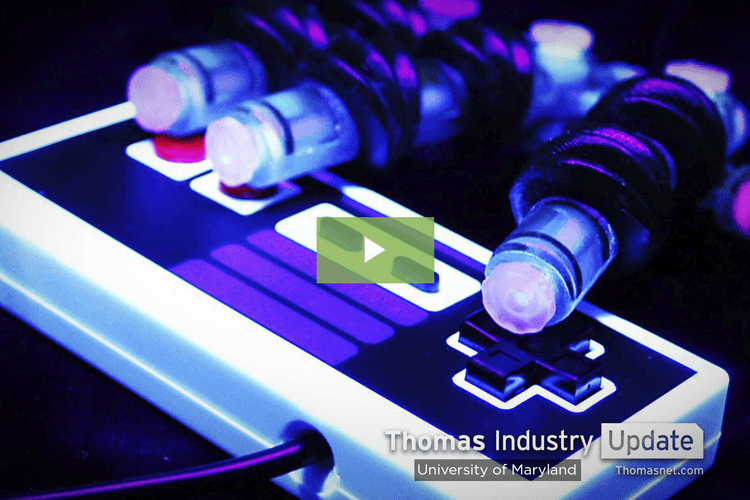
Researchers at the University of Maryland recently 3D printed a soft robotic hand that could play Nintendo, specifically the original Super Mario Bros. initially released in 1985. But the team didn’t want the hand to simply play the game but beat the first level.
Powered by air and water, soft robots are made of soft, flexible materials and can be more agile and safer than traditional robots. They can also unlock new movements previously unattainable by their electrified counterparts.
Precise control over soft robots has been particularly challenging, so controlling the simple controller on the original 8-bit system proved to be an ideal example with real consequences — Mario dies.
To make it happen, the team 3D printed the three-fingered hand with fluidic transistors that only actuate under a certain pressure. So, the hand can be controlled by a single pressure input and not three separate lines. For example, the low pressure activates the first finger to press the D-pad on the controller to make Mario walk. A medium pressure presses the D-pad and the B button to make Mario run, and high pressure pushes all three buttons to make Mario jump.
The hand beat the first level of Super Mario Bros. in less than 90 seconds. Of course, humans have accomplished the feat in as little as 11.75 seconds, but it’s a step in the right direction.
The researchers used PolyJet 3D Printing to build the fully integrated fluidic circuitry in a single print run. PolyJet 3D Printing works like a color printer, only it lays different materials throughout the build.
The team printed the entire hand in about a day, including all soft actuators, fluidic circuit elements, and body features.
What’s interesting is that the researchers made their work completely open source. They hope the move will help accelerate advancements in the field.
Next, the team is working on how their method could translate to biomedical applications, including rehabilitation devices, surgical tools, and customizable prosthetics.