The most worrying aspect of hypersonic weapons can be summed up in the words of Vladimir Putin’s 2018 boast: “The [hypersonic weapons] system is invulnerable to intercept by any existing and prospective missile defense means of the potential adversary.”
Russia’s Avangard system, reportedly put into service at the end of December 2019, consists of nuclear-capable missiles that can travel between five and 20 times the speed of sound. Their computerized precision glide system provides extraordinary maneuverability that could make the missiles impossible to defend against as they slam into Navy ships and ground targets and aircraft in minutes or even seconds after launch.
The Department of Defense, the Space Development Agency, and U.S. weapons developers have made it a priority to find a viable way of disabling or destroying “invincible” hypersonic weapons before they hit a target. Failing to do so will mean nuclear deterrence is undermined.
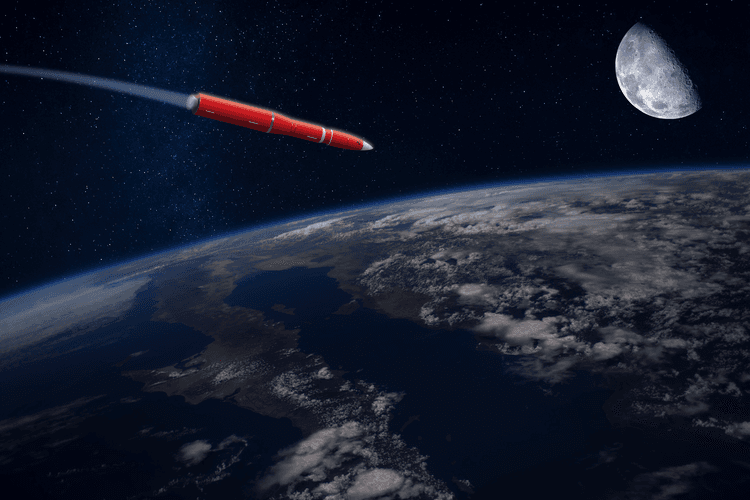
Hypersonic weapons can be cruise-type missiles powered throughout their flight, or they may be carried onboard an intercontinental ballistic missile to 40 to 100 km above the earth’s surface. At this point, the glide vehicle separates and flies like a “fireball” or a “meteorite” — in Putin’s words — to its target, maneuvering all the way to avoid interception. Slamming into a target at this speed can inflict massive damage through kinetic energy alone, without the need for explosives.
Sensing and Tracking Technology
Raytheon Missiles and Defense has a dedicated division that is developing methods to counter hypersonic attacks through advanced detection and sensing satellites in lower-earth orbit. Sensing from above — rather than from ground-based stations — means detection is not limited by the Earth’s curvature.
A June 2020 hypersonics testing report from the Pentagon notes that land-, silo, and air-launched hypersonic weapons “challenge the existing U.S. sensor architecture … so new sensors must come online.” Because satellites are global and maneuverable, “It does drive you towards a space architecture, which is where we’re going,” the report says.
A new project known as the Hypersonic and Ballistic Tracking Space Sensor is now part of the larger national defense architecture. The DOD has had a prototype of such satellites “in space for some time” and is collecting data from it, while additional hypersonic-tracking satellites will be launched from this year onwards.
With a network of tracking satellites in space, the military will be able to transition from indications and warning “into a fire control solution” wherein an interceptor is launched. Space-based sensors will be a part of a larger system of land, sea, and air-based sensors that together will detect, track, and engage hypersonic weapons.
Disrupting Hypersonic Weaponry Airflow
Other areas of inquiry for combatting hypersonic missiles include laser weapons, neutral particle beams, microwaves, low-frequency shock waves, and the modification of existing interceptors.
Scientists are looking into a way to disrupt the “boundary layer,” or the airflow and temperature around a hypersonic weapon in flight. Doing so will impact the stability of the system and cause an instantaneous angle change and even cause the entire missile to break up.
Who Has Hypersonic Weapons?
Russia and China currently lead in hypersonic weapon development, followed by the United States. France, Australia, and India are reportedly also researching the technology, while Japan is investing in scramjet and boost-glide hypersonics.
In late December 2018, Russia launched a ballistic missile carrying an Avangard glide missile from the Dombarovskiy base in the Urals. After separating from its carrier, the missile zigzagged across 3,700 miles to successfully hit a target on the far-off Kamchatka Peninsula — an event that Putin labeled “the perfect New Year’s gift for the country.”
Concerned about a new arms race, nonproliferation experts are working to limit or outlaw hypersonic weaponry, but a treaty seems unlikely.









![An Expert’s 101 Guide to Tackling Digital Transformation as a Business Leader [New Podcast]](https://machinerys.net/upload/cache/202507/an-expert-s-101-guide-to-tackling-digital-transformation-as-a-business-leader-new-podcast.webp)