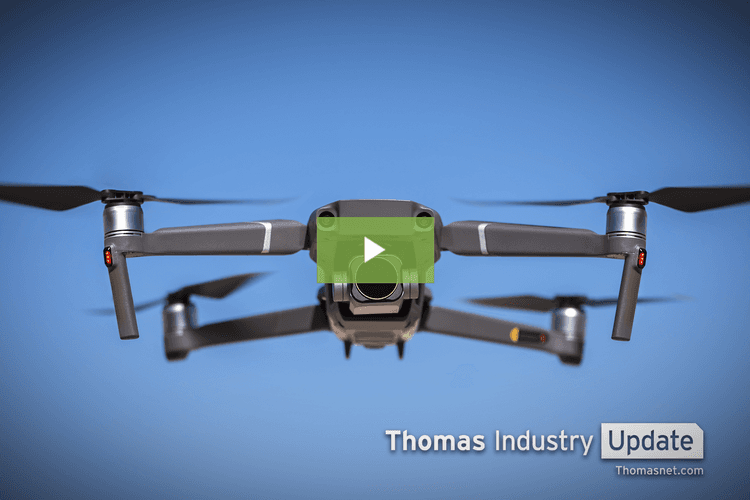
The use of drones is becoming more widespread and the applications are seemingly endless, no matter the industry.
Boeing’s MQ-25 Stingray prototype recently made history when it became the first unmanned aircraft to successfully perform air-to-air refueling. In just a few years, it could significantly change how the Navy manages its naval aircraft fleet.
Two new drone applications have come out, and while they’re not refueling mid-air, they still stand to make a significant impact: one addresses nuisance odors at plants and the other could soon save lives.
Plants that emanate odors are a problem. For example, construction on a new chicken plant in Alabama was halted due to odor concerns, and a containerboard plant in South Carolina was penalized after receiving more than 17,000 odor complaints from the community.
Researchers from the Institute for Bioengineering of Catalonia in Barcelona, Spain, built an olfactory drone prototype to monitor and improve management at water treatment plants. If there has ever been a plant that can use odor remediation, it’s a water treatment facility.
The institute partnered with water plant operation and maintenance company, DAM, to develop the Sniffdrone. The Sniffdrone has an electronic nose made up of 21 chemical sensors to create odor concentration maps. The drone also has temperature, humidity, and pressure sensors as well as GPS positioning. Powered by artificial intelligence, the system helps plant managers take appropriate actions to improve odor management.
The second application isn’t entirely new as drones have been used in search and rescue efforts for years, but it could be a game-changer.
Researchers from Fraunhofer FKIE have created a drone that can hear victims’ screams following a catastrophe.
The team mounts a cluster of microphones called the Crow’s Nest Array to the drone.The team uses an advanced array of processing and filtering techniques, like beamforming, to cut out the many environmental noises that would otherwise make the microphones useless. The Crow’s Nest Array has various detection procedures that enable it to hear screams despite noise from wind, helicopters, or ground vehicles.
While the team is still developing the technology, listening drones outfitted with Crow’s Nest Arrays could soon be saving lives of people buried under rubble after an earthquake or trapped in a collapsed building.