In the world of military aviation, the United States has long stood out with its advanced fighter planes that combine state-of-the-art technology, formidable firepower, and unparalleled performance into a single unit.
Four fighter jets have gone on to distinguish themselves as the titans of the skies. These include the Lockheed Martin F-35 Lightning II, Lockheed Martin F-22 Raptor, Boeing F/A-18E/F Super Hornet, and Boeing-F15EX Eagle II. Below, we examine what makes each aircraft the most mighty U.S. fighter plane in service today.
1. Lockheed Martin F-35 Lightning II
Lockheed Martin, despite navigating a turbulent road with its principal partners, Northrop Grumman and BAE Systems, produced the F-35 Lightning II, which is widely considered to be the most advanced and versatile fighter jet ever built. The project overshot its deadline by ten years and costover $400 billion, contributing to the F-35 program being one of the most expensive in military history.
The lifetime costs of the program are projected to be at $1.5 trillion (a figure that includes the $400+ billion spent to date). Though each F-35 variant has different costs, experts estimate the total per-unit price of each range anywhere between$150 and $200 million, including maintenance.
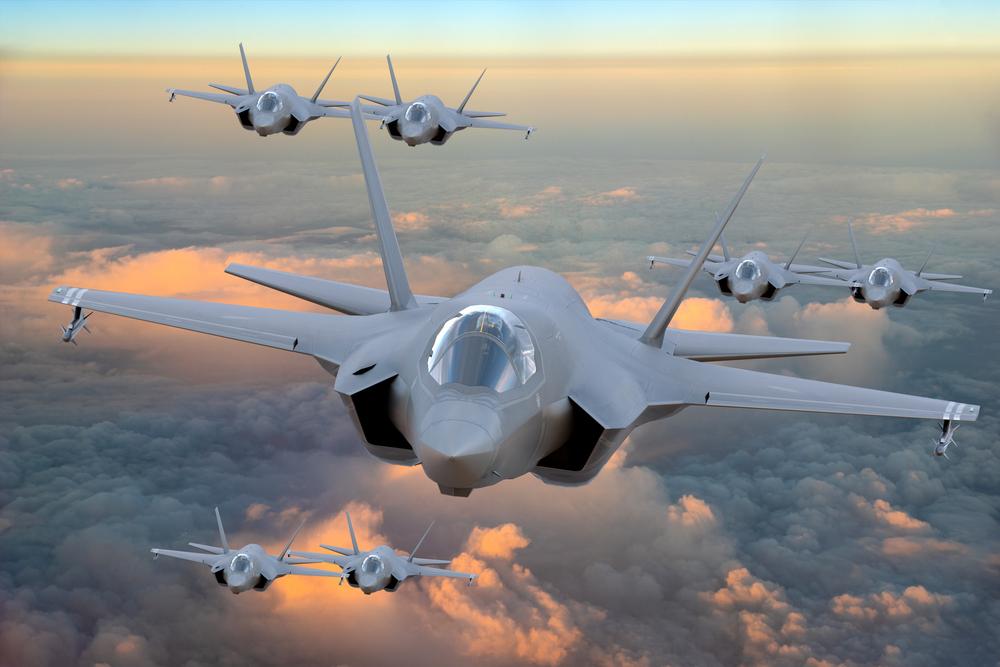
The F-35 and its multiple variants (F-35A, F-35B, and F-35C) are tailored for use by different branches of the U.S. military. The jets stand out for their stealth capabilities, advanced avionics, and robust sensor networks, all designed to operate in high-threat environments, providing pilots with unparalleled situational awareness.
The F-35 has been sold to numerous allied nations, including the United Kingdom, Australia, Italy, and Japan, among others. The F-35 Lightning II, in particular, was also featured in the filmTop Gun: Maverick, alongside the Sukhoi Su-57 Felon, F-14 Tomcat, the P-51 Mustang, and another plane on this list, the Boeing F/A 18E/F Super Hornet.
2. Lockheed Martin F-22 Raptor
The F-22 Raptor is another aeronautical marvel from Lockheed Martin. Lockheed collaborated with Boeing to build the Raptor, quickly establishing itself as one of the most capable fighter planes in the U.S. military’s arsenal.
Like the F-35, the F-22 program was notoriously expensive, with a per-unit cost of$150 millionand a total program cost of around $66 billion. When each plane’s maintenance expenses are included in those costs, they exceed $350 million.
The Raptor is similarly renowned for its stealth capabilities, supercruise — sustained supersonic flight without afterburners — capabilities, and advanced avionics. It’s considered one of the best pure fighter planes in the world, capable of outmaneuvering nearly any adversary.
In contrast to the F-35, however, the F-22 is exclusively operated by the United States Air Force. The U.S. government has banned the export of the aircraft due to the sensitive technologies that it carries. Despite this, the F-22 has seen combat in operations against ISIS and is frequently used today to conduct air patrols around the globe. However, it has not been involved in any documented air-to-air combat but is used to demonstrate the country’s air superiority.
3. Boeing F/A-18E/F Super Hornet
Boeing Defense, Space & Security manufactures the F/A-18E/F Super Hornet, the U.S. military’s top carrier-based aircraft through the 1990s and into the early 2000s. The Super Hornet is produced in several configurations, the most expensive of which costs$66.9 million per unit.
Primarily used by the United States Navy, the Super Hornet has also been exported to countries such as Australia. Though initially designed as a carrier-based aircraft, numerous countries have purchased it for use as a ground-based craft.
As a fourth-generation fighter jet (the Raptor and Lightning II being part of the fifth generation in contrast), the Super Hornet has a much longer service history. It lives up to its name, having been used as a multi-role fighter capable of dominating the skies, performing ground attacks, and striking sea vessels. It has proven its mettle in both air-to-air combat and ground attack roles, used extensively in Iraq, Syria, and Afghanistan.
Its versatility, carrier compatibility, and advanced electronic warfare capabilities make it a critical asset for the U.S. Navy. Still, the rise of 5th-generation fighters is closing the Super Hornet’s window of air dominance. Still, it remains a robust solution for attacks against ground and sea forces, and it has also graced the silver screen, appearing alongside the F-35 in the critically acclaimedTop Gun: Maverick.
4. Boeing F-15EX Eagle II
Like the Super Hornet, Boeing manufactures the F-15EX Eagle II, a newer version of the old but reliable F-15 fighter jet. The per unit costs of the F-15EX Eagle II are approximately$80 million, and as of 2023, only the U.S. Air Force uses the craft.
The F-15EX is new to the Air Force, so it hasn’t seen any combat yet. But everyone is buzzing about the capabilities of this unique aircraft. They haven’t been sold to other countries yet, but Boeing will likely do so in the future, as long as the U.S. government doesn’t shut down any export deals.
If the F-15 moniker sounds familiar, that’s because it is. The original F-15 (the F-15A) took to the skies inJuly 1972. Past variations of the F-15 have seen extensive combat, demonstrating the versatility and capability of this flagship fighter plane. The F-15EX is considered to bethe third-generation Eagleand is a more cost-effective option than the F-22 and F-35.
In addition, since the F-15 EX builds on the existing F-15 design, getting pilots up to speed on the new aircraft is more accessible, making it a welcome addition to the U.S. Air Force’s arsenal that provides a versatile air-to-air fighter plane.
Looking Ahead
The United States has dominated the skies since the 1940s and continues that near-century-long tradition with aircraft like the F-22 Raptor, F-35 Lightning II, and F-15EX. Even previous-generation aircraft like the Super Hornet can outperform most fighter aircraft used by other countries. Nevertheless, U.S. defense contractors continue to push the limits of what’s possible with avionic technologies to ensure that American warfighters are fully prepared whenever duty calls.
More Aviation Insights
Image Credit: Mike Mareen / Shutterstock.com