A team from Honda Research Institute USA Inc. (HRI-US) announced the development of a “nanoribbon” material that supports protected quantum communication for transmitting sensitive data.
Nanoribbons measure tens of atoms wide and one atom thick. According to HRI-US, the researchers’ nanoribbon growing method enables control over the materials’ width, thickness, and electronic properties.
Creating an Encryption Key
The HRI-US researchers and collaborators encoded information onto individual photons emitted by their nanoribbon material. The photon stream could then facilitate data creation and transmission. In this process, the sender transmits photons in one of two quantum states, the recipient measures them, and the two parties create an encryption key. Eavesdropping will disrupt the states, causing detectable errors.
Controlling Thickness
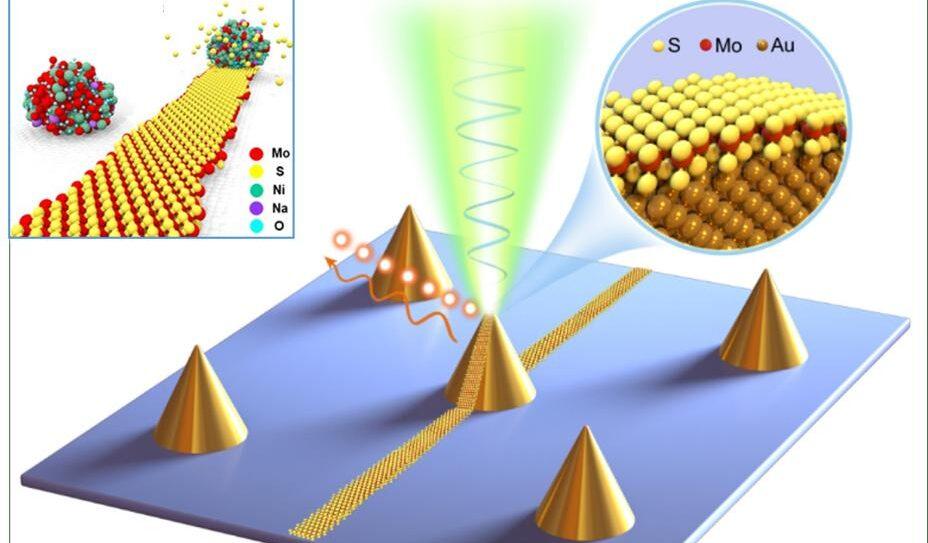
HRI-US Principal Scientist Xufan Li explained that the team created a single atomic-layer nanoribbon from materials like tungsten diselenide and molybdenum disulfide, and used metal-alloyed nanoparticles to help initiate nanoribbon growth. This allowed the team to control nanoribbon width down to seven nanometers.
The scientists then transferred the nanoribon material over a cone-shaped probe’s tip. This created an electronic structure on the cone’s tip that emitted single photons when exposed to a laser beam.
Achieving 90% Purity
Senior Chief Scientist Avetik Harutyunyan said the nanoribbons demonstrated impressive strain-induced and width-dependent electronic characteristics and quantum emission properties, with the stream’s single-photon purity reaching 90%.
Image credit: Ksenia Bets and Weibin Chen/Honda Research Institute USA, Inc.