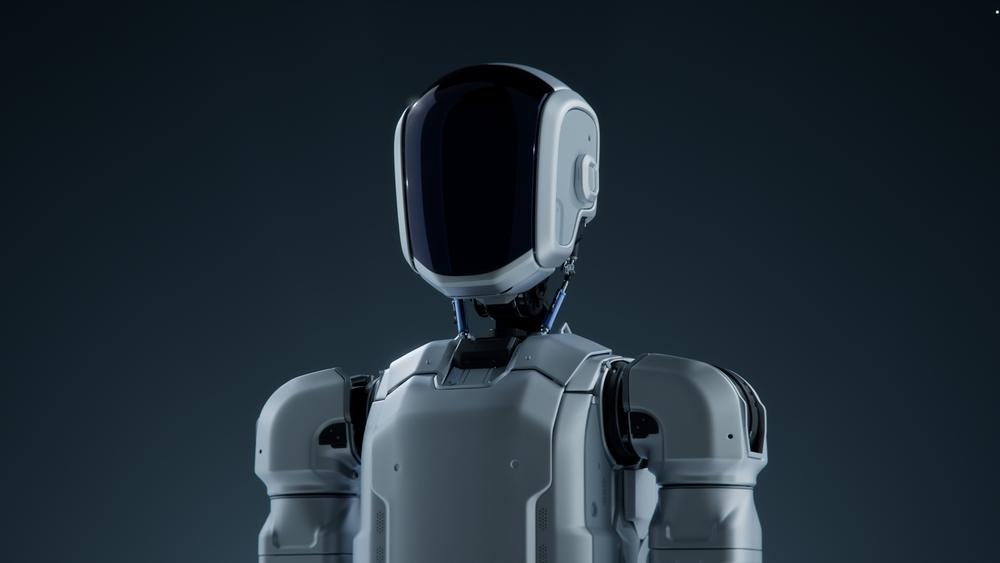
The market for humanoid robots is fast growing. Designed to look, act, and talk like human beings, these machines can lift heavy objects, operate industrial machinery, navigate complex environments, provide impeccable customer service, and perform monotonous household tasks.
According to a Goldman Sachs report, the global market for humanoid robots could reach $38 billion by 2035, up from previous projections of just $6 billion. Factors driving this exponential growth include rapid advancements in artificial intelligence (AI), which has accelerated the development of highly sophisticated robots while lowering production costs and enabling faster commercialization.
The arrival of smart and affordable humanoid robots in the industrial sector is welcome. These robots can supplement the sector’s dwindling labor force and carry out repetitive and dangerous tasks. They also operate with the utmost precision and speed to boost productivity and improve customer satisfaction.
Here’s a rundown of nine humanoid robots expected to make waves in manufacturing.
1. Phoenix: SanctuaryAI
Phoenix is SanctuaryAI’s sixth-generation robot and the world’s first humanoid general-purpose robot. It is powered by the robotics company’s pioneering AI control system, Carbon, and is specifically designed to fulfill roles in the workplace.
At 5’7″ tall, Phoenix has human-like general intelligence and full-body mobility. It can travel at speeds of up to 3 mph and has a maximum payload of 25kg. Already, the robot is autonomously completing simple tasks with impressive speed, precision, and strength.
Earlier this year, for example, SanctuaryAI released video footage of Phoenix carefully sorting a pile of assorted objects into different piles. The company claims the latest Phoenix model can learn new tasks in as little as 24 hours.
SanctuaryAI hopes that Phoenix, which was recently recognized as one of TIME magazine’s “Best Inventions of 2023,” will augment the human workforce, address the profound labor shortage, and make our workplaces safer.
2. ROBONAUT 2: NASA and General Motors
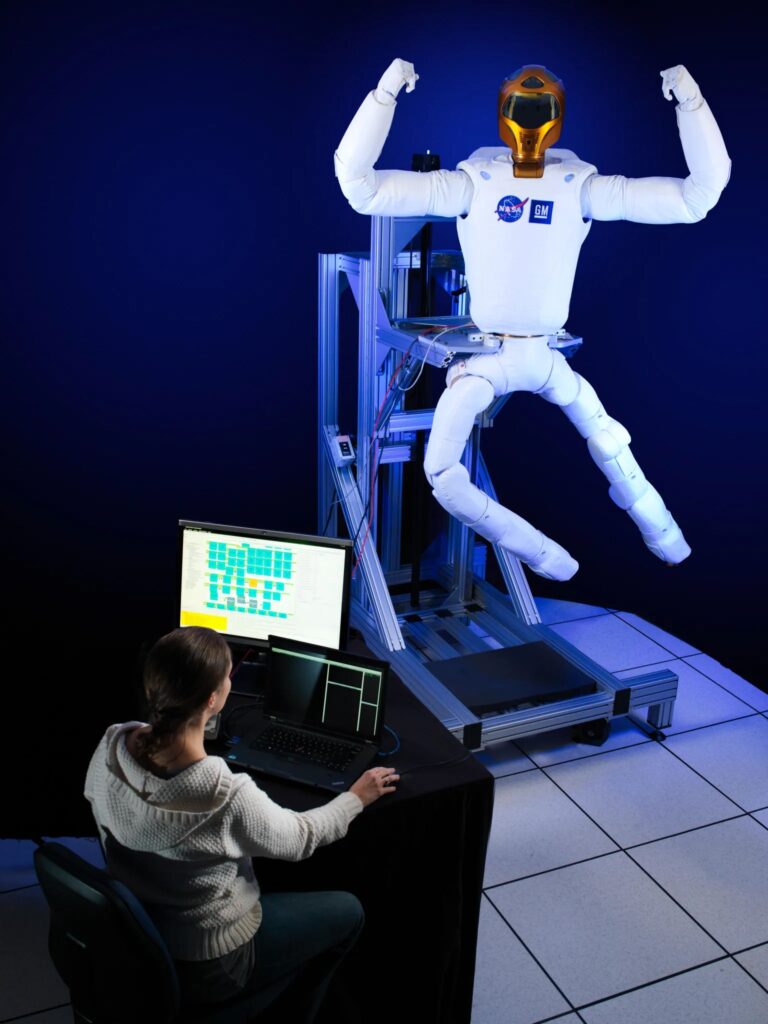
Developed jointly by NASA and General Motors (GM), Robonauts are dexterous humanoid robots that are built and designed at the NASA Johnson Space Center in Houston, Texas. The machines are intended to operate side-by-side with humans as they explore and work in space.
In 2011, Robonaut 2 (R2) became the first humanoid robot deployed into space via space shuttle Discovery. At the time, the machine was a torso-only humanoid, but it has since been upgraded with two climbing manipulators (“legs”), more capable processors, and additional sensors.
Since arriving at the International Space Station (ISS), the robot has helped astronauts perform a variety of simple tasks. It can grasp objects, flip switches, and high-five crew members.
NASA and GM hope their Robonauts will one day venture outside the space station, making repairs or additions to the station or performing scientific work. The robots could also be used in telemedicine, controlled by doctors on Earth to care for sick or injured astronauts on the ISS.
3. Punyo: Toyota Research Institute
Developed by the Toyota Research Institute (TRI), Punyo, a Japanese word that elicits feelings of chubby, cute resilience, tackles everyday tasks that demand more than manual dexterity.
TRI’s soft robot, which is undeniably cute, is designed for whole-body manipulation. Its hands, arms, and chest are all covered with compliant materials and tactile sensors. These features enable Punyo to feel contact with large and unwieldy items and manipulate them with its entire body.
“Traditionally, robots for manipulation are intended to make contact only with their hands or grippers, and this is generally inefficient,” said Alex Alspach, a tech lead with TRI’s Punyo Whole-Body Manipulation team. The team believes Punyo’s interactions are safer and more effective.
In an industrial setting, this lightweight and low-cost robot could improve worker safety by handling toxic substances or operating heavy equipment.
4. DIGIT: Agility Robotics
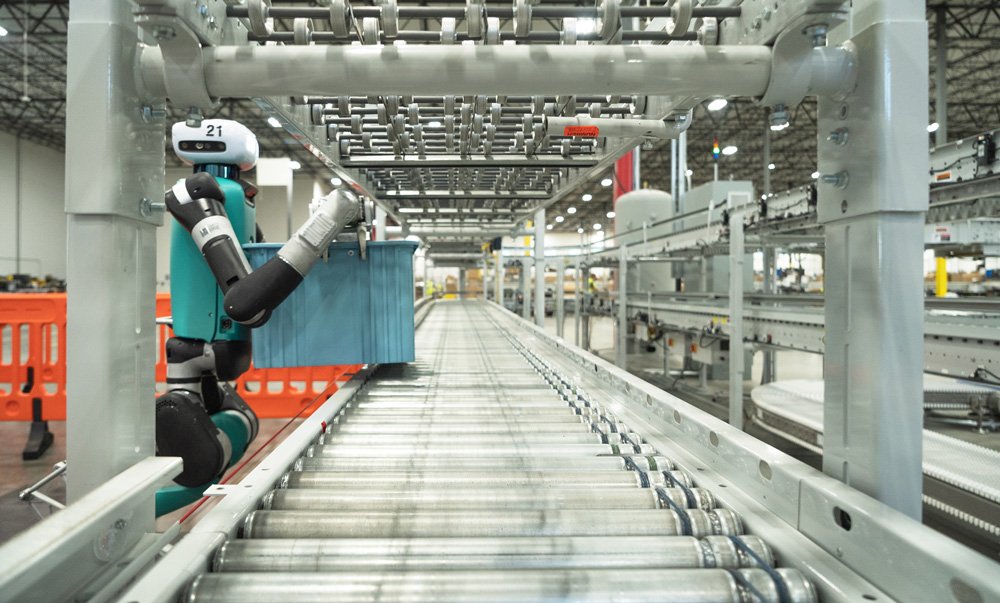
Digit is Agility Robotics’ advanced Mobile Manipulation Robot (MMR), which is designed to work alongside humans in a logistics environment. At 5’9″ tall, the humanoid robot weighs 140 pounds, can lift up to 35 pounds, and is capable of completing a range of warehouse tasks, including lifting and moving containers and grasping and manipulating heavy objects.
The robot made history earlier this year after completing its first work shift in a commercial setting at GXO Logistics, the world’s largest pure-play contract logistics provider. GXO has signed a multi-year deal with Agility Robotics to deploy Digit across various logistics operations.
Agility Robotics CEO Peggy Johnson hopes that Digit will begin to address the 1.1 million unfilled warehouse jobs by taking on the most undesirable, unsafe, and repetitive tasks while enabling human warehouse workers to upskill.
Last year, the Robotics company announced that it is constructing a 70,000-square-foot RoboFab manufacturing plant in Salem, Oregon. The plant will produce more than 10,000 Digit humanoid robot units annually.
5. ARMAR-6: Karlsruhe Institute of Technology
Developed at the Karlsruhe Institute of Technology (KIT) in Germany, ARMAR-6 is a collaborative humanoid assistant robot, which is designed for use in industrial environments.
The 6’3” robot weighs 160 kg and has a maximum payload of 14 kg per arm or 10 kg per arm when its arms are stretched out above its head. Thanks to its telescopic torso, ARMAR-6 can also increase its working height by an additional 40 cm.
The robot can wield a variety of tools designed for humans, including power drills and hammers. Its AI capabilities allow it to observe its human coworkers to learn new skills and autonomously perform tasks. ARMAR-6 even makes decisions on how best to grasp or pick up an object, depending on the next action to be executed.
KIT was particularly focused on designing a robot that could interact directly with human co-workers. For example, it is equipped with 3D cameras, which perceive its surroundings and recognize humans, and laser sensors to ensure collision-free navigation.
6. Apollo: Apptronik
Apollo is a general-purpose humanoid robot designed for friendly interaction, mass manufacturability, and high payloads. At 5’8” tall, it weighs 72 kg and has a maximum payload of 25 kg. Its modular system means it can be mounted onto any mobility platform — either stationary or fully mobile.
Thanks to Apollo’s unique force control architecture, it can work safely alongside humans, pausing all movement when it detects a person or object close by. The robot can carry out a range of tasks, including case picking, palletization, machine tending, trailer unloading, and work cell delivery.
Apptronik plans for Apollo to join human workforces at warehouses and manufacturing plants in the near future and will later extend its reach to other sectors, including construction, oil and gas, electronics production, retail, home delivery, and elder care.
Earlier this year, the robotics company announced a partnership with Mercedes Benz. The robot will be deployed to the latter’s manufacturing facilities to deliver assembly kits and inspect the car brand’s vehicle components.
7. Optimus: Tesla
First introduced at Tesla’s 2022 AI Day, Optimus is a humanoid robot that stands at 5’8” and weighs 57 kg. The robot, which adopts much of the technology used in the automaker’s electric vehicles (EVs), can walk on two legs (albeit slowly) and engage with the physical world with its arms and hands. For example, it can pick up, sort, and make corrective adjustments to hand-held objects.
Optimus is equipped with a trained neural network, which enables it to interact with the physical world around it completely autonomously. It learns about its surroundings as it passes through and remembers the information the next time it encounters the same area.
Tesla CEO Elon Musk believes Optimus will one day help millions of people and potentially boost economic output by “two orders of magnitude.” The company intends to mass-produce the Tesla Bot to the scale of its vehicle production and expects the unit cost to be less than $20,000.
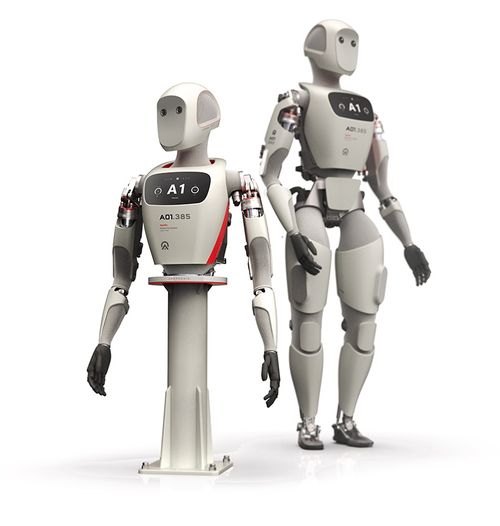
8. Agibot Raise A1: Agibot
Agibot Raise A1 is a general humanoid robot designed by the Shanghai-based robotics company Agibot. At 5’9” tall, the robot has a maximum payload of 80 kg and a maximum walking speed of 7 km/h. It is equipped with an RGBD camera, LiDAR sensors, and modular components, which enable it to adapt to various scenarios.
Initially designed to operate in industrial environments, Raise A1 is capable of tasks such as bolt tightening, vehicle inspections, and laboratory experiments. Agibot, however, envisages wider applications for its robots in research and education, healthcare, and customer services.
Earlier this year, at the World Robot Conference in Beijing, Agibot showcased its newest humanoid robots, which have been designed to act as salespeople, gallery guides, or pickers at factory plants. In stark contrast, Tesla’s humanoid robot, Optimus, was displayed inside a clear box next to the automaker’s cars.
Agibot hopes to begin deliveries of its humanoid robots in mid-October, followed by another batch of 300 robots in November.
9. Figure 02: Figure
Figure 02 is Figure’s highly dexterous second-generation humanoid, which is designed to operate in industrial environments.
At 5‘ 6” tall and weighing 70 kg, Figure 02 travels at about 2.6 mph, has a maximum payload of 20 kg, and features a range of innovative technologies, including computer vision, AI, actuators, and sensors.
The robot works effectively in areas with physically demanding, unsafe, or repetitive processes and can complete tasks with its hands — including complex grasping and coordination of both hands in unison — fully autonomously.
Earlier this year, Figure partnered with BMW to test its robot at the automaker’s factory in Spartanburg, South Carolina. During its first shifts on the factory floor, Figure 02 inserted sheet metal parts into specific fixtures, which were later assembled into a chassis.
BMW hopes its use of humanoid robots will save employees from having to perform ergonomically awkward and tiring tasks and is exploring additional applications at its production facilities.
The Future of Humanoid Robots
Wei Cao, partner at Lanchi Ventures, an Agibot investor, expects a commercially viable and fully autonomous humanoid robot to grace our factory floors within the next couple of years.
Which robotics companies will come out top? The race is on.
More Robotics Insights
Image credit: IM Imagery/Shutterstock