While topographers have been using drones to map, scale, and photograph land for years, the use of drones is on the rise in the world of agriculture, offering many other perks, too. These super-drones are much more than just aerial cameras; they provide significant benefits for farmers, improving farm efficiency and increasing crop yields.
It’s not just the larger farms that are integrating drone use into their operations. 90% of all U.S. farms are smaller, family-owned farms, and they, too, are bringing in agricultural drones to help with aerial surveillance, mapping, and even crop spraying.
How Are Drones Used for Farming?
Agriculturalists recognize that “precision agriculture,” or detailed data collection, is the most effective way to grow a business. Learning algorithms get smarter with use and offer a precise view of the analytics of a farm. Pattern recognition uses previously collected data to detect not only a recurring pattern but also to plan future courses of action.
An agricultural drone, otherwise known as an unmanned aerial vehicle (UAV), is used to monitor the health of trees, land, and crops using high-tech sensors and digital and satellite imaging to provide comprehensive information about the land. These drones give the user the option of either watching live video footage while the drone is in flight or downloading the material to watch at a later time.
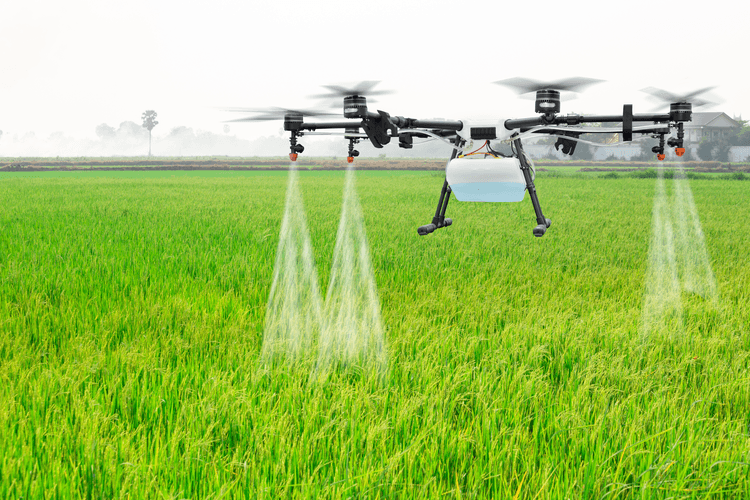
These clever flying bots can remotely detect land and crop damage from insects, weather conditions, wildfire, and construction; they can indicate which crops need more or less nutrients, estimate yields, and even count cattle. Recent advancements have seen these agro-drones spraying and distributing fertilizer and pesticides, and some can now even pick ripe nuts and fruit off trees.
Drone companies are starting to make agricultural drones available for rent to better sell their tech. The companies claim it gives skeptics a chance to see the advantages before spending upwards of $1000 on their own. After taking a trial flight, farmers can usually see how useful a drone can be and realize it’s worth the investment. For example, an invasive weed species can be easily missed by humans but an AI drone can seek it out and swiftly nip it in the bud, saving crops, money, and time in the process.
There are a few challenges present for farms in more remote locations, however. As the nature of the agricultural industry generally places farms in rural areas, downloading drone footage can be tricky since a high-speed internet connection may not yet be present in the vicinity.
Are Drones the Future of Farming?
The rise in automation in agriculture means that agro-specific drone use will only increase. In 2019, the global agriculture drone market was valued at a little over a billion dollars and it is projected to reach around $3.7 billion by the year 2027, exhibiting a CAGR of 18.14% during the forecast period.
Hardware is stated to be the sector’s biggest money-making segment, with North America holding the highest share of the market. Among the top companies providing drones for agricultural use are the American manufacturers Precision Hawk, DroneDeploy, AeroVironment Inc., Trimble, AgEagle Aerial Systems, and American Robotics.
Also leading the market is the Chinese manufacturer, DJI.Advanced agriculture drones such as the T16 from DJI are waterproof, dustproof, and weatherproof and can navigate and fly in most weather conditions, including fog. They are even equipped with a floodlight to fly safely at night.
Obstacle avoidance technology and highly sophisticated software can plan a flight and map out the area before precision-spraying crops using AI. A drone that can carry up to 60 liters of chemicals can get the job done 50 times faster than manual spraying and works out to be twice as cost-effective as, and more precise than, using a helicopter.
Advancement in this field is growing by the day with scientists adding more and more features to drones such as “optical flow”; teaching a drone how to travel through confined spaces by emulating the flight patterns of birds and bees. For drones in agriculture, it seems that the only way is up.







![“With ROI Results Even the CFO Will Like,” Cobots Could Close the Skills Gap [Q&A]](https://machinerys.net/upload/cache/202507/with-roi-results-even-the-cfo-will-like-cobots-could-close-the-skills-gap-q-amp-a.webp)