According to data from the American Hospital Association, there are 924,000 staffed hospital beds in the U.S., two-thirds of which are typically occupied at any given time.
While most planning guidelines for new hospitals dictate that between 15-20% of spaces are dedicated to transmissible diseases, the majority of medical centers were not adequately equipped to manage a pandemic on the scale of COVID-19.
To alleviate the immense strain placed on healthcare systems around the world and to avoid hospitals reaching capacity, several organizations quickly designed pop-up medical facilities.
These makeshift treatment centers and hospitals have been established in fairgrounds, football stadiums, motels, parking garages, navy ships, sports fields, stadiums, and college campuses. In some cases, this involves converting existing infrastructure, while in others architects design innovative new spaces that are quick and easy to erect. The American Institute of Architects recently released a design guide to help identify compatible buildings that can support patient care during this time.
What Constitutes an Effective Pop-up Medical Center?
- Additional space – To effectively mitigate the spread of coronavirus throughout medical centers, health care professionals need a lot more space; Space to practice social distancing, consult with patients, put on and take off PPE between shifts, separate infected patients from non-infected patients, and implement one-way directional pathways around the facility.
- Improved ventilation – Ideally, COVID-19 patients will be completely isolated and air should be cycled from a patient’s room up to 10 times per hour to prevent cross-contamination.
- Universal rooms – Designing rooms with built-in capabilities to handle patients with a diverse range of treatment needs is another way to control disease spread and keep infectious patients isolated. These rooms tend to be more expensive and require specialists to move around hospitals to visit patients, but this is the most effective way to safely manage coronavirus patients.
- Easily established – Envisioning the ideal COVID-19 medical center is one thing, but actually building them in the middle of the pandemic, when urgency and funding are two very real concerns, is unrealistic. It’s essential that pop-up medical centers open up as quickly as possible, which calls for simple, flexible structures that can be assembled quickly and (ideally) transported to locations where they are needed the most.
Pop-up Medical Facilities Around the World
The Boldt Company and HGA’s Prefabricated Modules
Construction company Boldt and architecture firm HGA have manufactured prefabricated modules designed to sit alongside existing medical facilities or exist as standalone field hospitals. The units are fitted with stations for healthcare workers to put on their PPE and the controls for patients’ IV pumps sit in corridors so staff can monitor them without entering their rooms.
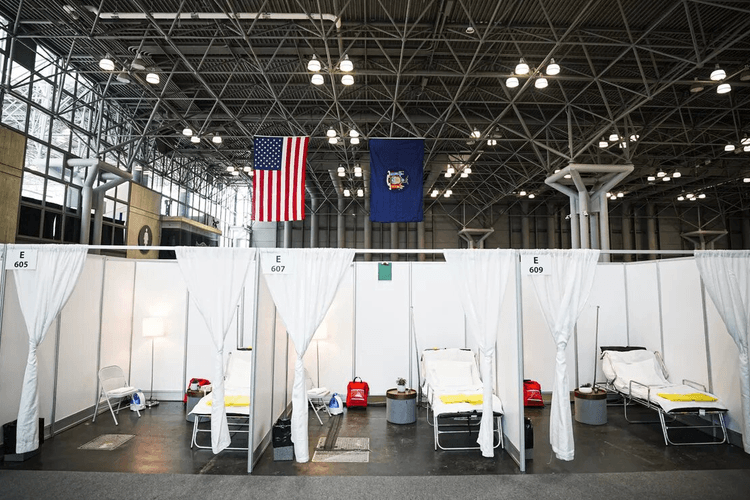
The Jacob K. Javits Center in New York
The Jacob K. Javits Center in Manhattan was converted into a 3,000-bed capacity overflow hospital. This center was one of the first pop-up hospitals to open in the U.S. thanks to the efforts of The Army Corps of Engineers, the New York National Guard, and several civilian staffers.
Jupe Health’s Rest and Recovery Units
Start-up Jupe is determined to address hospital room shortfalls with its flat-packed mobile units, which include rest and recovery rooms and ICUs. The units, which cost just 1/30 of a hospital room, can be shipped anywhere they are needed and could be placed in hospital parking lots or even in the backyards of healthcare workers who don’t want to risk infecting their family members.
The rooms designed for coronavirus patients who don’t require intensive care are fitted with ventilator hook-ups, a toilet, and sink, and provide the option for negative pressure, which prevents germs from flowing outward.
Carlo Ratti’s Converted Shipping Containers in Italy
Carlo Ratti and Italo Rora have collaborated with an international team of experts to develop Connected Units for Respiratory Ailments, also known as CURA. The plug-in intensive-care pods are made from converted 20-foot shipping containers, each containing the necessary medical equipment to accommodate two coronavirus patients, including ventilators and intravenous fluids stands.
VHL Architecture’s Mobile Hospital in Da Nang
VHL Architecture is collaborating with Da Nang Architecture University to design a new mobile hospital. Designed for mass production, the model offers low installation costs and is fitted with all the necessary functions and facilities of a medical and treatment facility.
The coronavirus pandemic has been a devastating wake-up call, reminding governments around the world that hospitals and medical centers need to be better equipped and prepared to manage transmissible diseases and pandemics. There is no doubt that the work organizations are doing today in creating effective and affordable pop-up medical facilities will inspire long-term planning in the medical industry.