For the rich and famous, a bunker could set you back as much as $8.35 million and come equipped with every modern convenience you can imagine – a shooting range, bowling alley, swimming pool, cinema, gun room, and aquaculture systems to breed fish for food. As expected, these structures are also incredibly secure with features such as escape tunnels, armed security, and bullet-proof glass throughout.
The apparent rise in disruptive black-swan events has driven many Americans to formulate a disaster preparedness plan. Companies that provide survival gear, including bunkers, have reported 2020 as a record-breaking year for their businesses with some seeing their sales increase by 500%.
Business Insider attributes a few key events to the uptick in demand for survival equipment, including the coronavirus pandemic and bushfires in Australia. Several bunker companies have even capitalized on people’s fears of coronavirus, advertising chemical air filtration systems, and air scrubbers that claim to stop the spread of the virus.
For many, even “affordable” bunkers are unattainable, such as Terra Vivos’ 2,200-square foot bunker (priced at $35,000) or Rising S Bunkers’ Safe Cellar model, which is installed under a 28-inch concrete slab within the customers’ house.
It is clear that there need to be more affordable ways to quickly build resilient emergency structures that provide secure, temporary accommodation to those who have been displaced by natural disasters like earthquakes. Around the world, architects, planners, and engineers have been experimenting with the use of alternative, local materials, and new designs to cater to this need.
Shigeru Ban’s Paper Tubes
Japanese architect, Shigeru Ban, is known for his paper tube housing. As well as designing sophisticated and complex homes with cardboard tubes, he has applied this technique to create simple emergency shelters for use in relief camps. This includes family-sized tents for temporary shelter and cabins for longer-term housing. The structures are delivered in pre-cut sheets, are fast to assemble, and don’t require skilled workers to do so.
Another innovative feature of Ban’s emergency shelters is the use of crates filled with sandbags to provide a shallow foundation. This ensures other construction materials are protected from adverse weather.
Architecture for the Mass’ Bamboo Homes
Bamboo is versatile, resilient, and resistant to both compression and bending. It’s found all over the world making it an ideal material for the building of temporary structures. When hundreds of thousands of people in Nepal were displaced by 2015’s earthquakes, architects Charles Lai and Takehiko Suzuki formed a relief organization, Architecture for the Mass, to respond to the need for emergency shelters.
These structures featured frameworks made from bamboo, which is cheap and abundant in the area and can be clad using a range of materials depending on what is available. Unskilled laborers can assemble the shelters in two to three days and they have been designed to withstand tremors and keep occupants dry during monsoon season.
Shipping Container Homes
Shipping containers are often used in the building of emergency shelters, including Sean Godsell’s mass-produced Future Shack design. This shelter is fitted with solar panels, water tanks, and lighting fixtures and can be set up on uneven terrain thanks to the addition of telescoping legs, which serve to level it.
Daiwa Lease has adopted shipping container specifications for the EDV-1, which can be deployed anywhere by truck or helicopter. Within five minutes, it can expand to two stories and comes equipped with a bio-toilet, shower, kitchen, storage for supplies, and an office desk. The shelter’s pixelated skin lights up and can be used to share critical information during emergencies.
Yale University, Gray Organschi Architecture, and the United Nations’ Eco-Living Module
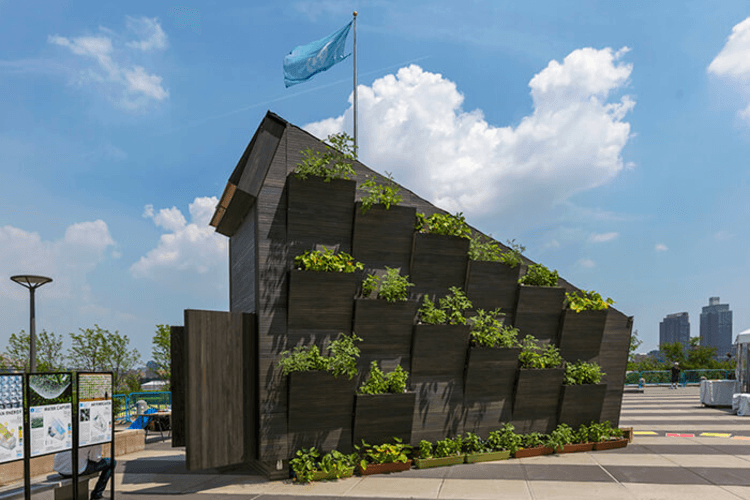
These three organizations have collaborated to design a 215-square-foot-module with a primary focus on self-sufficient living. The module includes solar panels, batteries that can power a radiant heating and cooling system, and a condenser that extracts rainwater for drinking, bathing, and irrigating plants. The structure includes an external plant wall for growing produce, which designers claim can feed a family of four for at least 260 days of the year.
The reCover Shelter
This Accordion-shaped origami structure is composed of polypropylene, which means no harmful gases contribute to its production and it is 100% recyclable after use. A family of four can be sustained for up to a month following a disaster, with the ridges in the structure used to collect drinking water.
The Green Horizon Prefab Home
This sustainable shelter was designed by James Pope. Constructed from 100% recycled and recyclable materials, it can sustain a family of four with a week’s worth of food, water, and electricity. The shelter’s metal frame construction can accommodate many different configurations, which means it can be used to build medical units, community centers, and offices, as well as temporary living space. Photovoltaic panels and biofuel generators enable the shelter to generate its own electricity.
3D Printed Emergency Housing
Crane-like 3D printers can construct emergency or social housing in 12 to 24 hours. ICON’s Vulcan printer is expected to be capable of printing an 800 square foot home for a cost of only $4,000 per house. The model contains a living room, bedroom, bathroom, and a curved porch. ICON has chosen to print using cement because it is such a common material worldwide, but 3D printers can construct houses using plastic, rubbish, or even convert rubble in earthquake zones into new building materials.