In March, Chipotle introduced Chippy, an AI-powered robotic arm that makes intentionally imperfect tortilla chips; some with slightly more salt, others with a more distinct tang of lime. And Chippy isn’t the only robot being put to work; Cecilia.ai, a mechanical mixologist, is being implemented in bars around the world to serve up the perfect margarita while chatting with customers using conversational AI.
Since the mid-2010s, the world has been advancing Industry 4.0, which is a combination of artificial intelligence (AI), additive manufacturing, and the Internet of Things (IoT). Experts argue that the COVID-19 pandemic accelerated the shift to Industry 5.0 and that soon AI-powered platforms and robots will largely take on monotonous tasks that no longer require human labor.
So how do robots learn to fulfill these tasks? And can they expand their knowledge on their own?
What Is Artificial Intelligence (AI)?
As far back as the 1950s, Alan Turing, often considered the father of computer science, asked, “Can machines think?” Since then, AI has been defined as the use of machines and computers to mimic human behavior like the problem-solving capabilities required to fulfill tasks that once required human intelligence.
Combining computer science and datasets, AI algorithms use data to make predictions and fulfill tasks. Deep learning and machine learning are both subsets of AI, although often used interchangeably, and have been used for speech recognition, customer service, stock trading, and more.
Some of the more commonly-known uses of AI include Siri and Alexa, self-driving cars, email spam filters, and even Netflix recommendations.
How Do Robots Learn?
In the long term, scientists and engineers want to create AI that can take on tasks ranging from driving people to and from locations in a taxi to stocking grocery shelves.
Josh Tenenbaum, a psychologist at MIT in Cambridge, says AI-powered robots should be able to “interact in the full human world like C-3PO.” But to accomplish this, advanced machine learning is required.
Training is often the hardest part of developing an AI-powered system, as it calls for time, a plethora of resources, and suitable data. The CTO of FruitCast, an agricultural AI startup, said it takes real-world training and examples to properly train AI because robots aren’t very smart — until you make them smart.
To develop an AI system, the computer or robot first gathers data about a specific task or situation through human input and sensors. Using other stored data, the system then decides which action, based on the scenario, will be most successful.
Because the system can only use the data it has available at any given time, if it is asked to do something it isn’t equipped to do it may fail. Think of these programmed AIs like an automated message when you call the doctor’s office to make an appointment: If you say something the system is unfamiliar with, it usually asks you to repeat yourself or suggests an alternative.
It’s true that these bots can definitely be trained to work on an assembly line, but this doesn’t mean that robots aren’t simply programmed to fulfill tasks.
Do Robots Learn or Are They Merely Programmed?
Robots can learn… to an extent. For example, robotic vacuums often have the capability to learn the layout of a room. There are also social robots currently employed as aids for the elderly that are coded to help them clean, get in and out of bed, and retrieve meals. However, these bots are only programmed to do specific tasks.
Machine learning often uses a “neural network,” which is a set of data used for training. This method is inspired by the workings of the human brain and functions by giving the system a dataset and the solution, then allowing it to study the data. Then, once it is “trained,” it is tested without being given the solution until it correctly identifies the answer nearly 100% of the time.
Like the human brain, natural intelligence is complex and ultimately required to push AI to its full potential. “We do know that the brain contains billions and billions of neurons, and that we think and learn by establishing electrical connections between different neurons,” writes HowStuffWorks. “But we don’t know exactly how all of these connections add up to higher reasoning or even low-level operations.”
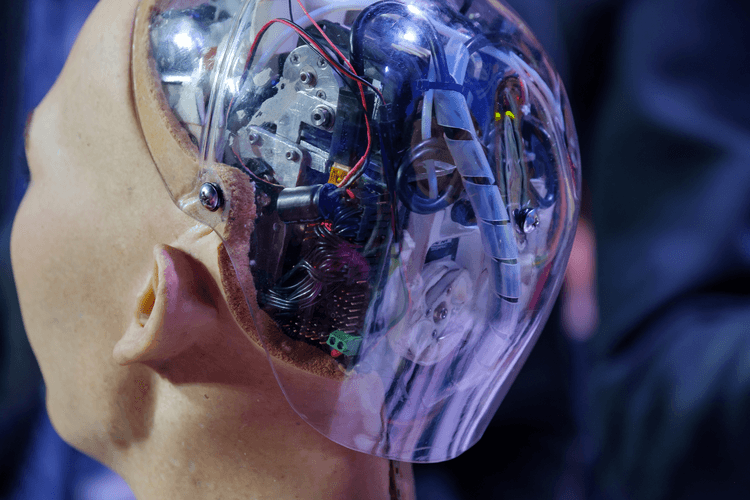
This is why many scientists are focused on humanoid robots, as fully operational AIs need both innate and programmed abilities that come with more human-like intelligence. It must be trainable and learn from its own experiences.
Humanoid robots often have actuators, which allow them to sense their environment. But these bots are still coded to fulfill certain tasks, and while the capacity to interact with humans is still widely limited, AI allows humanoids to understand commands, answer questions, and even respond sarcastically or use slang.
So, depending on your definition of learning, robots can “learn” in some capacity.
For more about the state of AI in 2022, IEEE Spectrum breaks it down visually here.