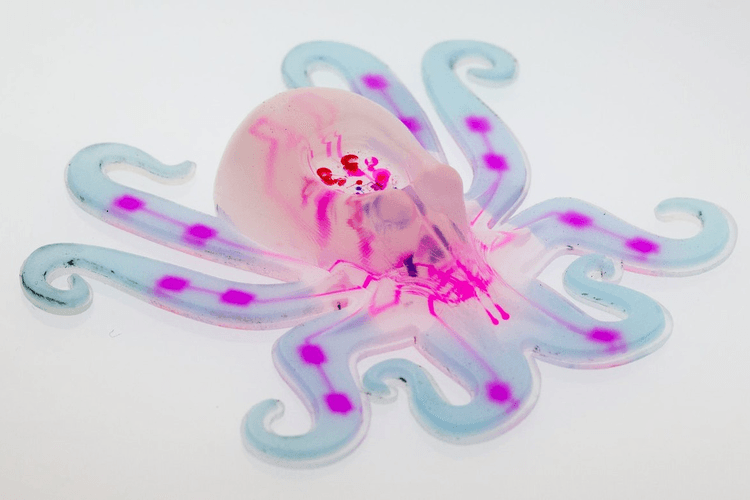
Octopuses are well-known for being soft and flexible. Most octopus species have no internal skeleton or protective shell, which allows them to contort their bodies to squeeze into the smallest of cracks and crevices.
But this wasn’t always the case. Research published in 2017 revealed that octopuses once sported a hard outer shell that was lost during the Jurassic and Cretaceous periods. Ridding themselves of the rigid covering enabled them to become the agile, evasive marine creatures we are familiar with today.
The rise of soft robotics tells a similar evolutionary story.
What Is Soft Robotics?
Soft robotics moves away from the sharp edges and rigid materials of traditional robotics and instead draws on the behaviors and characteristics of living organisms for increased flexibility when performing tasks.
Through the use of soft and compliant materials, soft robots are safer and more resilient as well as having the potential to perform more life-like, delicate movements.
In 2019, the soft robotics market was valued at more than $780 million, with this figure predicted to grow to $4.7 billion by 2025.
A key factor stalling the development of soft robotics is designing components known as actuators. These components function much like muscles in a human or animal, with the ability to bend and contract in multiple directions but, to date, actuators in soft robotics have been bulky and impractical.
The Twisted and Coiled Actuator
Inspired by the octopus’ nimble, muscle-like contractions, assistant professor Jianguo Zhao and a team of students at the Colorado State University have developed the “twisted-and-coiled actuator,” which can generate programmable motions in a soft robot.
This new device is just a few centimeters long and made from common household sewing thread, which can be manipulated into a range of shapes that generate a motion. A team led by graduate student Jiefeng Sun created the actuator by repeatedly twisting thread fibers before coiling it into the shape of a spring. Their technique allows for even gaps between neighboring coils, which enables the device to contract without being preloaded.
Much like a human muscle, the actuator can feel and respond to forces, such as a weight hanging from it. The finished actuators can be embedded into soft robots, allowing for a wide range of motion including gripping, twisting, and bending.
Sun’s next goal is to create miniature soft robots with an even greater range of motions and manipulation. Eventually, these might be beneficial in search-and-rescue applications, or even used within the human body to deliver targeted drugs and other therapies.
The twisted and coiled actuator isn’t the world’s first foray into the world of marine animal-inspired soft robotics.
Jellyfish-inspired Soft Robotics
Jellyfish are the source of inspiration for researchers at North Carolina State University and Temple University. Last month, they unveiled their soft robots, dubbed jellyfish-bots, which highlight a technique that uses pre-stressed polymers to increase a robot’s power.
During the earlier stages of research, the team’s efforts were directed towards the study of cheetahs, but the resulting soft robots, although fast, had a stiff inner spine. The latest iteration is a completely soft robot with no spine that can move more quickly and with greater power than a real jellyfish.
Squid Ring Teeth Self-healing Actuators
Researchers at Penn State have come up with an innovative solution to the problem of soft robotics actuators wearing down or breaking. Actuators fitted within soft robots are designed to carry out repetitive motions. But any material exposed to a relentless motion will eventually suffer tears and cracks. To address this, researchers have developed a biodegradable biosynthetic polymer, inspired by squid ring teeth. This self-healing polymer responds to the application of water and heat, although researchers say it could also heal in response to light.
Existing self-healing materials typically have a low healing strength and the healing time can be several hours long. But these protein-based soft robots can repair tiny defects in the actuator long before the robot fails. In fact, the researchers at Penn State have succeeded in reducing the usual 24-hour healing time to just one second.
In the months and years to come, these studies will pave the way for the development of more complex soft robots with wider applications in the real world.