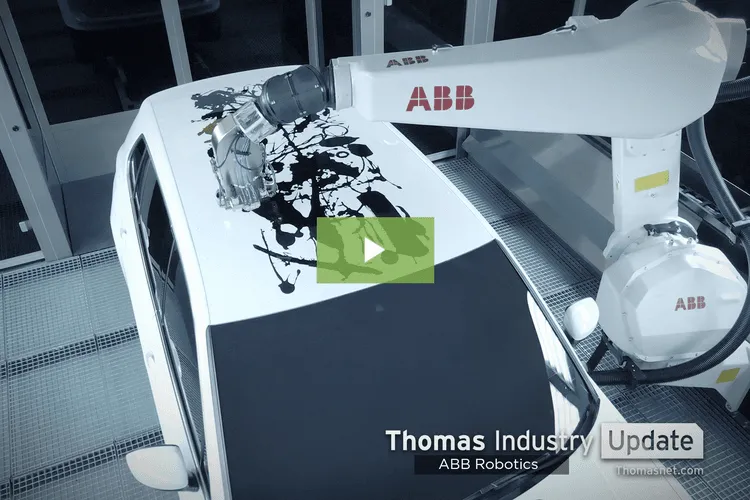
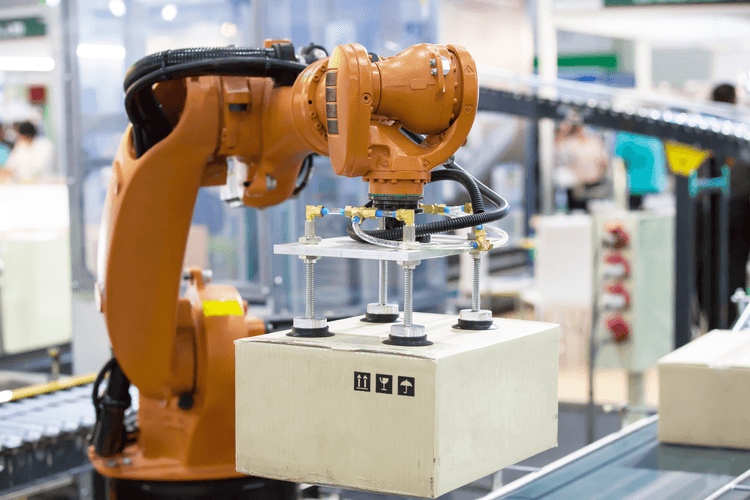
In the 1960s, the earliest industrial robots were put to use in American automotive factories. Back then, they had simple functions like repetitive pick-and-place tasks and the handling of heavy die-cast parts and hot materials.
Today’s robots can do everything from retrieving products in warehouses to taking and preparing fast-food orders, to assembling entire mechanical parts comprised of many components.
As the use of robotics has ramped up over the last 50 years, the notion that robots are taking human jobs has persisted, whether accurate or not. Much of the public still envisions a future with very little human labor, while other industry experts are skeptical.
A new study from the Massachusetts Institute of Technology tackled this topic head-on, seeking to find out how many jobs robots actually replace. The MIT study, covering 1990 to 2017, found that the U.S. added one additional robot for every 1,000 workers, lowering the country’s employment-to-population ratio by approximately 0.2%. The study noted that certain areas of the U.S. were affected far more than others. In simpler terms, the study found that each additional robot added in the manufacturing space replaced about 3.3 workers in the U.S. on average. Additionally, the study found that the rise of workplace robots lowered wages by about 0.4% during the timeframe.
An advanced form of the study was published in the Journal of Political Economy.
The study examined data of 19 industries that was compiled by Frankfurt-based International Federation of Robotics. Researchers combined IFR’s data with data from U.S. government sources that include the U.S. Census Bureau and Bureau of Labor Statistics.
Their analysis compared robots deployed in the U.S. to that of international practices, ultimately finding the U.S. trailed Europe in their timeframe. MIT said between 1993 to 2007, U.S. companies introduced one new robot for every 1,000 workers, while Europe deployed 1.6.
Other details the study uncovered:
- In the U.S., four manufacturing sectors comprised 70% of robotics: automotive (38%), electronics (15%), plastics and chemicals (10%), and metals (7%).
- Geographically in the U.S., Michigan has the highest concentration of robots in the workplace, as human employment in Detroit, Lansing, and Saginaw is impacted more than any other metropolitan area.
- In commuting zones that added robots, each robot replaces about 6.6 local jobs. However, the study found that robots in manufacturing help people by lowering the cost of goods, among other positive factors.
- Factoring in the economic benefits of robots, the study found that each additional robot replaces approximately 3.3 U.S. jobs as a whole.