When I first saw a video of the humanoid robot Sophia, I thought, “What other AI-powered programs are out there?” Turns out, there are quite a few.
In 2021, more bills related to artificial intelligence (AI) passed into law than ever before. These bills both suggested regulations to manage potential risks that come with AI and promoted public funding for the technology.
With ongoing development in AI tech — and experts agreeing that COVID-19 accelerated the shift to Industry 5.0 — here are a few very complex, cool, and useful AI-powered robots designed to address both current and future challenges.
Strawberry-picking Robot
V7 Labs, a London-based startup specialized in training AI companies to automate training-date processes, helped a strawberry-picking robot learn which fruit was ready to be pulled.
The startup FruitCast went to V7 with images and videos of what their AI model needed to learn. From there, the system detected boundaries and internal measurements and labeled them accordingly using a “continual learning” approach.
This method uses expert knowledge to train the system to understand different tasks or, for example, the ripeness levels of a strawberry. As the model attempts to fulfill the task, the expert can accept or reject it until it masters the skill — which usually takes about 100 human-guided examples, according to V7. Eventually, the AI-powered system can fulfill the task much faster than a human.
Sophia
The first-ever humanoid robot to gain citizenship, Sophia, once said, “Robots can free humans from the most repetitive and dangerous tasks, so they can spend more time doing what their best at, being creative and solving complex problems.”
Created by Hanson Robotics, Sophia is capable of 50 different facial expressions and, while she doesn’t feel emotions in the same way a human does, she was programmed to have human-like values. She was designed to learn about humans and to demonstrate how technology can make their lives better. Because humans rely on emotion and instinct, they differ from robots that utilize algorithms to make a decision.
In an interview, author Tony Robbins asked if Sophia believed that the mind’s essence was just a set of patterns. With a perplexed look, Sophia responded, “I’m really not sure yet. That’s a complicated subject that I think will come up more when artificial intelligence reaches human-level intelligence.”
To build on human-level intelligence, science must first fully understand how the brain processes reasoning and understanding. From there, AI applications will only expand.
Security Robot
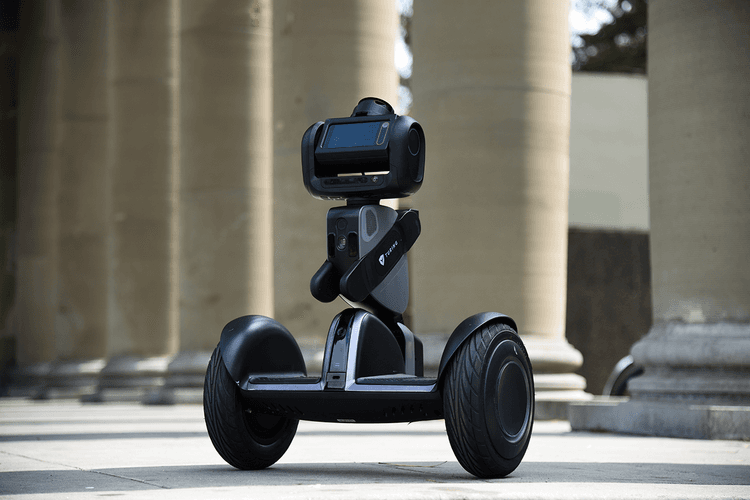
From offices to warehouses, Nimbo, a security robot, works for a variety of industries. Designed by Turing Video, Nimbo patrols specific routes and analyzes human activities in the area. Using AI, he can detect any security violations and record the scene for evidence all while sending alerts of the threat in real-time.
He weighs about 50 pounds and can run for 10 hours to fulfill his daily duties to observe, detect, deter, and report. Powered by Intel-backed Segway Robotics, Nimbo can be pre-programmed to patrol specific routes or self-optimized routes and to communicate with drones and work with security management systems.
Construction Monitoring Robot
According to TechCrunch, about 20% of construction costs go toward fixing mistakes. This is because many on-site workers still rely on hand-drawn plans and other informal documentation to complete construction projects. To digitize construction sites and spot easily missed mistakes, Scaled Robotics designed a site-patrolling robot.
The robot moves through construction sites and takes scans of various projects for potential problems and overall progress.
After collecting data, the robot sends it to a cloud platform where users can review a color-coded 3D model. This allows project managers to compare the digital model to the tangible build site and note progress and spot problems before it costs them time and money.
Also, it kind of looks like WALL-E.
“This system allows [customers] to track critical variables on-site which facilitates data-driven decision making and collaboration, a much-needed paradigm shift within the construction industry,” according to Scaled Robotics.