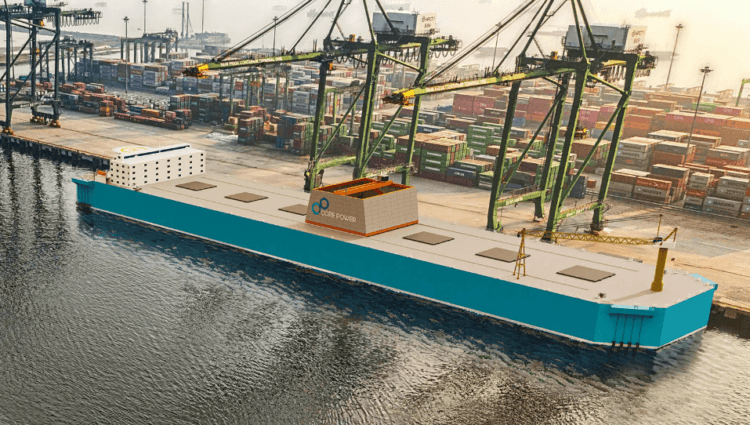
UK-based maritime nuclear technology company Core Power has announced plans to bring floating nuclear power plants (FNPPs) to market by themid-2030s.
These FNPPs might just be a big part of efforts to decarbonize and move towards more sustainable energy solutions, providing reliable, emission-free power around the world.
The Liberty Programme
The project, dubbed the Liberty Programme, will create a new, scalable approach to nuclear energy that moves away from more traditional land-based infrastructure, which is significantly more expensive.
Theprojectis still in its concept phase, but Core estimates that the market could be worth $2.6 trillion, and has set a rather ambitious timeline; orders opened by 2028, and commercialization sometime in the 2030s. The company’s CEO, Mikal Bøe, isconfidentthat “shipyard construction of nuclear will deliver on time and on budget.”
Floating Nuclear Power Plants
Unlike traditional nuclearpower plantson dry land, FNPPs are mobile and barged-based, meaning that they can be towed to different locations, providing energy wherever needed.
A major perk is safety; FNPPs are naturally protected from earthquakes and tsunamis, unlike their land-based counterparts. Another is better waste management, thanks to molten salt reactor technology.
Nuclear Powering Maritime
Core Power’s goal is to blend shipyard manufacturing and modular constriction to mass-produce these FNPPs, making clean energy more accessible to coasts, ports, and offshore industries.
Industries that could benefit greatly from these FNPPs include green hydrogen production, heavy industry, ocean transport, and large-scale desalination.
Companies Involved
Core Power isn’t working alone on this project. The company is collaborating with international regulatory bodies, such as the International Maritime Organization, and the International Atomic Energy Authority to define the safety and security standards for nuclear-powered maritime operations.
Core has partnered with naval architecture and marine engineering firm, Glosten, to design the FNPPs. Glosten is also handling the safety and regulatory considerations. In addition, Mitsubishi Research Institute is on board for potential FNPP deployment in Japan.
Image Credit: corepower.energy