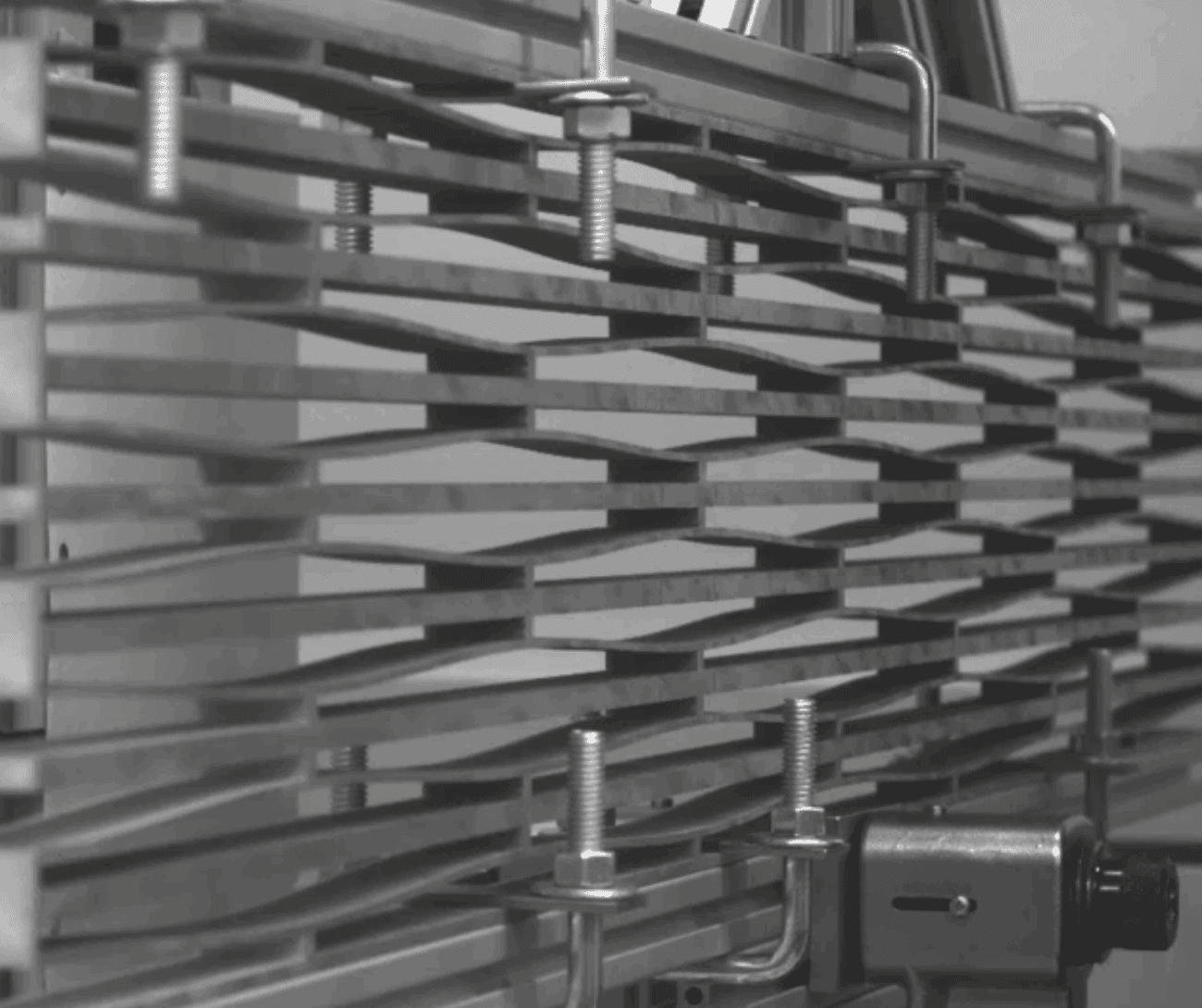
Researchers at Purdue University recently developed intelligent materials that can change from one stable configuration to another and then back again.
They resemble an over-engineered accordion — or perhaps a new industrial bedspring technology — but instead of an innovative squeeze box, the materials are being tested for use in airless tires and in landing mats on temporary airfields.
The patent-pending technology can dissipate energy caused by bending, compression, and other stresses without permanent damage or deformation. The ability to be reused and avoid damage makes it particularly well-suited for structural durability projects, such as temporary runways in remote areas.
According to Purdue civil engineering professor Pablo Zavattieri, the structures are similar to shape memory materials that generate smart responses to outside forces like temperature changes. Besides runways and airless tires, Zavattieri adds that the materials could also be used to make impact-resistant structures that better stand up to earthquakes or even biomedical devices.
The structures can also be constructed from nearly any material, including polymers, rubber, or concrete.
In August 2020, the team received a $1 million grant from the U.S. Air Force to fast-track 3D-printed runway mats using the structure. Zavattieri is collaborating with Indiana Technology and Manufacturing Companies (ITAMCO) to develop a new runway mat using 3D-printed metal.
The 3D-printed panels are made from a carbon-fiber reinforced metal composite and could be used to make runways for defense, public health, and even natural disaster response.
Zavattieri is also working with the U.S. Army to use the materials to create non-pneumatic tires. The technology has proven elusive for companies, including Michelin and GM, which have been working on airless tires for years.
So far, the Purdue team has created a computer-based model that shows the feasibility of a non-pneumatic tire as specified by Tire and Rim Association standards.
Image Credit: Purdue