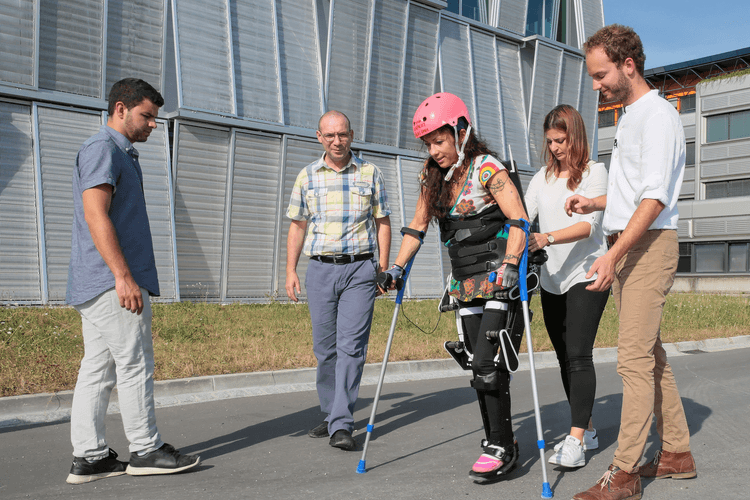
Swiss company TWIICE may not have been the first in the business to create an exoskeleton, but they seem to be one of the more advanced.
Co-founders Tristan Voga and David Ptacek of Fischer Connectors demonstrated the device on June 13 as part of MD&M East. TWIICE’s technology and unique design recently landed the invention as one of 10 finalists at the UAE AI & Robotics Award for Good in Dubai.
Voga says their design is the lightest of all of their competitors, weighing in at about 30 pounds, compared to up to 60 pounds on other models. Their main goal is to give the disabled population an enhanced quality of life and make their exoskeleton as easy-to-use as possible.
“At TWIICE our mission is to enable these people to reconnect with their community to connect with life and have access to life again,” the team explained. In order to accomplish their goal, the TWIICE team set out to build a device that helps people walk again, even without feeling in their legs.
Building a Uniquely Supportive Exoskeleton
The exoskeleton, known as TWIICE 1, is designed to give its ‘pilot’ as much independence as possible; the device can be manipulated into a sitting position on a chair so that the user can transfer from a wheelchair to a seat by themselves.
During its design and testing phase, creators kept in mind that the use of the TWIICE would involve engaging a user’s entire body, so the company included a smartwatch for turning on the device and buttons built into the crutches for changing modes and additional controls. The crutches are also magnetic, so they can be connected along the forearm brace to become one larger crutch when wearers only need one for balance.
Voga says the pilot can walk up to approximately 2 mph on most of their models, the equivalent of a slow walk, but the device isn’t built just for walking.
When using the TWIICE 1, a “person can not only walk but also do other activities, like going up stairs, up and down slopes as well… you can switch to different modes depending on the activities,” said Voga. “The idea is really to give people the ability to connect with the community and access to places they could not before and be with other people in the community at eye level.”
"Our goal is to give people a feeling of inclusion, a feeling of independence, and [the ability to] explore the world using all of their senses again,” he explained.
However, building a device capable of essentially becoming someone’s legs was no easy task, according to Voga.
While the invention is technically hardware, the design and development process has actually been more "like software development,” explained Voga, "with much shorter cycle times, reduced cost of failure, and harder development [that] has been computed with software development, which has changed the whole industry.”
Customizing Modular Designs for Individual User Needs
The company also opted to custom-build each device for its pilot, giving them huge amounts of flexibility in the population to which they can cater.
“We received requests and stories from people who always had the wrong disability, and never the right exoskeleton. That’s why we came up with our technology,” said Voga. “It’s a modular and customizable device that can be adapted to different pathologies and needs of the patients.”
While customization is great for this industry, it also can act as a roadblock; similar devices typically take months to design and manufacture to fit the person correctly, and as a result, can be incredibly expensive. But Voga says this isn’t the case for TWIICE. He explained that their entire process of design, manufacturing, and early-stage testing can be accomplished in just one month thanks to their unique manufacturing process.
“Our approach is to leverage our hardware system and customizable framework in order to decrease the machining and manufacturing costs of each integration,” he said. TWIICE also uses a modular design for all exoskeletons to keep the device simple yet highly customizable.
Connecting People to Robots
Throughout Voga’s demonstration of the device’s capabilities, he placed significant emphasis on ensuring that the pilot feels in control of their own body at all times.
“The idea is that the human is the author of the actions upon the robot,” he explained. When using the device, the user should get "the feeling that this is my body, these legs that are moving on my command are part of my body.”
To accomplish this sense of control, the team had to completely change their approach to building robots to also include the person insidethe machine. When building traditional robots, developers run a series of perturbation tests to measure how well the robot can work around obstacles and errors; in this use case, however, the main obstacle was the person inside the robot.
With the TWIICE, “the model of the system [includes] the human inside of it, the human[‘s] behavior, and this very tight physical and behavioral attraction between the human and robot,” says Voga. “That causes the system to be really difficult to model.”
One of the most critical issues TWIICE’s team is still grappling with is the pilot’s potential to fall, which Voga cites as one of the most prominent risks in their analysis testing. For this reason, he recommends using the device with a companion, so if a fall were to happen the user could receive immediate help.
Voga also mentioned that the company plans to integrate improved balance capabilities into the device to potentially prevent these fall risks from occurring. The balance functions would also give users the ability to use the device without crutches for some functions.