The gold medal for top sportswear brand in the world, by revenue, in 2020 was Nike, with Adidas coming in for the silver medal. Oregon-based Nike brought in $39.1 billion, whereas its German competitor brought in $25.6 billion. To earn these profits, these brands compete to get the hottest designs with the best performance to the market as quickly as possible.
How did these companies get their start and go on to win the sportswear supply chain race?
Earlier this year, we reported that the 3D printing market is predicted to quadruple by 2030, which will result in it becoming a $51 billion market. Both Nike and Adidas have turned to 3D printing to enhance their sneakers and decrease production time.
Nike Takes Inspiration from the Ancient Greeks
Originally called Blue Ribbon Sports (BRS), the American brand Nike was founded as a side hustle by an accounting professor, Phil Knight, and university track coach, Bill Bowerman, in 1964. When the growing company changed its name in 1971, it took inspiration from Greek mythology: the winged goddess Nike personifies victory. In Ancient Olympia, Greece, where the original Olympic games were held, there had stood a marble statue of Nike.
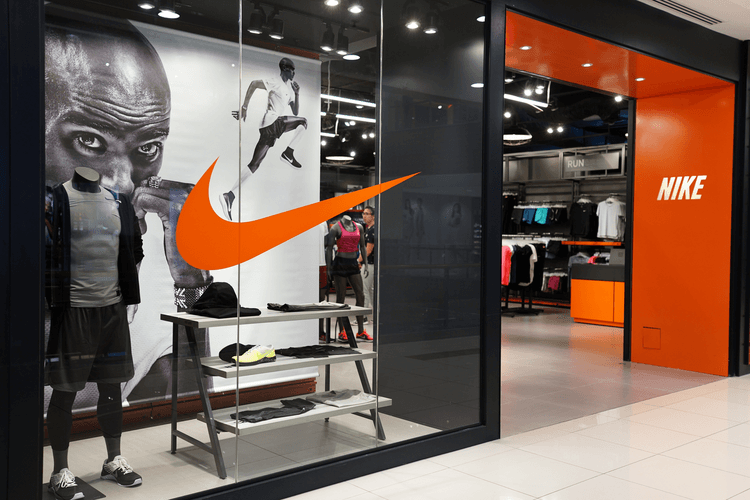
The “Swoosh” logo, designed for $35 by graphic design student Carolyn Davidson, drew inspiration from the shape of the goddess’s wing. It symbolizes speed, grace, and triumph. Today, the logo is so iconic that it can stand in place of the brand name and still be widely recognized.
While its sneakers are meant to allow athletes to perform at their fastest, Nike is also known for a swift supply chain that helps it win the athletic retail race.
Nike Speeds Up Its Supply Chain with 3D Printing
As early as 2013, Nike was looking to the advantages of additive manufacturing. Its Vapor Laser Talon football cleat used a groundbreaking 3D printed plate. This immediately inspired them to then create the Nike Vapor Carbon 2014 Elite Cleat. Next, they introduced their second 3D-printed football cleat, the Nike Vapor Hyper Agility Cleat, which used Selective Laser Sintering (SLS) 3D printing to integrate small material particles into a 3D shape using lasers.
In 2016, Nike’s Zoom Superfly Flyknit took advantage of 3D prototyping to develop a sprint spike for a running sneaker that met an athlete’s desired stiffness. Selective Laser Sintering (SLS) 3D printing took the process from weeks to only days, allowing for fast modifications.
By 2018, Nike had introduced the first-ever 3D-printed textile upper in performance sneakers with Flyprint. Using computational design tools to analyze the athlete data it captures, Flyprint finds the right material composition for an athlete’s needs. Then, it uses solid deposit modeling (SDM) to create the uppers.
More recently, in 2021, Nike’s Air Zoom Alphafly Next Nature began utilizing recycled waste from the 3D-printing process that develops the material for its Flyprint and Flyknit upper. This both improves sustainability and reduces material purchasing needs.
Nike’s Express Lane initiative, which began in 2016, cut its supply chain timeline from months to mere weeks. This program uses rapid prototyping and uses 3D printing to bring sneakers to market faster than traditional manufacturing methods. By 2018, the company had confirmed that 3D prototyping made the process 16 times faster than previous methods.
Adidas Generates Its Own Electricity
The Herzogenaurach, Germany-headquartered Adidas is Europe’s biggest sportswear manufacturer. The company was founded in 1924 as Gebrüder Dassler Schuhfabrik(Dassler Brothers Shoe Factory) by brothers Adolf and Rudolf Dassler in their mother’s home. Unlike today’s technology-driven conglomerates, the brothers had to sometimes pedal a stationary bicycle to generate the electricity they needed to run their equipment because of how erratic electricity was at the time.
When they convinced runner Jessie Owens to wear their sneakers during the Berlin Olympics, he went on to win four gold medals and the Dassler Shoes went on to sell many more shoes. But, after World War II, the brothers had a falling out and split the business. Rudolf established Puma — today, the world’s third-biggest sportswear brand — and Adi took Adidas, which today owns the subsidiary Reebok.
The Adidas name stems from its owner’s name: Adolph was nicknamed “Adi,” and the “das” is simply the first three letters of his last name, Dassler.
The hallmark of the Adidas logo is its three stripes, and Adidas often referred to itself as the three stripe brand. The stripes were apparently added for durability and variety. The company purchased its logo from Karhu Sports, a Finnish sports equipment company that had fallen on hard times during the war, for “€1,600 and two bottles of whiskey” (the euros would equal about $2,000 today) in 1952.
While the three stripes have remained, the logo itself has seen various iterations. In 1971, the company introduced the Adidas trefoil. The three leaves of the clover logo were meant to represent the three markets the company sold into at the time: Europe, North America, and Asia.
The most popular Adidas logo today, though, is the triangle, or mountain, which was created in the 1990s. It symbolizes athletic performance and climbing towards challenging goals.
More recently, in 2002, Adidas introduced a sphere for its sub-brand NEO. This is meant to appeal to a younger generation.
Sometimes, the company just uses its iconic stripes. However, the General Court of the European Union released a verdict that the three stipes cannot be trademarked.
Adidas Runs Toward 3D Printing
Adidas has turned to 3D printing to help it compress its supply chain and increase its abilities to customize en masse. It journeyed into additive manufacturing in 2014 and sought to overcome some of 3D printing’s early hurdles related to material restrictions and slow manufacturing speed.
In 2017, Adidas released its Futurecraft 4D. Working with Carbon, a 3D printer manufacturer based in California, they created “the world’s first high performance footwear featuring midsoles crafted with light and oxygen using Digital Light Synthesis” (DLS). The venture removed the need for standard prototyping and used 17 years of running data. Carbon’s DLS technology proved victory over the 3D printing shortcomings Adidas had struggled with previously. It took the production process of a single shoe midsole from 90 minutes to a mere 20 minutes.
Amid the backdrop of the COVID-19 pandemic, Adidas still managed to innovate. In 2020, they unveiled the Futurecraft STRUNG, which was described as “the ‘ultimate’ 3D printed running shoe.” Working again with Carbon, they created a 3D-printed midsole that uses performance data to individualize shoes to perfectly fit each wearer’s foot. For this shoe, Adidas and Carbon teamed up with the Belgium-based 3D printing company Materialise, which uses its 3-matic data optimization software to create a lightweight lattice upper that melds a wearer’s desired flexibility with their need for strength.
While many companies have been reshoring amid the pandemic, Adidas actually closed down its German and U.S. Speedfactories in 2020. It’s partnered with Oechsler AG, a German injection-molded precision parts company, to continue its 4D printing in Asia.
The Competition Continues
Nike’s Swoosh and Adidas’ three stripes blur past the competition, in part, because of their investment in 3D printing. Today’s sneaker heads and athletes demand speed to market. In fact, Nike’s Vaporfly sneakers were banned from the Olympics when the scarcity of the product meant runners successful in obtaining them had a technological edge over those who couldn’t get their hands on a pair.
Technology will continue to develop to create superior performing shoes, customized products designed specifically for the highly individualized needs and preferences of the person who is going to wear them, and fast, automated delivery.
Get More Insight into 3D Printing’s Role in the Supply Chain
- How the Adidas Supply Chain Keeps Running Ahead of the Competition
- Adidas Faces Colossal Challenges to Reshoring with 90% of Its Products Manufactured in Asia
- How Is Nike Using Automation, Robotics in Its Manufacturing?
- Nike Supply Chain Sets the Pace for the Activewear Industry
- How Retail Supply Chains Find Their Perfect Fit