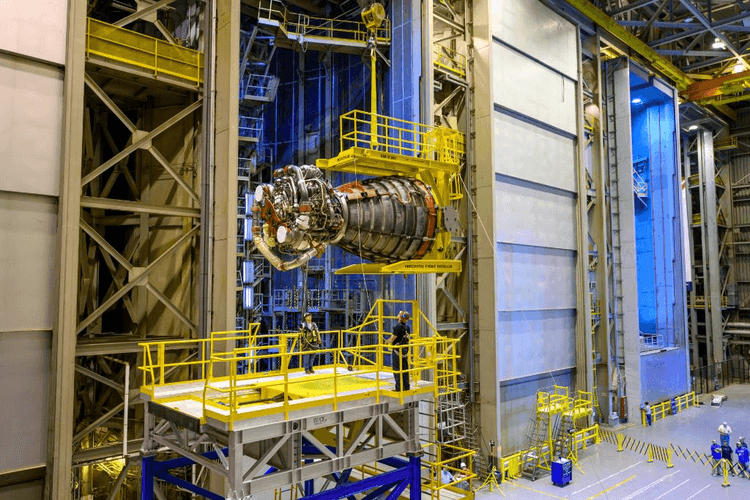
Sacramento, California-based Aerojet Rocketdyne recently entered into a Space Act Agreement with NASA’s Marshall Space Flight Center for the development and production of a lightweight rocket engine. The goal of the new rocket will be to provide a thrust chamber assembly that utilizes additive manufacturing materials and processes.
The use of additive manufacturing is seen as a way to reduce production costs and offer a more scalable thrust chamber that can be used for a wider array of mission types. The project will call upon a number of 3D printing technologies, including solid-state and laser deposition, to speed up fabrication of these complicated parts.
The scalability will help ensure that the cost benefits are realized on propulsion systems that will range in size from those capable of supporting a lunar lander to larger boosters used to launch spacecraft beyond the earth’s gravitational pull. The triple threat of cost savings, production efficiency, and modular scalability are seen as critical factors in helping to preserve space exploration investments.
The overall project is supported by NASA’s Space Technology Mission Directorate through its Announcement of Collaborative Opportunity (ACO) initiative. The ACO was drawn to the project’s focus on bringing an emerging technology like additive manufacturing to space exploration.