As you would expect, each generation of rover sent to Mars by NASA’s Jet Propulsion Laboratory (JPL) has been considerably more sophisticated than its predecessors.
From the trolley-like Sojourner to Opportunity, Spirit, and Curiosity, rovers over the past 20 years have grown not only in capability but have advanced significantly in terms of manufacturing techniques.
Now, the next rover to land on Mars includes 11 metal parts made with 3D printing, otherwise known as additive manufacturing.
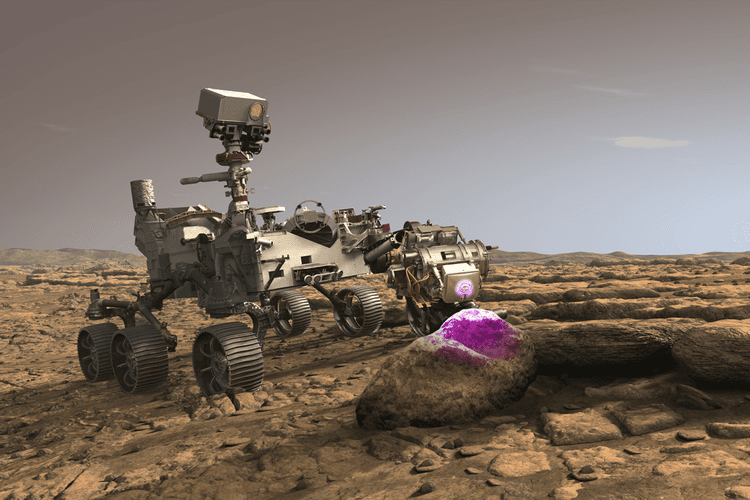
NASA’s car-sized Perseverance rover is due to land on the red planet on February 18, 2021. Its primary purpose is astrobiology, or the search for fossilized microbial life. Perseverance will collect and “cache” samples of Martian regolith for future pickup by NASA/European Space Agency spacecraft. But with the help of some sophisticated 3D-printed parts, Earth’s latest ambassador to Mars is capable of a lot more.
Which Parts of Perseverance Are 3D-printed?
The 11 3D-printed parts are all found within two instruments: PIXL and MOXIE. These are both “secondary structures,” which means they won’t jeopardize the mission if they fail to work as planned.
NASA has released the following details about exactly which parts are 3D printed, and the benefits or properties this manufacturing technique brings to Perseverance.
PIXL
PIXL (The Planetary Instrument for X-ray Lithochemistry) uses an x-ray spectrometer to measure the chemical make-up of Martian rocks at a tiny scale, and it includes a camera for extreme close-ups of features as small as a grain of salt. Mounted on the 88-pound rotating turret at the end of Perseverance’s seven-foot robotic arm, PIXL’s main mission is to search for signs of fossilized microbial life.
PIXL has five 3D-printed parts: a mounting frame, two support struts, and a two-piece titanium shell. Additive manufacturing was used by a manufacturer called Carpenter Additive to make these parts hollow, thin, and as light as possible, with 3x to 4x less mass than if they’d been manufactured using conventional fabrication.
PIXL weighs around 10 pounds; as NASA points out, laboratory tools that perform the same task usually weigh over 500 pounds.
MOXIE
MOXIE (Mars Oxygen In-Situ Resource Utilization Experiment) is a car-battery-sized test model of an oxygen generator, which will demonstrate how future missions could produce liquid oxygen from carbon dioxide in the Martian atmosphere for breathing and for propellant. MOXIE will create oxygen by heating the Martian air to 1,500 °F.
MOXIE contains six 3D-printed, nickel-alloy heat exchangers that protect sensitive parts of MOXIE from these high temperatures. While conventionally manufactured heat exchangers are made by welding two parts together, JPL’s parts were each 3D-printed as a single piece. These superalloys will maintain their strength and resist corrosion even at 1,500 °F.
The plates were subjected to intense pressure and heated in a hot isostatic press to over 1,832 °F to avoid pores or cracks forming in each layer of the alloy during the 3D printing process, before being tested at the microscopic level.
33 to 50 tons of propellant will be needed to launch from Mars, which means industrial-sized oxygen generators of the future will need to be about 100 times larger than MOXIE.
3D Printing and the Space Industry
Andrew Pate, JPL’s group lead for additive manufacturing, said: “Flying these parts to Mars is a huge milestone. It opens the door a little more for additive manufacturing in the space industry.”
In the longer term, NASA and private organizations are pursuing 3D-printing construction systems for future settlements on Mars and the Moon. NASA ran a 3D-printed habitat challenge in 2019 as part of its Centennial Challenges program.
Perseverance is not the first rover to take 3D printing to Mars. Curiosity included a 3D-printed ceramic part in its SAM (Sample Analysis at Mars) instrument.
Want to learn more about Perseverance? Use NASA’s touch-and-drag 3D digital model here to learn about the rover’s many components.