The University of Glasgow announced that space technologies lecturer Gilles Bailet received a patent for a system that addresses challenges associated with 3D printing in zero gravity. The technology may allow orbital fabricators to produce components for assembly into new equipment, including solar reflectors, improved communication antennas, and drug production devices.
Using a Granular Material
Bailet’s prototype employs a granular material instead of filaments traditionally used by 3D printers on Earth, which can jam or break in a vacuum and microgravity. The materials’ properties allow for more efficient drawing from the printer’s feedstock tank and faster delivery to the nozzle.
Testing the Prototype
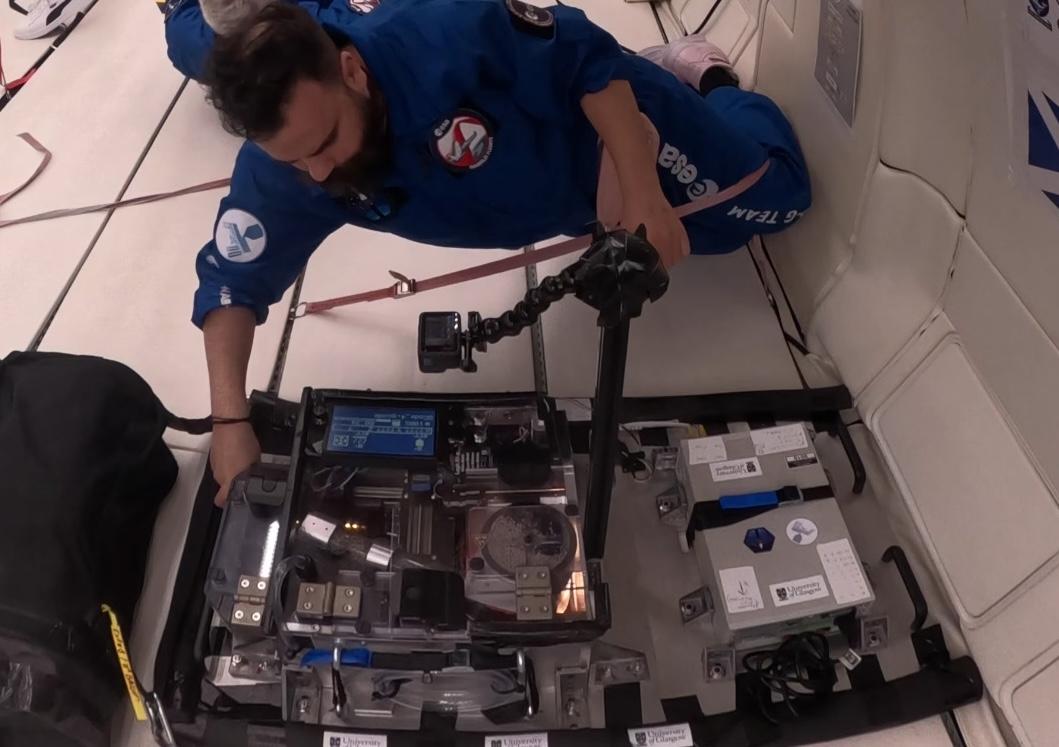
Bailet’s team tested the prototype on three flights that provided 90 22-second periods of weightlessness. They reported that the system’s power consumption and dynamics confirmed that it operated as intended in microgravity.
The team also plans to explore integrating electronics into the materials during printing, potentially enabling the creation of functional components for devices made in space and recyclable systems.
Saving Time and Money
Bailet explained that the ability to fabricate structures in space would transform the conventional approach of building everything on Earth before launching into orbit. He noted that the shift would address various issues, including payload restrictions and the risk of costly cargo destruction during launches.
The team plans to seek funding to support an in-space demonstration.
Image credit: The University of Glasgow