No industry was immune from the supply chain disruptions brought about by the COVID-19 pandemic. Factory closures, border delays, raw materials shortages, and production backlogs have impacted everything from healthcare and construction to manufacturing and technology.
A survey conducted by McKinsey found that, in response to the pandemic, 93% of senior supply-chain executives planned to make their supply chains more flexible, agile, and resilient. Mitigating against future disruptions and thus ensuring long-term supply chain stability is important, but what happens when the resources needed in the here and now are unattainable?
In the early months of the pandemic, 3D printing, also known as additive manufacturing, addressed several medical supply chain challenges. Now, amid ongoing disruptions, the U.S. military is ramping up its usage of 3D printing to acquire mission-critical parts.
The Rise of 3D Printing in the U.S. Military
In February of this year, the Department of Defense (DoD) released an assessment of defense-critical supply chains. The report recommended increased use of 3D printing to drive mission success, advice the U.S. military is already acting upon.
The Arsenal Additive Manufacturing Center of Excellence in Rock Island, for example, is home to a large collection of 3D printing equipment. In January, the facility announced it was expecting a second metal 3D printer, which will leverage high-speed metal fabrication technology to quickly print tools and spare parts. More recently in June, arsenal revealed it will soon be home to the world’s largest 3D metal printer, the Jointless Hull Large Format Tool. The printer will be capable of printing metal 30 feet long, 20 feet wide, and 12 feet high.
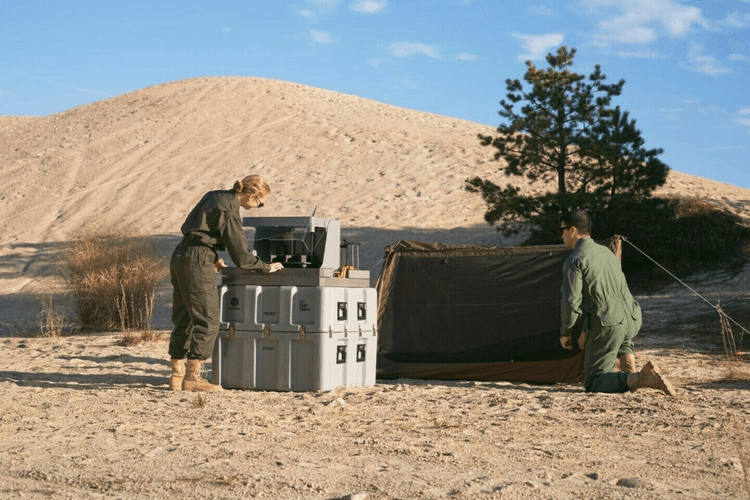
It was announced last year that 3D printer manufacturer ExOne had won a contract with the DoD to develop a 40-ft long portable unit, which can be deployed to frontlines via land, sea, and air. Members of the military will be able to 3D print a digital file of a broken or damaged part and obtain a finished product in less than 48 hours.
Robert Gold, director of engineering enterprise at DoD said, “additive manufacturing offers DoD unprecedented supply chain agility while enabling our developers to sustain technological dominance for our Warfighters.”
Here’s how these kinds of 3D-printing technologies are being applied.
Components and Parts
Supplying 3D-printing equipment to frontlines enables the military to acquire critical products and components efficiently, cost-effectively, and on-demand. In the event of a major crisis or equipment breakdown, downtime can be reduced from several weeks or months to a matter of days. It also means military bases, ships, and aircraft needn’t store a whole lot of excess inventory, as personnel can simply print what they need, when they need it.
Just last month, it was reported that one of the U.S. Navy’s largest warships was using a 3D printer to produce replacement parts for drones.
Of course, 3D printing is not exclusively benefitting military operations on the front line. With the knowledge that several suppliers are struggling to meet the growing demand for submarine parts, the U.S. Navy decided to pair them up with 3D printing companies. It is hoped this will relieve some of the pressure on single-source suppliers and accelerate production.
As mentioned, driving efficiency is a core benefit of 3D printing. In January, Joint Base Langley-Eustis successfully printed a replacement flame arrestor cap for a high-lift (vertical-extension platform for refueling operations) that had been inactive for almost a year.
Medical Supplies
In the military, immediate access to proper medical supplies, such as blood, can mean the difference between life and death. Ideally, an injured civilian or soldier who requires a life-saving blood transfusion will be transported to a secure medical facility. But that isn’t always possible in the middle of a war zone.
With this in mind, the Delta Development Team, supported by Xometry’s digital manufacturing platform., has developed a compact blood refrigeration unit called the APRU. Injection molding, 3D printing, and sheet metal cutting are used to develop the model that can withstand a variety of environmental hazards.
These units are already being used by several military branches and address many of the challenges associated with providing blood transfusions in remote areas. This includes access to sufficient amounts of blood and the means to keep it properly refrigerated. The design is durable, can withstand being dropped from a plane, is heat-resistant, and will stay cool for up to four days.
Infrastructure
Additive manufacturing is also being used in various aspects of military infrastructure.
Indiana Technology and Manufacturing Companies ITAMCO (ITAMCO), for example, have developed a 3D-printed runway for military expeditionary airfields. German company EOS used its M290 3D printer to produce runway mats that can be installed on weaker ground surfaces, allowing military aircraft to land and take off.
Meanwhile, 3D printer company Icon has developed a 9500-pound, 46.5-foot-wide machine called Vulcan to 3D print entire army barracks. Over the next 10 months, three 5,700-square-foot barracks will be built at Fort Bliss, Texas. Leveraging 3D printing for the construction of army barracks will save money, time, and labor and, in time, could also be used to establish U.S. military housing around the world.